Sussex Economics professor wins European innovation award for teaching students to use AI critically
By: Serena Mitchell
Last updated: Tuesday, 28 July 2026

Professor Gabriella Cagliesi
Economics students
Economics students AI session workboard output
Economics students
As AI tools become part of everyday study and work, students need to know how to question, test and challenge them.
Professor Gabriella Cagliesi, Professor of Economics at the University of Sussex Business School, has won the 2026 European Economic Association Award for Innovation in Teaching with AI for her work helping students develop those skills.
The award recognizes Professor Cagliesi’s work on bringing generative AI into economics teaching, assessment, learning materials and econometric training. Her approach teaches students how to use AI as part of the learning process, while also encouraging them to think critically about the answers AI tools produce.
The project was designed and piloted in postgraduate Macroeconomics modules for students on the MSc Development Economics and MSc International Finance and Economics. The next phase will extend the work into local schools through outreach activities and support for teachers and tutors, helping pupils build AI skills before they enter higher education.
Professor Cagliesi first presented the teaching approach at TeachECONference 2026 in June and will also present it at the EEA Annual Congress in Dublin in August.
Insight and learning from the AI teaching project
Explaining how the project developed, Professor Cagliesi said:
“The project began as a question about assessment and became a question about learning. My first instinct was to redesign assessments to protect academic integrity and prevent students outsourcing their thinking to AI. I then realised that this was not enough. We may be able to remove AI from an exam room, but we cannot remove it from students’ academic and professional lives.
“The turning point was recognising that critical use of AI is something we must teach the students. My question shifted from how to assess to how to design learning in the age of AI.
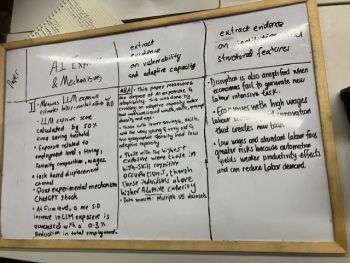
“I began by identifying what students needed to learn, then designed the teaching around those goals. Rather than bringing AI in only at the assessment stage, I built it into the learning process. Students worked with different AI tools, including a Socratic tutor, which asks probing questions to help them think more deeply; a devil’s advocate, which challenges their assumptions; a simulator, which helps them test economic scenarios; and a tool that generates practice data and feedback. Each tool was designed to develop a different skill.”
How AI is integrated into the modules
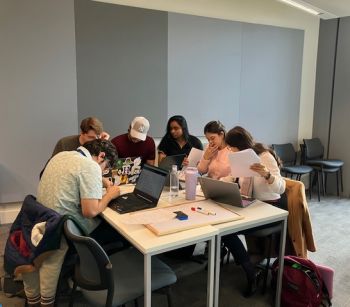
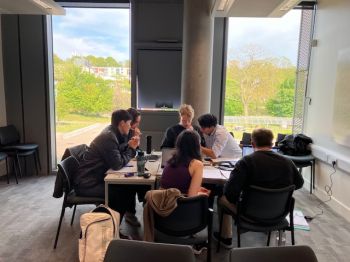
Across both modules, AI is integrated into teaching and assessment. Students use the AI agents during seminars and workshops, then complete AI-based tasks as part of their assessments. They also reflect on their use of AI, which forms part of the graded work.
The classroom becomes the place to learn with AI, and assessment becomes the place to demonstrate that learning. The guiding idea is simple: using AI only to complete tasks helps students get it done; designing AI into the learning process helps them get it right.
For MSc students, the approach supports skills increasingly valued by employers, including questioning AI outputs, working critically with data, testing economic assumptions and communicating evidence-based conclusions.
What students learned from using AI critically
Students said using AI in this way helped them think more critically, question their assumptions and feel better prepared for the future.
One student said AI “provided perspectives we hadn’t considered and challenged our answers and ideas”, helping them “think more deeply and question our assumptions”. Another said the key lesson was “to control it but not be controlled”, adding that “AI cannot replace our own critical thinking”.
Students also valued using AI for simulations, which helped them “visualise what we are learning in real life situations”, while recognising that this still “requires a real understanding of concepts”. Others welcomed Professor Cagliesi’s decision to “lean into the use of AI” and treat it as a tool, while “remaining sceptical”.
Future project development
The Business School is preparing students not just to use AI, but to think critically and responsibly with it and is extending that opportunity to schools so that AI literacy does not become another barrier to university access.
The next stage, planned for the coming year, is to help students become creators rather than only users, designing and refining their own AI tools for economic analysis.
Professor Cagliesi said:
“The project will also extend beyond Sussex. My students will visit local schools as ambassadors, a model I drew from my work with the Royal Economic Society’s Discover Economics programme. Alongside these student visits, we will offer training and materials to tutors at the participating schools. In this way, the students who began as users of AI become, in effect, its teachers, while we also build the tutors’ own confidence with AI.”
The momentum for this phase came from the Business School’s recent Experience Day in June, which brought more than 150 pupils and over 20 tutors from local schools to Sussex. Professor Cagliesi chaired a session on AI for tutors, which generated considerable interest, and the Business School is now working with those schools to plan the next phase.
A central aim is to make sure pupils have the AI skills they need before they start university, especially those who may not already have people around them who can help them understand and use AI. Without that support, they risk starting university at a disadvantage.
Find out more
If you are interested in studying Economics at the University of Sussex Business School, visit our undergraduate and Masters course pages.
If you are interested in the project's development, the school outreach programme, or the open-access toolkit, contact Professor Cagliesi.