“I have always been interested in the big picture”
By: Jacqui Bealing
Last updated: Monday, 20 July 2026
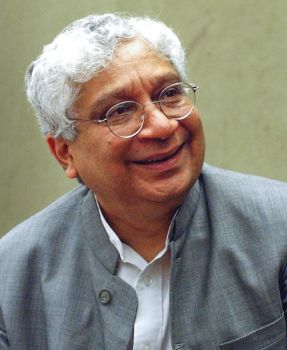
Deepak Nayyar
Deepak Nayyar, renowned Indian economist, author, academic, policy practitioner and chair of the board of trustees at the Institute of Development Studies, will be conferred an Honorary Doctorate at the University at Sussex’s Summer Graduation 2026.
When economist Deepak Nayyar arrived at the University of Sussex to take up his first academic teaching appointment in 1973, he entered what was then thought of as “a brave new world” in Oxford and Cambridge and elsewhere in British higher education.
Born in India, and educated both in Delhi and then at Oxford, Nayyar remembers being drawn to Sussex for its engagement with development economics and its innovative interdisciplinary approach to building knowledge.
While economics students formed the core of his classes, he also taught contextual courses in social sciences across the University in different schools, including in, African and Asian Studies, European Studies and Social Sciences.
“It was an exciting time in economics,” says Nayyar, listing some of the renowned economists he found himself working alongside, such as Tibor Barna, Donald Winch and Geoffrey Heal. He notes the University also had rich talent in the social sciences, such as David Pocock and Bill Epstein in Social Anthropology and Ranajit Guha in History.
“I think it was an excellent liberal education for undergraduates. We did most of our teaching in small groups. But we also did lectures on microeconomics, macroeconomics, international economics and development economics.”
Nayyar was working alongside luminaries in economics and development at the newly established Institute of Development Studies (IDS). Based on the Sussex campus, IDS was already developing an international reputation with leading thinkers in development economics and international development: such as Dudley Seers, Hans Singer, Richard Jolly and Michael Lipton, and many others, with whom he interacted closely. In addition, Sussex was home to the Science Policy Research Unit (SPRU) – a pioneer in the study of how science, technology, innovation and R&D shaped economic growth and development – where he remembers engaging conversations with Chris Freeman, Sam Cole and Charles Cooper.
Pushing the boundaries
In the early 1970s, the idea of studying development through an interdisciplinary lens was “something of an experiment”, he says. But the University of Sussex, along with IDS and SPRU, were pushing the boundaries of how knowledge could be organised and taught, and pioneering an approach that later came to be adopted by other universities.
“Knowledge is now developing at the intersection of disciplines, not only in life sciences but also in social sciences,” he says. “If you want to study development, you need to have some understanding not only of economics, but of political science, sociology, history and geography. The focus, then, is on studying the processes of development.”
Nayyar left Sussex in 1980 and returned to India, continuing a career mostly in academia but partly in government.
Although he acknowledges that he is an academic at heart, a quarter of his professional life has been spent in public service in India. He has served as economic advisor in the Ministry of Commerce and, later, as Chief Economic Advisor to the Government of India and Permanent Secretary in the Ministry of Finance.
As an academic, in addition to his experiences at Sussex and Oxford, he has held positions at Indian Institute of Management in Calcutta, the Jawaharlal Nehru University, New Delhi, and New School for Social Research in New York. He also served as Vice-Chancellor of the University of Delhi (2000-2005). He is now Professor Emeritus of Economics at Jawaharlal Nehru University (JNU) in New Delhi.
He explains: “Academia enabled me to influence the world of ideas in terms of teaching and research. Whereas the time I spent in government enabled me to exercise influence in terms of policy and the public domain.”
He adds: “As a social scientist, particularly as an economist, they were not dichotomized worlds. They were closely interconnected. Most people of my generation picked a career path and stayed with it.
“But I have no regrets about the path I took. You know, in a sense, I left each world richer for the experience, and I contributed better to the other when I went back to it.”
Nayyar has continued to chair and serve on boards of multiple organisations and institutions such as UNU-WIDER, Helsinki and the Social Science Research Council, New York. He is currently the Chair of the Board of Trustees for IDS. In his 80th year, he still works ten hours a day, six days a week – a legacy of the hard work and dedication he showed as a young student.
"The big picture"
Born and brought up in “small-town India”, he attended Hindi-medium schools (where lessons are taught in Hindi rather than English) and moved frequently because of his father's government postings.
His life changed when he arrived at St Stephen's College at the University of Delhi. “I felt like Alice in Wonderland,” he remembers. “The University of Delhi was my portal to a different world. It provided me with not only educational opportunities, but also equal opportunities. I was elected to a Rhodes Scholarship. That is what enabled me to get to Oxford. I couldn’t even have dreamt about it otherwise.”
In recent decades, Nayyar's research has focused increasingly on economic history and the rise of Asia. He became interested in revisiting ideas put forward by the Swedish economist Gunnar Myrdal, whose influential 1968 work Asian Drama: An Inquiry into the Poverty of Nations painted a deeply pessimistic picture of Asia's future.
Nayyar came to believe that history had proved Myrdal wrong. He points out that in 1970, Asia was the poorest continent in the world, with social indicators of development worse than those in sub-Saharan Africa. But by 2020, the continent accounted for around one-third of global output, 40 per cent of world trade and nearly half of global exports of manufactures. This transformation became the subject of his later research.
His work challenges what he sees as the Eurocentric perspectives that have shaped much of world economic history. In books, such as the internationally best-selling Catch Up and Resurgent Asia, he explored the long arc of changes in the world economy, tracing Asia's historic dominance until the end of the 18th century, through its decline and fall in the era of imperialism and colonialism, to its resurgence in the past half century.
“The big picture” is what interests him most. “And it is not about joining the little dots.”
“A lot of my work in the past ten years has been at the intersection of history and economics, spanning continents in space and centuries in time.”
But working in academia has brought him the greatest personal satisfaction. “The most important thing has been teaching my students, taking pride in how well they have done as they have moved on in life and over time.
"Economics is a global profession. In that sense, I am global. But the classroom and India have always been my natural home.”
His advice to young people starting out on their own paths now is to remember we each only have one life and we must choose with care what we want to do with it. “It must be what you want, and not what your peer-group, friends or families suggest. That, I think, is important, even if the world is now more challenging.”