School of Global Studies hosts international conference on religion, conflict and peace
By: Maria Andreou
Last updated: Wednesday, 8 July 2026
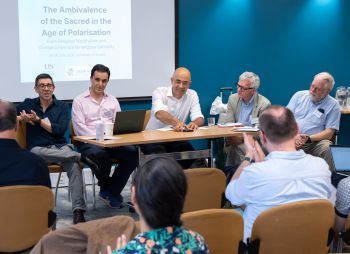
The event welcomed leading scholars from around the world to examine how religion can both deepen political divisions and foster peace.
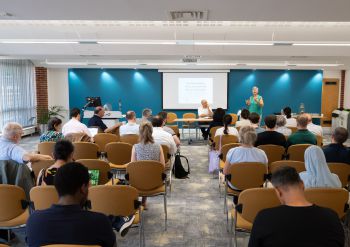
Vice-Chancellor Professor Sasha Roseneil highlighted the conference's timely focus on religion's complex and often ambivalent role in contemporary international affairs.
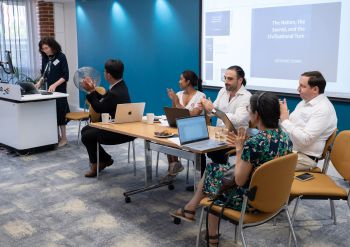
The conference featured keynote addresses from internationally recognised scholars.
Religion in an age of polarisation
Can religion both drive division and help build peace? This question was at the heart of the two-day international conference, The Ambivalence of the Sacred in the Age of Polarisation: From Religious Nationalism and Civilisationism to Interreligious Solidarity, held on campus on 25-26 June 2026.
Co-organised by Sussex's Religion and Foreign Policy Initiative and the University of Notre Dame's Ansari Institute for Global Engagement with Religion, the conference was co-sponsored by the Economic and Social Research Council (ESRC) and The British Academy.
The event welcomed leading scholars from around the world to examine how religion can both deepen political divisions and foster peace, dialogue and international cooperation.
Global perspectives on religion, conflict and peace
In her opening remarks, Vice-Chancellor Professor Sasha Roseneil highlighted the conference's timely focus on religion's complex and often ambivalent role in contemporary international affairs, and its potential to contribute to human flourishing – one of the three central themes of the University's Sussex 2035 strategy.
Conference organisers Professor Fabio Petito and Dr Ugo Gaudino emphasised that, alongside religion's capacity to fuel conflict, religious actors and movements can also play a vital role in promoting peace – an idea Professor R. Scott Appleby has described as "religious militancy for peace".
The conference featured keynote addresses from internationally recognised scholars Professor R. Scott Appleby (Notre Dame), Professor Jocelyne Cesari (Birmingham), Professor Adrian Pabst (Kent) and Professor Fabio Petito (Sussex).
Across five panels, academics in international relations, politics, theology and peacebuilding joined researchers, practitioners, postgraduate students and policy specialists from Europe, North America and Asia to examine the challenges posed by religious nationalism, civilisationism and culture wars.
Speakers explored religion's role in both fuelling conflict and building peace, alongside discussions on democratic solidarity, international cooperation, migration, social cohesion, ethics and religious diversity.
Professor Petito said: "Fifteen years ago, Sussex hosted a landmark conference on the post-secular in International Relations, which went on to shape the study of religion in international affairs. We hope this conference will have a similar impact by advancing understanding of the growing hyper-politicisation of religion in international relations.
"As our opening keynote speaker, Professor R. Scott Appleby, argued 25 years ago, we hope that ‘the nonviolent warrior for peace’ will prove more influential in the long run than ‘the religious extremist’."
Dr Gaudino added: "The conference provided a vibrant platform for interdisciplinary dialogue, creating new opportunities for collaboration across disciplines and generating valuable new perspectives.
"We look forward to developing these discussions through one or more special journal issues featuring papers presented at the event."
Find out more
Learn more about the mission of Sussex’s Religion and Foreign Policy Initiative and explore publications and research from academics involved in the project.