SHL Week 2026 brings Digital and Data Futures into focus
By: Elena Dennison
Last updated: Friday, 3 July 2026
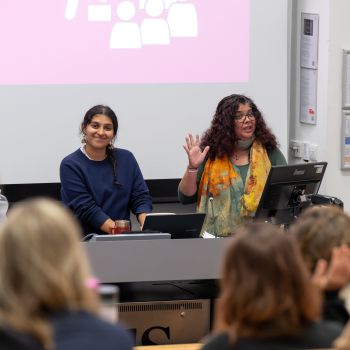
Bareya Khan and Anasuya Sengupta

Ian Winters
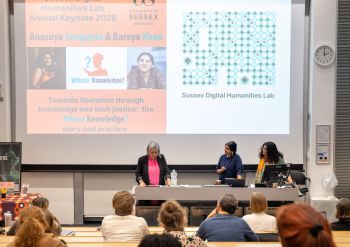
Dr Sharon Webb, Bareya Khan and Anasuya Sengupta
SHL Week 2026 concluded after four days of interdisciplinary discussion, creative experimentation, and critical reflection on the future of digital technologies, data, and knowledge. Held from 16–19 June as part of the University of Sussex’s Summer of Research, the annual event brought together researchers, artists, students, activists, and members of the public to explore some of the most urgent questions of today.
This year’s focus aligned with the University’s transformational theme of Digital and Data Futures, placing issues of technological power, representation, and public participation at the centre of conversation. Through a combination of academic debate, artistic practice, and public engagement, SHL Week showcased how the humanities play a vital role in understanding and shaping our increasingly digital world.
Whose Knowledge? a provoking and inspiring keynote
A major highlight of the week was the Sussex Digital Humanities Lab Annual Keynote, delivered by Anasuya Sengupta and Bareya Khan, co-leaders of the global initiative Whose Knowledge?. Their presentation, “Towards liberation through knowledge and tech justice: the Whose Knowledge? story and practice,” challenged audiences to rethink whose knowledge is represented in digital spaces and whose voices remain excluded. In the form of an inspiring and provoking intergenerational conversation, Anasuya and Bareya explored issues of representation, inclusion, and inequality in knowledge production, arguing for more equitable approaches to technology and information systems.
The themes of tech justice and knowledge equity resonated strongly throughout the week. At a time when artificial intelligence, digital platforms, and online information ecosystems play an increasingly influential role in shaping public understanding, the keynote served as a reminder that technology is never neutral. Decisions about what knowledge is preserved, shared, and amplified have profound social and political consequences, making questions of inclusion and visibility more important than ever.
Digital Sovereignty Symposium
A key event at the centre of SHL Week 2026 was the PhD Community Symposium on Digital Sovereignty, organised by PhD community advocates Sandy Di Yu and Tatiana-Lynn Makhoul, and human rights defender and researcher in digital rights Sara Al-sherif. The symposium examined questions of control, access, governance, and agency within digital environments, exploring how digital infrastructures influence power relations across societies. Contributions from Open Rights Group Executive Director Jim Killock, researcher Jonathan w. y. Gray of King’s College London, and participating doctoral researchers encouraged attendees to consider who owns data, who benefits from digital systems, and how communities might reclaim greater control over the technologies that shape daily life.
The symposium’s focus on digital sovereignty was timely. As governments, institutions, and technology companies increasingly compete over the ownership and governance of data, questions about privacy, platform power, and democratic accountability are becoming ever more pressing. Discussions throughout the event highlighted the importance of interdisciplinary approaches to addressing these challenges and ensuring that digital futures are developed in ways that serve the public interest.
Domestic Light and the hidden structures of everyday experiences
Alongside the academic programme, SHL Week showcased the power of artistic practice to open new perspectives on technology and everyday life. Visitors experienced the UK premiere of Domestic Light, an immersive installation by international artist and researcher Ian Winters. Presented as work- in-progress, Ian invited audiences to reflect on the relationship between light, technology, and domestic space. Funded by Leonardo IAST Domestic Light underscored the recurring message of SHL Week 2026: understanding digital futures requires more than technical expertise alone. Creative practice and art offer unique ways of imagining alternatives and questioning assumptions, and make visible the hidden structures that shape everyday experience.
From debates over digital sovereignty and data governance to calls for knowledge justice and more inclusive digital cultures, SHL week 2026 demonstrated the importance of critically engaging with the systems that increasingly define modern life. More than a celebration of research, SHL Week served as a timely reminder that the future of technology is ultimately a question of values, participation, and collective responsibility.