Sussex ranked first in the UK and sixth globally for Peace, Justice and Strong Institutions in new THE ranking
Posted on behalf of: Internal Communications
Last updated: Friday, 26 June 2026
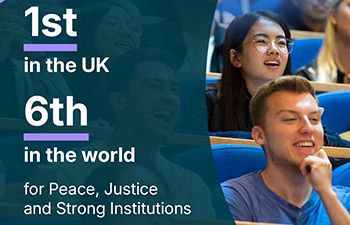
The University has risen to sixth place globally (up from equal 83rd in 2025) and taken first position in the UK (up from 13th in 2025) for Peace, Justice and Strong Institutions in the newly-published Times Higher Education Sustainability Impact Ratings for 2026.
Sussex made submissions in relation to six of the 17 SDGs and our top three positions are:
-
6th in the world and 1st in the UK for Peace, Justice and Strong Institutions (SDG16)- up from equal 83rd globally and 13th in the UK in 2025
-
33rd in the world and 17th in the UK for Responsible Consumption and Production (SDG12)- up from equal 63rd globally and equal 24th in the UK in 2025
-
38th in the world and 7th in the UK for Climate Action (SDG13)- up from 101-200 globally and equal 21st in the UK in 2025.
Sussex also rose in the rankings for Sustainable Cities and Communities (SDG11), to 88th globally (from 92nd in 2025), with a small fall in the UK position from 11th in 2025 to 13th in 2026. There was a rise for Partnerships for the Goals (SDG17) to 95th globally and equal 17th in the UK (from 101-200 globally and equal 22nd in the UK in 2025). This means that five of the six SDGs submitted were placed in the top 100 globally.
Vice-Chancellor, Professor Sasha Roseneil, said: "Our Sussex 2035 strategy is built around three transformational themes – human flourishing, digital futures, and environmental sustainability – which closely align with the UN Sustainable Development Goals. These latest results demonstrate the impact of Sussex’s passionate collective commitment to tackling complex global challenges through world-leading research, education and engagement.
"We are particularly proud to be ranked first in the UK and sixth in the world for Peace, Justice and Strong Institutions. This outstanding achievement reflects the importance of Sussex’s work addressing pressing issues of global conflict, social justice and inclusion, corruption,democracy and power.
“My gratitude goes to the Sustainability team for collating and submitting evidence of our work, as well as to everyone across the University who has contributed the multitude of projects that are measured by this ranking.”
The data behind the ranking
SDG16, Peace, Justice and Strong Institutions, has seen a rise of 77 places to 6th place globally this year from 83rd last year. Adam Batchelor from the Sustainability team said: “The significant improvement in SDG16 reflects both the University's strong contribution to policy development and public institutions, and our ability to better evidence that impact. Following a detailed review of previous submissions and benchmarking against leading institutions, we worked with colleagues across the University to bring together evidence of our engagement with governments and policymakers at local, regional, national and international levels.
“We also identified and showcased a broader range of research and collaborative projects that demonstrate the reach and impact of Sussex’s work. Projects such as Landscape Integrative Mapping and Modelling for Multifunctional Analysis (LIMMMA), alongside many other initiatives across the University, helped to illustrate the breadth of our contribution to advancing peace, justice and strong institutions. The result is a more comprehensive picture of the excellent work taking place across Sussex and its contribution to the UN Sustainable Development Goals.”
About the methodology
The Times Higher Education Sustainability Impact Ratings assess universities against the United Nations’ SDGs. The rankings measure for research, stewardship, policies and operations, outreach and teaching, and universities can submit data on as many of the SDGs as they choose. Last year, Sussex provided evidence against six SDGs.
To generate their ranking, Times Higher Education sources research data on publications, and continuous metrics measure contributions across years. For the institutionally-submitted data, the Sustainability team within Estates and Facilities submits over 100 pieces of evidence to support claims about performance against indicators and metrics. This means a large data collection process working with colleagues across the University to find out about projects which are contributing to the SDGs, and following up to ensure that the evidence about these projects is publicly available.
Each year the Sustainability team produces a full annual report covering all the SDGs, and this contributes to our ranking for SDG17, Partnerships for the Goals. The evidence collection process is long and detailed but yields significant results,showcasing the wide variety of the University’s work which contributes to these internationally important goals which aim to achieve a better and more sustainable future for all.
For more information about our contribution to the SDGs please contact Adam Batchelor, Sustainability Manager.