Project film – ‘the land that holds us’ – launched online, plus upcoming screenings
Posted on behalf of: Rachael Durrant
Last updated: Thursday, 18 June 2026
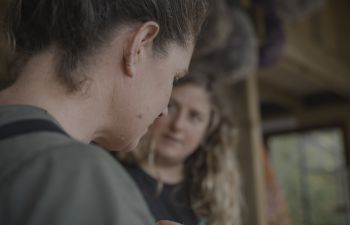
The project film – the land that holds us – has finally landed online and will be screened at several public events this summer. It is available to stream for free at the following link: https://vimeo.com/1178802360. A list of public screenings is provided at the bottom of this post.
The film features four market gardeners from the Sussex Weald and rural mid-Wales, drawing attention to the challenges they have faced in getting access to and building a livelihood on the land. It also portrays the deep sense of place, purpose, and occupational therapy that agroecological farming has to offer.
The women featured in the film are Zoe Proctor of Tir Awen Market Garden in Monmouthshire, Katie Hastings formerly of Mach Maethlon in Powys (now the Gaia Foundation’s Seed Sovereignty Coordinator for Wales), Rosa Farber of Laines Organic Farm in West Sussex, and Collette Haynes of Ashurst Organics in East Sussex.
Film synopsis
Through intimate interviews and carefully observed moments of everyday labour, the film offers a rare, unguarded portrait of life on the margins of British agriculture. Without commentary or instruction, it allows its subjects’ experiences to unfold: the physical demands of the work, the uncertainty of tenure and income, and the less visible burden of domestic and caring labour.
What emerges is both fragile and quietly radical: a vision of farming rooted in care, reciprocity, and persistence. In its restraint and attentiveness, the land that holds us invites us to reconsider who belongs on the land, and what more just and sustainable futures might grow there.
Why has this film been made?
Against the backdrop of contemporary Britain’s unequal land system, these women confront financial precarity, housing insecurity, and the persistent challenge of accessing land without inheritance or established family ties. As Katie Hastings explains, “We don’t have long-term security… we can’t build any infrastructure… I’m earning less than minimum wage.”
Alongside this – and the physical toll of farming – they must also contend with the emotional labour of claiming space and legitimacy within a deeply traditional sector characterized by gendered segregation and segmentation of work. This means constantly navigating self-doubt, external scrutiny, and the ongoing struggle for recognition as farmers in their own right (as opposed to ‘farmers wives’, ‘workers’ or ‘volunteers’).
In Katie’s words: “It was so hard to make this my livelihood that essentially I had to give up on that dream of being a farmer and find something else to do.”
Yet small-scale organic horticulture and agroecological farming play a vital role in building healthier, more sustainable food systems. By growing diverse, nutrient-rich food while prioritising soil health, biodiversity and low-impact farming practices, these women are helping to demonstrate how food can be produced in ways that both nourish communities and care for the land.
Who should watch it?
I would personally like to live in a world where this kind of farming was supported by robust policy frameworks and widely recognised for the diverse benefits that it offers to people and nature. If you feel similarly, please share the film enthusiastically with friends and allies in positions of power, and consider it as a tool for shifting people’s perspectives, reframing issues around food and land use, and intervening in policy debates.
Streaming link:
Confirmed screenings at public events:
- Ecosocialism Conference, May 30th, London/online
- Sussex Retold, June 19th, University of Sussex
- Buddhafield, July 15th-19th, Devon
- Green Gathering, July 30th-August 2nd, Monmouthshire
- Women and Diverse Genders Skill Share, 7th-9th August, Devon
Additional screenings are planned but not yet confirmed. Watch this space or email r.durrant@sussex.ac.uk for further information.