Caring for new entrants: who gets to belong in agroecology?
Posted on behalf of: Rachael Durrant
Last updated: Thursday, 18 June 2026
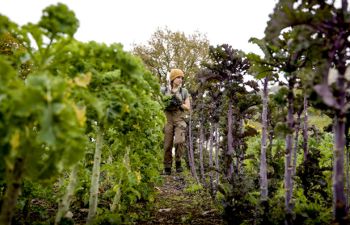
A woman in overalls stands in front of a polytunnel holding a bunch of kale. Photo credit: Black Bark Films
How do we learn to become farmers — and who gets to feel that they truly belong?
While much of the public conversation around sustainable farming focuses on supposedly ‘hard science’ matters like soil health, biodiversity, and GHG emissions, my work tackles something slightly different. My new paper, Learning Farmerhood: Intersectional Pathways into UK Agroecology, grew out of an enquiry into the ideas and images that shape who enters alternative farming movements, who stays, and who is recognised as legitimate.
“Setting up on the land” as an organising dream
Across interviews and fieldwork in agroecology spaces, one ideal was pervasive – the aspiration to eventually set up on the land. This dream is powerful. It demands sacrifice, justifies unpaid internships, and sustains people through seasons of precarity. It is also deeply political.
For some, “setting up on the land” is a tangible future backed by inheritance, savings or supportive networks. For others, it is a horizon that recedes the closer they walk toward it. The path into small-scale organic and agroecological farming in the UK is often mediated by unpaid or low-paid labour, informal recruitment, and tacit cultural norms.
In this sense, agroecology is not just a set of ecological practices. It is also a regime that teaches us – often quietly – what a “real” farmer or grower looks like, how a legitimate pathway unfolds, and which compromises are acceptable in the name of the greater good.
The invisible labour of becoming
Another pattern that emerged strongly in the research concerns the hidden survival work carried out by women and gender-marginalised people – especially women of colour, working-class, queer and disabled women. Many of those that I spoke with were not only learning to farm. They were also:
- Educating colleagues about unconscious bias and discrimination
- Carrying anti-racist and other forms of inclusion work
- Creating safer spaces for others
- Performing emotional self-regulation to endure precarity
- Justifying their presence in masculinised spaces
This labour was rarely named, rarely paid, and often assumed to be part of their character rather than their contribution.
At the same time, traditional divisions of labour persisted in subtle ways. Men were more likely to be associated with straight-up grower roles, especially where this involved machinery and arable production – women with growing-related roles involving outreach, administration, marketing, and care. These patterns do not negate the radical potential of agroecology – but they do complicate it.
What this means for food activism
Food movements in the UK – including organisations such as the Landworkers’ Alliance – are already engaged in important work on land access, labour rights, and policy reform, and many are actively reflecting on questions of inclusion, representation, and power. My research underlines the value of this and emphasises the need to continue attending to how cultural and pedagogical norms shape aspiration within these spaces, alongside more material struggles.
This raises ongoing questions such as:
- What stories do we tell about success in farming and growing?
- Who is most visible in movement media and events?
- Who takes on the labour of making spaces welcoming and accessible?
Making these dynamics explicit does not weaken the movement. On the contrary, it can help to shift responsibility away from individual resilience and towards a clearer understanding of structural conditions.
Where “setting up on the land” is held up as a central benchmark of success, there is a risk – often unintended – of obscuring the value of urban producers, cooperative models, and hybrid livelihoods. Broadening our imaginaries of farmerhood may therefore be as important as securing access to hectares.
Rethinking agroecology training
These insights also have implications for agroecology education. Training programmes do an extraordinary job of teaching ecological design, soil management and systems thinking. But they also communicate, implicitly, what kind of person thrives here.
What if training spaces made this explicit?
Students could be invited to map their imagined futures and identify the structural supports required to realise them. They could examine the gendered, classed and racialised allocation of tasks during placements. They could discuss labour rights alongside composting systems. They could reflect on the emotional realities of precarity, rather than quietly absorbing them as personal failings. They could mobilise around the pressing need for affordable accommodation to go hand-in-hand with growing jobs in rural areas. None of this detracts from practical learning. It deepens it.
Opening the conversation
As with my earlier work on psychosocial and ecofeminist methods, I’m interested in how these findings travel beyond the page, which is why I'm keen to develop and support workshops and resources that explore:
- The powerful pull towards “setting up on the land”
- The invisible labour of creating and sustaining space to farm
- Alternative imaginaries of farmerhood – beyond the heteronormative family unit
- Structural literacy as part of regenerative practice
If you are part of a food organisation, training programme, or activist network and would like to host such a conversation, I would be very glad to hear from you.