Obituary: Inman Harvey
Posted on behalf of: University of Sussex
Last updated: Wednesday, 17 June 2026
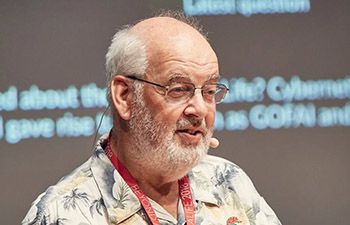
Inman Harvey, an enormously influential academic in the Department of Informatics, and its predecessor, the School of Cognitive and Computing Sciences (COGS), died suddenly on Friday 5 June.
Inman was the sort of person who once met, was never forgotten. The combination of his unique mind – brilliant, combative, irreverent – and his warm, gently humorous personality made him a very popular and highly regarded figure on the international stage, as well as a much-valued mentor to countless postgraduate students. He was a key player in the emergence of COGS as a major centre for research in Artificial Life and new approaches to AI in the 1990s.
At school in Bristol Inman became great friends with Geoffrey Hinton (Nobel Prize Physics 2024, for foundational work on artificial neural networks). Geoff told me, “I first met Inman when we were seven. He was always smarter than me. When we were teenagers, he told me that a memory might be distributed across many brain cells and each brain cell might be involved in storing many different memories. That idea drove my research for the next 60 years.”
In 1966 Inman entered Trinity College, Cambridge University to study Mathematics, being awarded a prestigious college scholarship. His interests shifted toward philosophy and he graduated in 1969 with a BA in Mathematics and Moral Sciences. He stayed on at Cambridge for a year to complete a postgraduate certificate in social anthropology, setting the tone for the highly interdisciplinary approach to research he would later take. Following university, Inman travelled, first on the hippy trail through South Asia and then further afield. He built a successful import-export business which he ran for twenty years from 1973, centred around trade with Afghanistan. This whole period gave him a huge fund of entertaining tales about his escapades and near misses.
Geoff Hinton takes up the story, “He was an insanely fearless traveller. When he went to Phnom Penh he was puzzled that everybody else seemed to be leaving the city: he arrived the same day as the Khmer Rouge. But his craziest adventure occurred when the Russians were occupying Afghanistan and he was one of the three Britons who still had a visa. Afghani bank notes were worth almost nothing in London but were still valuable in Afghanistan, so Inman bought a whole suitcase full to smuggle into Afghanistan. This involved giving the suitcase to a tribesman in the Khyber pass who spoke no English and then going to the market in Kabul to find the tribesman's correspondent. It worked! In 1986, Inman rediscovered his interest in AI. He thought reinforcement learning was a better bet than backpropagation, and we spent the next 40 years arguing about it.”
Hence, when Inman re-entered academia in 1988, as a mature student on the COGS MSc in Knowledge Based Systems, he had an extraordinarily rich hinterland. The highly interdisciplinary and relaxed nature of COGS suited him very well and Sussex became his permanent academic home. His DPhil thesis provided the crucial theoretical underpinnings of the pioneering collaborative research on evolutionary robotics he performed with me, Dave Cliff and other colleagues in the 1990s. That work quickly became very high profile and led to the rapid growth of our research group (Evolutionary and Adaptive Systems), which attracted elite students from all over the world.
Inman, by now a postdoctoral research fellow, was a pivotal figure in the ensuing explosion of creativity, and he was a founding member of the renowned cross-campus Centre for Computational Neuroscience and Robotics, formed in 1996 between COGS and the School of Biological Sciences.
In 1999 he became a member of faculty in COGS. His idiosyncratic style, elegant insight-packed lectures and highly original mind made him very popular with students, particularly those on the MSc in Evolutionary and Adaptive Systems, which he directed from 2000-2011, and the many PhD candidates he successfully supervised to completion.
Inman made important research contributions in numerous different areas: from embodied AI, to ecological and evolutionary modelling, to novel forms of learning, to exposing philosophical problems at the heart of cognitive science, with much else in between. Revered as a researcher and thinker by his colleagues far and wide, he published prolifically and gave numerous keynote talks at international conferences and workshops. He was particularly influential in the field of Artificial Life, leading to a Lifetime Achievement Award from the International Society for Artificial Life in 2015.
Inman had little time for conventions and formalities – ideas and people were what mattered to him. He loved organising social gatherings, from impromptu soirees for students, to riotous trips to France for the research group, to the legendary parties he and his partner, Shirley Kitts, held at their home in Lewes, fuelled by the carloads of cheap sparkling wine he regularly brought back from Dieppe.
Inman retired from the University in 2011 but retained strong links through a visiting senior fellowship. He stayed as research active as ever, regularly publishing and presenting, and continuing with his membership of various national and international advisory and research evaluation bodies, journal editorial boards, and conference programme committees.
The tributes that have poured in from all around the world since news of his death broke, pay testament to the extent of his influence. He inspired so many, in so many different ways. He was a remarkable individual who will be sorely missed.
Author: Phil Husbands, Emeritus Professor, School of Engineering and Informatics