Press review of the year - 2011

There is a proverb – of dubious origin and equally dubious meaning – that says: “May you live in interesting times”.

In the media, ‘interesting’ usually equates with ‘bad news’ – and true to form, natural disaster, wars and uprisings, economic and political meltdown were all among the subjects that consistently grabbed the headlines in 2011. 

And so it was that in 2011, University of Sussex academics were called on frequently by the media to provide expert analysis of turbulence of all kinds around the world. 

There were, however, a few column inches to spare on other subjects, such as the University’s 50th birthday celebrations, some eye-catching research and a number of significant milestones for Sussex. 

Here are some of the year’s highlights.

Golden opportunities

Sussex's first students - the 1961 cohort - returned to the Students' Union in Falmer House to celebrate the University's 50th anniversarySussex's first students - the 1961 cohort - returned to the Students' Union in Falmer House to celebrate the University's 50th anniversary

The University saw the start of its 50th anniversary in September, with thousands of alumni, staff and students joining together for a weekend of celebrations, which included the premiere of a film by Sussex alumna Mary McMurray, the launch of a book by Professor Fred Gray and the announcement of a major fundraising campaign to see the University on its way into the next 50 years. A raft of doctoral scholarships for tomorrow’s academics was also launched, while some of today’s most important thinkers contributed to (and will continue to do so throughout the anniversary year) to the highly popular Sussex Conversation roundtable discussions held in London.  Further events are planned throughout the anniversary year, including an exciting collaboration with Sussex alumnus and Turner Prize winner Jeremy Deller and a new exhibition celebrating the University designs of the celebrated architect Sir Basil Spence

The year also saw celebrations in honour of one of the University’s founding fathers, the historian Asa Briggs, who marked his 90th birthday with a special lecture and dinner on campus. It was a double celebration for Lord Briggs, who marked the publication of a book about his WWII code-breaking work at Bletchley Park with a Brighton Festival talk with the Vice-Chancellor, Professor Michael Farthing.

Sussex around the world in a year – and a day

A protestor with his arms aloft in Tahrir Square, EgyptA protestor in Tahrir Square, Egypt

The world got a bit smaller in 2011 as the spirit of revolt seemed to spread like wildfire through the Middle East. Meanwhile, Europe, the USA and others stared into the abyss of economic collapse as tax payers turned into protestors. And in the UK, rioters took to the streets during a summer of discontent. Sussex academics on the ground, or on the end of a phone, were called on to give first-hand accounts and analysis of the various dramas as they unfolded. Kamran Matin (International Relations) offered expert comment on the popular uprisings in Egypt and Libya, and latterly on the death of Libyan leader Colonel Gaddafi and the trial of Egypt’s Hosni Mubarak.  Professor Craig Barker (Law), meantime, provided a legal perspective on international intervention  in Libya and Egyptian scholar Ramy Aly (Global Studies), who returned to Eqypt during the protests of early 2011, spoke to Al Jazeerah and others about the impact of social media on popular revolt. 

Closer to home, Professor Tim Bale (Politics and Contemporary European Studies) and Professor Mariana Mazzucato (SPRU) were kept busy providing analysis of the economic downturn and the resulting political fall-out in the Euro zone. Professor Bale dealt with media interest (Reuters, Bloomberg Business News, BBC and various broadsheets among them) in the UK quitting the EC,  Tory Euroscepticism and the UK political perspective on the bust-up in Brussels, while Professor Mazzucato, who joined Sussex during the autumn term, debated innovation and revival of the UK economy with Jeremy Paxman and Lord Heseltine on BBC’s prestigious Newsnight

In the USA, 2011 saw the tenth anniversary of the 9/11 terrorist attacks. Sussex academic Professor Cynthia Weber’s book, I Am An American, reflected on the event through interviews with American citizens from all backgrounds who still live under the shadow of the terror attacks on New York and the Pentagon. 

Disaster of the natural kind dominated the news in March, as Japan came to terms with the scale and tragic impact of an earthquake and tsunami. Japanese students at Sussex were quick to put their own concerns aside and organise a fundraising campaign for survivors. Academics Professor Andy Stirling (in The Times) and Professor Jim Watson and Dr Alister Scott (in The Guardian), of SPRU’s Sussex Energy Group, were left to reflect on the inevitable fall-out surrounding the disaster’s threat to Japan’s nuclear energy facilities – which had been a threat just waiting to happen, according to Watson and Scott. 

Population growth was identified as one of the chief threats to development in Africa in a report by Sussex economists Robert Eastwood and Professor Michael Lipton, which was published in the March issue of the journal Population Studies. In the summer, student Nathan Green, a one-time Liverpool FC apprentice, made a difference in Africa in his own small way, helping football-mad youngsters in Rwanda develop their skills during his summer vacation. 

The tragedy of man’s inhumanity to man is never far from news headlines, but the horror of a lone gunman’s murder of more than 70 defenceless young people in Norway in July  led to fears that such a brazen act of cruelty must be the work of a terror organisation. It was left to Dr Shane Brighton (International Relations) to consider the possibility for Sky News. 

Violence of another kind came to the streets of London in the summer too, with an eruption of protest, then looting and rioting. Dr Dan Hough (Politics) speculated on the causes of the UK riots for the benefit of listeners to German national radio in August. Crowd psychologist Dr John Drury is often called on to comment on the dynamics of crowd behaviour, but it was his views on another newsworthy protest that were sought after- the attack on Rupert Murdoch by a custard pie-wielding comedian as the media mogul gave evidence at the parliamentary inquiry into the phone hacking scandal. He told the Discovery News Channel that ‘humour and humiliation are used to undermine and disempower the powerful’. Although Dr Drury has never conducted research into political pie-throwing, he had, he revealed, studied protesters who flung Cornish pasties in protest at the hated poll tax. 

But perhaps the most vivid portrait of life around the world came with the premiere in January of the online film Life In A Day, made by Hollywood director Kevin Macdonald and inspired by the day diaries of the Mass Observation Archive at the University. An edited collection of personal films made by ordinary people around the world on one day, it tells the moving story of what it means to be a human being in the 21st century world.

Researchers looked to the past, the present and the future

One of the pages of Newton writings now digitised by the University of Cambridge in collaboration with SussexOne of the pages of Newton writings now digitised by the University of Cambridge in collaboration with Sussex

The riches of the past have played a key role in the work of many or our academics this year.  A collaboration between Professor Robert Iliffe and the University of Cambridge saw the works of Sir Isaac Newton held by Cambridge made available online. Newton’s personal annotated copy of his seminal work, Principia Mathematica, is among the notebooks and manuscripts made available through the Cambridge Digital library and the University of Sussex Newton Project.

Meanwhile, Dr Matthew Dimmock and his colleagues in the University’s English department are poring over early printed versions of plays by Shakespeare, Ben Jonson and Marlowe, which were recently rediscovered at the National Trust’s collection at Petworth House. The 150-odd quarto texts, dating from the 1580s to the1620s, include Hamlet, Love's Labour's Lost and King Lear, as well as lesser known works by other writers. 

Shifting rapidly through the centuries, historian Dr Lucy Robinson, an expert on music and sub-culture in modern Britain, is currently researching the history of the charity single as part of a wider study of the politics and cultural heritage of the 1980s. 

And what of the present?  Dr Richard De Visser found that, despite advances in medicine and health care, the death rate of men aged 16-64 is twice that for women in the same age range in the European Union; research psychologist Eleni Ashikali’s study revealed that adverts with models displaying the trappings of wealth and success led to a greater body dissatisfaction for some women; and Professor Dora Duka delivered the sobering news that alcoholics who repeatedly fall off the wagon end up damaging the part of the brain that would normally help to inhibit their behaviour. 

Predictions for the future seem bleak for some. Professor Richard Dickens warned that the coalition government was unlikely to reach its target to reduce child poverty with its current strategies, and Dr Ricardo Sabates revealed that teenagers who want to be ‘famous’, or whose ambitions are mismatched with their educational expectations, spend more time in unemployment as adults and achieve lower wages.   

But there is some good news. Dr Sam Cartwright-Hatton is looking into how parents can help instill confidence in anxious children, Dr Jessica Horst demonstrated that repeatedly reading the same story to your child enhances their learning more than reading a variety of books, and Dr Mark O’Driscoll and his team have found tumour-killing properties in an existing drug that could lead to a new treatment for blood cancer.

Onwards and upwards

As money markets and price indices saw record falls during 2011,  the University of Sussex saw its stock rise. The Sunday Times, The Times, The Guardian and the Independent all placed Sussex among the top 20 universities in the UK, while the University held its own in the increasingly competitive Times Higher Education magazine world university rankings. The National Student Survey placed Sussex among the top ten institutions for teaching satisfaction and Sussex research was showcased in the Big Ideas for the Future report published by Research Councils UK (RCUK) and Universities UK (UUK). 

Improved rankings were matched by growing application figures, bigger open days and big changes on campus: the second phase of student accommodation in Northfield got the go-ahead; work continued on the New Academic Building, which from 2012 will house the School of Law, Politics and Sociology and the School of Business, Management and Economics; and at the Gardner, which will re-open fully as the Attenborough Centre for the Creative Arts (ACCA) in 2013.

Champion commentators

A honey bee on lavenderA honey bee on lavender

Where would be without our trusty academics who answer the call of the media, often in their pyjamas? Here are some of the year’s stories, as illuminated by Sussex faculty… 

Professor Tim Bale on the press hacking scandal ((BBC, the Vancouver Sun, Reuters, The Guardian, Bloomsberg Business News etc) …  Jessica Horst on how repetition helps children to read (The Telegraph, The Independent, The Times, the BBC, Irish radio, French Tribune etc)… Karen McComb on why elephants don’t forget (The New York Times, Times of India, BBC, The Independent)… Dr Margaretta Jolly on Mass Observation and day diaries (BBC, The Independent and Today on Radio 4)… Cynthia Weber on 9/11 and the USA (coast to coast radio in the USA), Professor of Apiculture Francis Ratnieks and fellow researcher Dr Margaret Couvillon from the Laboratory of Apiculture and Social Insects (LASI) giving scientific insights into the life of the honey bee on Radio 4’s lyrical documentary Spirit of the Beehive (reviews from the The Daily Telegraph, The Guardian and The Spectator, among others). Those who missed the show first time round will have a chance to listen to excerpts, as the programme has been selected for the BBC Radio 4 review show Pick of The Year at 7.15pm on New Year’s Eve (or listen to the whole show)  … Professor Richard Black, Professor Dilip Ratha and Professor Laurence Haddad on the impact of climate change on migration (for BBC and various radio and online media), the UK aid budget (Radio 4’s Analysis) and how population growth will change the world order (for The New York Times)… James Williams on the dearth of male teachers and teaching jobs, creationism in schools, vocational GCSEs, science in schools, teacher training and Jamie’s Dream School (BBC regional radio, The Guardian, the Daily Telegraph, Scientific American, among others.

The year of rock stars, football heroes,  celebrity chefs and national treasures

Sanjeev Bhaskar, Sussex's Chancellor, talks with Stephen Fry at the 2011 Winter Graduation ceremonies at which Mr Fry was awarded an honorary degreeSanjeev Bhaskar, Sussex's Chancellor, talks with Stephen Fry at the 2011 Winter Graduation ceremonies at which Mr Fry was awarded an honorary degree

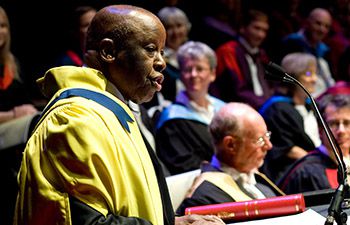
The year began with one of the nation’s best-loved actors and broadcasters, Stephen Fry, attending the University’s winter graduation. In accepting the honorary degree of Doctor of the University from University of Sussex Chancellor Sanjeev  Bhaskar, Fry announced that he "couldn't be happier or prouder". 

Also in January, the BBC aired an episode of The Great British Food Revival, which featured Ainsley Harriott’s visit to the University’s Laboratory of Apiculture and Social Insects. Harriott  was finding out why so little of the honey we eat is actually made by bees in Britain. 

As spring arrived on campus, so did the BBC TV series Bang Goes the Theory.  Presenters Liz Bonnin, Dallas Campbell, Dr Yan Wong and Jem Stansfield began using a former ‘bunker’ on campus to film  the popular science programme and enlisted  several of our academics and students to assist with creating entertaining and unusual experiments. 

In May hundreds of staff and students filled a campus lecture theatre to capacity to take part in a question-and-answer session with Labour MP David Miliband. The former Foreign Secretary talked about world affairs, including the fatal shooting the day before of Osama Bin Laden, which he said should be "rejoiced". 

Inspirational words from rock legend Jeff Beck were among the highlights of the summer graduation ceremonies in July.  Jeff, nominated by the Brighton Institute of Modern Music (whose degree courses are validated by the University of Sussex) for an honorary Doctor of Music degree, reflected on his 40 years in the business by advising: “Go with your passion, even if it isn’t financially rewarding. A talent to do something you love is far more satisfying for the soul. And don’t be put off by any setbacks as they will only make you stronger.” 

More inspiration came from Premier League footballers in September when Liverpool FC used the training facilities at Falmer Sports Complex on campus to prepare for a cup clash with Brighton and Hove Albion. Captain and England international Steven Gerrard, manager and club favourite Kenny Dalglish and World Cup-winning goalkeeper Pepe Reina were among those whose hallowed feet trod the turf. 

Sussex and the city

Product Design student, Rebecca Mark, with her concept - a virtual world for autistic pupilsProduct Design student, Rebecca Mark, with her concept - a virtual world for autistic pupils

It was a busy year in Brighton with public engagements and all things cultural involving Sussex.

Star-struck students took their talents to town in January when they presented a showcase at Brighton Corn Exchange to encourage public involvement in the University’s diverse societies.  The Salon series of public discussions continued in association with Brighton Dome covering, during the year, topics such as the banning of religious symbols, the role of city festivals, the rule of law in international affairs, climate change, politics and the media and gay equality. 

Art History doctoral researcher Alexandra Loske guest-starred on BBC show the Antiques Road Trip in February, sharing her knowledge of the art of Brighton’s Royal Pavilion with antiques fans, while local historian and doctoral researcher Geoffrey Mead took The Guardian on a guided tour of Graham Greene’s Brighton during Brighton Festival, which also featured offerings across all media from Sussex staff, students and faculty.  Professor David Alan Mellor (Art History) was curator of a Brighton museum exhibition with particular local resonance – Radical Bloomsbury – focusing on the work of the Bloomsbury group, who are associated with the nearby Charleston Farmhouse and with the University, where the artist Quentin Bell was Professor of Art History. Sussex students were also busy making their mark during 2011, featuring in local and national press with their films, photographs and stylish inventions in the Media degree show and Product Design degree show.

Tales of the unexpected

“This is a bit of a long shot, but…..” is how journalists usually preface some of their more bizarre requests for help with stories. Here are some of the more unusual stories that our academics commented on during the year. 

“Do cats really prefer women?” (US Daily referencing work on cat purring by Dr Karen McComb)… “swinging” on the internet (comment in London’s Evening Standard from psychologist Dr Richard de Visser)… quadruplet relations (psychologist Dr Alison Pike shares views on sibling behaviour for an ITV documentary ) … the history of Brighton’s naturist beach (historian Professor Fred Gray, for Radio 4’s In Living Memory)… media expert Dr Michael Bull on the 10th anniversary of the iPod Shuffle … Media and Film’s Professor Frank Krutnik on the late Hollywood legend Jane Russell…


Notes for editors

University of Sussex Press office contacts: Maggie Clune and Jacqui Bealing. Tel: 01273 678 888. Email: press@sussex.ac.uk 

View press releases