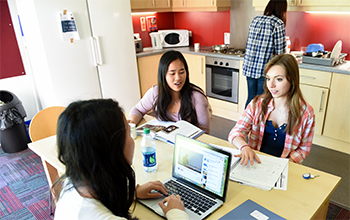
We aim to ensure that you enjoy what you are learning, gain experience in different ways of thinking and working and leave with the knowledge and skills fit for a global workplace.
Key facts
learn lifelong study skills from the start
choose from a range of subjects to suit your interests
lots of exciting ways to learn – make your own decisions with independent study
academic feedback challenges you to keep improving throughout your studies
Learning support
Because we understand that starting anything new can seem challenging, especially in another country where you may be studying in ways that may be very different from those you are used to, we try to ensure that your first few weeks go well and leave you feeling positive and confident. We help to give you the skills you need to make the most of your studies through support from your school of study, together with more specialist support from the Library, IT Services and the Sussex Centre for Language Studies. You will be able to see an appropriate member of staff to discuss any difficulties you may encounter, either personal or academic. Staff offer guidance and advice about modules, organise training and skills days, are responsible for student monitoring and discipline, and can deal with aspects of welfare provision. We also have specially trained student mentors who can offer support on learning and assessment from a fellow student’s perspective.
Depending upon your choice of modules, you will be based in one of our schools of studies. The schools form the academic heart of the University, providing a stimulating and supportive environment where you will be taught by staff at the forefront of their fields.
As a visiting and exchange student at Sussex, most of your day-to-day contact and support will be provided via your school of study. Your school also provides a community for you to become involved with – a place to collect mail, consult notice boards, and participate in social events. Please note that your choice of modules will not be restricted to those offered by your school.
It’s your choice
One of the most exciting things about studying at Sussex is the choice and flexibility you are offered in your studies. As you are not confined to just one subject, you can adapt your study to suit your interests, selecting modules from arts, humanities, social sciences, science and technology, providing there are no timetable clashes. We believe this approach gives you both depth and breadth of knowledge, and the best possible experience of study, so you can get the most out of your time here.
The main differences between arts, humanities and social sciences modules, and science and technology modules are described below, as well as information about assessment and transcripts.
Arts, humanities and social sciences modules
Teaching takes place primarily in small groups or seminars, with lectures providing an introduction to key themes and debates within each topic. Each week you should prepare for your classes by reading the texts on your reading list, so you can actively contribute to class discussion, developing your own ideas and arguments.
Seminars are likely to be based on the topic of the lecture, combined with presentations from members of the class. Seminars give you the opportunity to explore issues raised in the lectures and background reading in more depth with other students and faculty. You are also required to write between two and four essays per module each term.
Although the number of contact hours is probably smaller than you are used to – classes usually meet for between one and a half and two and a half hours a week – this does not mean that less work is required. The emphasis at Sussex is on independent study, and to make a success of your time here you need to be both motivated and self-disciplined in your work. The system is demanding, but once you adapt you will find the challenge it provides both stimulating and rewarding.
Irene's perspective
‘Time at Sussex seems to fly by. I had such a good time that a year passed before I even realised it.
My year at Sussex taught me a lot, first of all because it gave me the opportunity to experience an approach to learning that I had never encountered before and the teaching highlighted skills that I didn’t even know I had. It also allowed me to develop a more critical attitude, particularly in relation to my field of study.
‘Coming to study in a new country is quite a daunting prospect, but everyone at Sussex is so friendly and willing to help that all my fears soon disappeared. Finally, my year abroad allowed me to see how different cultures can live together, not to mention all the people I met who made my time at Sussex really great!’
Irene Tanzi,
from the University of Siena, Italy
Science and technology modules
Teaching in science and technology is typically made up of lectures and laboratory work in combination with other forms of learning support, such as workshops, seminars or tutorials. Lectures provide core information and an introduction to key debates for each topic, to enable problem-solving workshops and seminar discussions.
The teaching methods for a module will depend on its academic level. If you select modules from level 4 (year 1), you will have lectures, lab classes where appropriate, and tutorials, seminars or workshops. In tutorials a small group of students works intensively with faculty on a specific topic. Workshops give guidance and practice in problem solving, while seminars involve discussion and presentations from faculty and students.
Classes vary in size depending on the modules taken, but there tends to be more contact between students and faculty here at Sussex than in many other European universities at level 4.
In level 5 and 6 modules, as students become more experienced and independent, there are more lab classes and workshops and fewer tutorials and lectures.
Most members of faculty are involved in both teaching and research, and you may have an opportunity to engage in project work that brings you into direct contact with cutting-edge research in your field – an active involvement that greatly benefits teaching.
Assessment and transcripts
Your knowledge, understanding, skills and progress will be tested by different methods of assessment. Many of these may already be familiar to you: essays, reports on projects or practical work, examinations, and presentations where appropriate. This will be supplemented by academic feedback to help you understand your strengths and weaknesses.
At the end of your studies at Sussex, we issue a transcript listing the modules you have taken and the grades and credits awarded. It is the responsibility of your home institution to decide whether or not grades received will be incorporated in your grade average. Some graduate and professional schools require the submission of foreign grades and evaluate them as part of their admissions process.
Some of the teaching and learning methods you may experience include:
Lectures
Lectures enable the whole student group to be taught together. Often a number of different lecturers will contribute to a series covering a broad subject area. Lectures are important, but they represent only a starting point: you are expected to build on what you learn

Seminars
In seminars, a group of students and their tutor talk through ideas, question assumptions and discuss aspects of a topic in depth

Tutorials
Many subjects offer tutorials where you can ask questions, check your understanding, solve problems and discuss assignments individually with a tutor or in a small group

Exercise classes
Exercise classes are similar to tutorials, with a larger group of students working through exercises set by the lecturer

Laboratory and practical work
Laboratory and practical classes test the concepts and methods introduced in lectures and tutorials

Group work
Group work enables you to collaborate with other students on a project. The ability to work effectively in groups is much sought after by employers