Projects and events archive
2021
- Robo_Po
Robo_Po was part of the Robot Opera Research project, and was the first performance in a two-day event featuring creative practice research with Cleo, a Mesmer robot designed and built by Engineered Arts. Hosted by the Centre for Research in Opera and Music Theatre and the Sussex Humanities Lab, with funds from Media, Arts and Humanities Knowledge Exchange, Robo_Po was a poetry reading given by a robot. We put out a call to our poetic contacts locally and internationally, requesting submissions short (max 50 word) poems to be ‘read out’ by a robot. These poems were curated by Carol Watts and Kat Sinclair, who worked with programmer/animator Mike Oddhayward to create a spoken word / physical performance from Cleo the robot. Kat and Carol also read their poems with / from Cleo; Carol alternated lines with Cleo, and Kat had her voice implanted into Cleo’s mechanism, so that Cleo read alternately with her own and with Kat’s voice.
We then had a panel discussion with a mix of scholarly and artistic reflection, followed by a Q & A.
See full documentation of the event
Programme:
Monday 28th June 2021
Robo_Po
4:00 - 4:30pm Performance
4:30 - 5:30pm Panel Discussion, Q & A
4:00 Performance
Robot poetry reading/spoken word performance, followed by panel discussion. What does poetry mean from the mouth of a robot? What is explored through generative poetry? What is a ‘reading’?
Script of poems
Poets
Dylan Anton
Tessa Bahoosh
James Baker
Michael Black
Sally Darby
Alex Faulkner
Elise Ficarra
Paul Green
Kali Bird Isis
Dana Teen Lomax
Pauline McIldowie
Susie Meserve
Micheal O’Connell
Sarah Rosenthal
Kat Sinclair
Ruby Smith
Smiff Spike
Maw Shein Win
Carol Watts
Concept and Instigation: Evelyn Ficarra
Programming: Mike Oddhayward
Robot animation: Mike Oddhayward and Engineered Arts
Technical support and Zoom vision mixing: Alex Peverett
Zoom Hosting: Ahmed Koyes
Live Camera: Adam Whitehall
Administrative Support: Kat Sinclair
Documentation: Catalina Balan
The Robot Opera Project was initiated in 2017 by the Centre for Research in Opera and Music Theatre. Robo_Po /// Robo_Op is supported by Media, Arts and Humanities Knowledge Exchange and the Sussex Humanities Lab.
4:30 Panel
Chaired by Carol Watts (Poet)
Panel members:
Kat Sinclair (Poet, PhD student in Cultural Studies, University of Sussex)
Andrea Haslanger (Lecturer in 18th Century English Literature, University of Sussex)
Charlotte Geater (Poet based in London; zines of AI poetry available to download for free/a donation at www.tambourine.itch.io)
Jo Lindsay Walton (Research Fellow in Digital Humanities/Critical and Cultural Theory, University of Sussex)
Robo_Po is the work of many hands.
Thanks to:
Engineered Arts: Daniel Bragg, Marcus Hold, Will Jackson, Morgan Roe, Gill Spencer, and everyone at the factory in Falmouth.
Sussex Humanities Lab: Amelia Wakeford, Kate Malone, Alex Peverett, Alice Eldridge
Media, Arts and Humanities Professional Services: Danielle Salvage, Medeni Fordham, Laura Vellacott, Ahmed Koyes.
Creativity Zone: Jason Price
Sussex Finance: Jo Rogers, Emma Purnell, Allan Spencer, IR35 Team
Sussex Technical Support: John Latimer
Sound advice: Adam Staff
Video advice: Ian Winters
Here is original call for poems, which gathered in the poems which Cleo read out at the event:
Cleo the robot will give a poetry reading on 28 June, 2021, at 4pm British Summer Time. Cleo is a humanoid robot, in the Mesmer range designed by Engineered Arts, with silicon skin and metallic joints.
Please write a robot poem for Cleo to read at this event. This could be a solo poem for the robot or a poetic dialogue between a robot and a human, or a poem to be spoken by a human to a robot. Or, anything. What is the inner life of the robot? What does a robot want to say to a human? What sorts of hybrid beings are we creating? Cleo invites you to send in your robot poem, and asks that you be succinct, maximum 50 words.
- Robo_Op
Robo_Op was part of the Robot Opera Research project, and was the second performance in a two-day event featuring Cleo, a Mesmer robot designed and built by Engineered Arts. Instigated by the Centre for Research in Opera and music Theatre (CROMT), hosted by the Sussex Humanities Lab at the Creativity Zone at the University of Sussex, funded by MAH Knowledge Exchange, Robo_Op was an operatic performance co-devised by Evelyn Ficarra (composer) and Tim Hopkins (director / scenographer) with choreographer Janine Fletcher, singer Loré Lixenberg, cellist Anton Lukoszevieze, programmer Mike Oddhayward and a bucket head chorus.
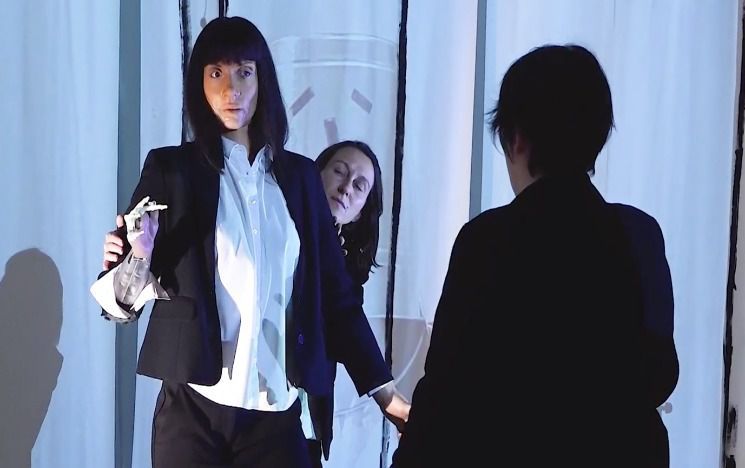
Cleo, a Mesmer robot created by Engineered Arts, with choreographer Janine Fletcher and singer Loré Lixenberg. Stills from video documentation by Catalina Balan. 29 June 2021.
This project explores the ramifications of robot presence through encounters between robots and humans through music, words, movement, image and operatic performance. Our particular focus this time was notions of hybridity between human and the robot world. The opera posits a dreamlike, mirrored world where humans and robots overlap, shifting in and out of robotic and human identities. How thin is the line between robot and human? How would a robot sing if its voice were generated from its own materiality? What can we learn about ourselves and about otherness through creative engagement with embodied AI?
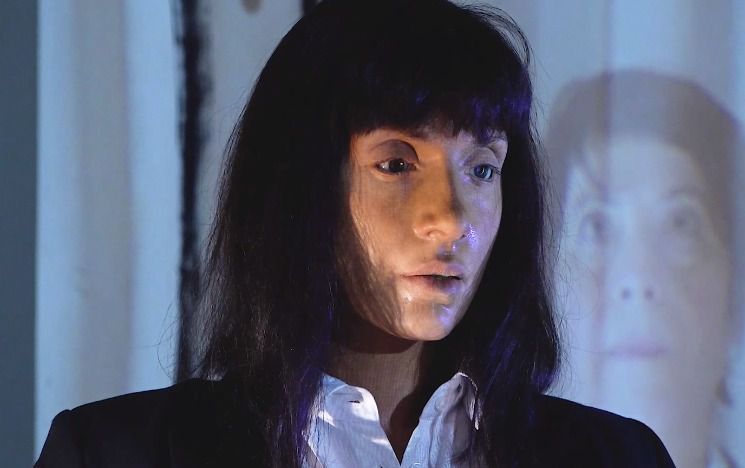
Cleo, a Mesmer robot created by Engineered Arts, with singer Loré Lixenberg. Stills from video documentation by Catalina Balan. 29 June 2021.
This work-in-progress performance was live-streamed on Zoom, followed by a reflective discussion by a panel from academia, the arts and industry, and a Q&A with the virtual audience. You can watch a short documentary about the project here:
Full documentation of the event is here:
Programme for the event:
Tuesday 29 June 2021
Robo_Op
4:00 - 4:30pm Performance
4:30 - 5:30pm Panel Discussion, Q & A
4:00 Performance
This showing is the latest stage in an ongoing investigation bringing robotics, performance practices and opera together, working this time with the robot Cleo. Cleo can enact recorded and live physical instructions, can speak and ventriloquise the voices of others, and can track movements through motion and face detection.
We have explored the robot Cleo’s abilities in movement, speech and song with human performers, and imagined scenes from Cleo’s point of view, as she decides to leave the robot world and join a human one. The lower part of Cleo’s body does not move.
Performers:
Loré Lixenberg (singer)
Janine Fletcher (dance)
Anton Lukoszevieze (cello)
Cleo the Mesmer Robot, designed and manufactured by Engineered Arts. A humanoid robot.
Bucket Head Robot Chorus:
Oscar Bussell
Stephen Goff
Jon Hayden Griffen
Kat Sinclair
Shu Yang
Concept and Instigation: Evelyn Ficarra
Direction and Scenario: Tim Hopkins
Choreography and Movement Consultant: Janine Fletcher
Libretto by Tim Hopkins and Evelyn Ficarra with additional words from Carol Watts, Elise Ficarra and Dana Teen Lomax.
Music composed and improvised by Evelyn Ficarra, Loré Lixenberg and Anton Lukoszevieve,
Sound score: Evelyn Ficarra, using sounds recorded with Loré Lixenberg, Anton Lukoszevieze, the cast, and sounds of robot manufacture at Engineered Arts.
Video and Set Design: Tim Hopkins
Programming: Mike Oddhayward
Robot animation: Mike Oddhayward and Engineered Arts
Robot Cello: designed by Sam Bilbow
Additional cello sounds: Chris Evans (coming out of robot cello).
Technical support and Zoom vision mixing: Alex Peverett
Zoom Hosting: Ahmed Koyes
Live Camera: Adam Whitehall
Administrative Support: Kat Sinclair
Documentation: Catalina Balan
The Robot Opera Project was initiated in 2017 by the Centre for Research in Opera and Music Theatre. Robo_Po /// Robo_Op is supported by Media, Arts and Humanities Knowledge Exchange and the Sussex Humanities Lab.
4:30 Panel
Chaired by Professor Nick Till, Professor of Opera and Music Theatre and Director of the Centre for Research in Opera and Music Theatre at the University of Sussex, Pierre Audi Chair, University of Amsterdam.
Panel members:
Will Jackson (robot designer / CEO of Engineered Arts)
Elizabeth Jochum (Associate Professor of art and robotics, Head of Research Laboratory for Art and Technology (RELATE) Aalborg University, Denmark)
Cath James (Artistic Director, South East Dance)
Annette Mees (Director of Audience Labs, Royal Opera House)
Ron Chrisley (Reader in Philosophy, Informatics, University of Sussex)
Robo_Op is the work of many hands.
Thanks to:
Engineered Arts: Daniel Bragg, Marcus Hold, Will Jackson, Morgan Roe, Gill Spencer, and everyone at the factory in Falmouth.
Sussex Humanities Lab: Amelia Wakeford, Kate Malone, Alex Peverett, Alice Eldridge
Media, Arts and Humanities Professional Services: Danielle Salvage, Medeni Fordham, Laura Vellacott, Ahmed Koyes.
Creativity Zone: Jason Price
Sussex Finance: Jo Rogers, Emma Purnell, Allan Spencer, IR35 Team
Sussex Technical Support: John Latimer
Sound advice: Adam Staff
Video advice: Ian Winters
Special thanks to:
Our fabulous Bucket Head Robot Chorus - Kat, Jon, Oscar, Shu, Steve.
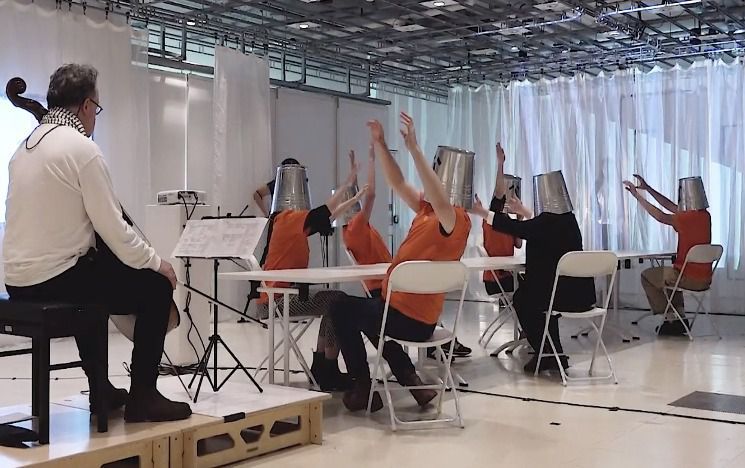
Cellist Anton Lukoszevieze with the Buckethead Chorus. Still from documentation by Catalina Balan.
2020
- Kagel Turning Points
Directed by Tim Hopkins for London Sinfonietta, Kings Place London.
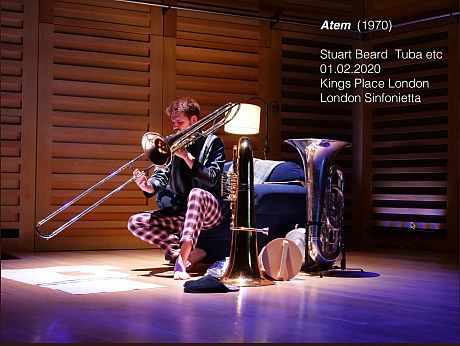
Match (Kagel) London Sinfonietta, players named on image
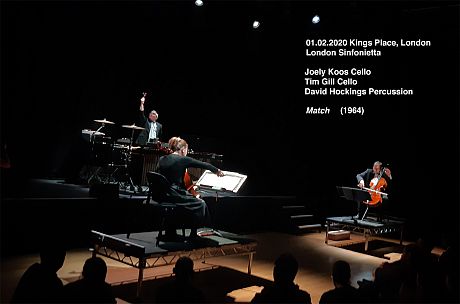 Match (Kagel) London Sinfonietta, players named on image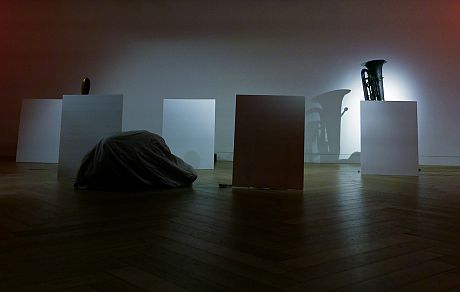
Sussex MA and BA Students perform their work Meditation on Kagel (Cast -Antonia Redding, Pete Myson, Moi Camargo Cano, Ryan Bridgwater, Kai Vollprecht)
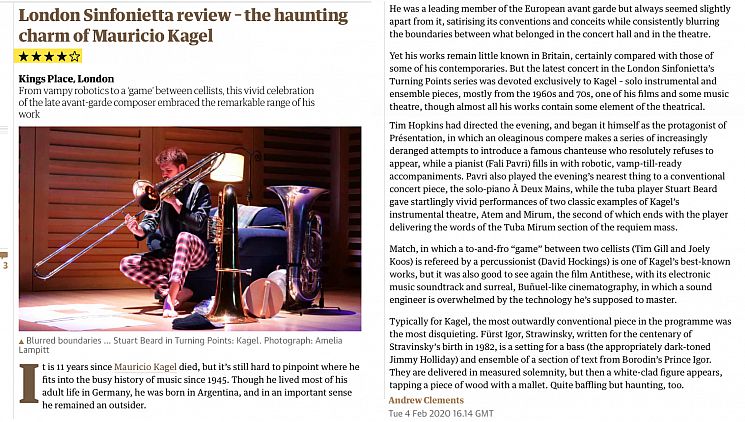
Guardian Review
Photos: Amelia Lampitt and London Sinfonietta
2019
- Robot Opera - What's Next?
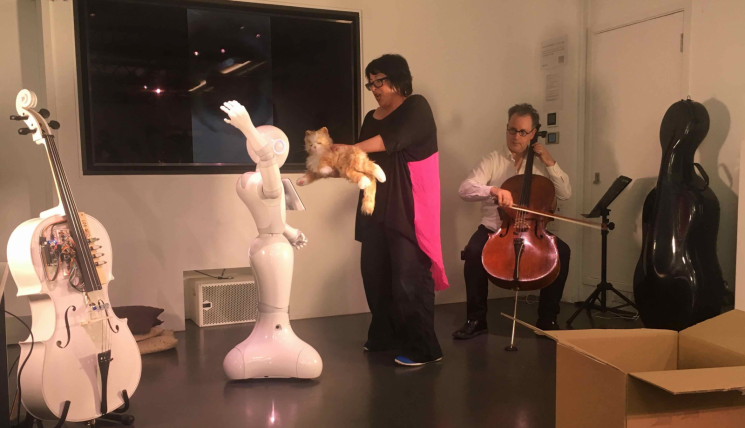
Photo from Here, Kittykitty?, 28th June 2019, Sussex Humanities Lab. Pictured left to right: robot cello, Pepper the robot, robot cat, singer Loré Lixenberg, cellist Anton Lukoszevieze.
Robot Opera - What's Next?
Performance / Demonstration / Discussion
28 June 2019, 3:30-5:00pm
Co-produced by CROMT with the Sussex Humanities Lab and support from the Sussex Research Opportunities Fund.
Robot Opera - What's Next?, continued with the themes of Performance, Embodiment and Vocality which we initiated in 2017 with the Robot Opera Mini-Symposium, but looked more closely at Human / Robot interaction. Working with musicians, programmers and a Pepper Robot we explored musical and theatrical relationships across the human / robot divide, presenting our findings through performance, demonstration and discussion.
This iteration of the robot opera research strand brought together singer Loré Lixenberg & cellist Anton Lukoszevieze of Apartment House, together with a Pepper Robot, composer Evelyn Ficarra, programmers Deepeka Khosla & Kopiga Kugananthavel, instrument designer Sam Bilbow, and Sussex academics Nick Till and Ron Chrisley to explore musical and theatrical relationships across the human / robot divide.
See a brief clip here:
This clip features a Pepper robot manufactured by SoftBank with singer Loré Lixenberg and cellist Anton Lukoszevieze.
Programme:
The Centre for Research in Opera and Music Theatre and the Sussex Humanities Lab present:
Robot Opera – What’s Next?
Sussex Humanities Lab
Friday 28 June 2019
______________________________________________________________________
3:30 Performance of Here, kittykitty?
4:00 Discussion chaired by Professor Nick Till with Dr. Ron Chrisley as first respondent.
Here, kittykitty?
a chamber opera for Pepper Robot, a robot cello, a human singer, a human cellist, and a surprise guest.
Cast:
Loré Lixenberg – singer
Anton Lukoszevieze – cellist
Pepper the Robot – as her(?)self
Robot Cello – as itself
Robot Cat – as itself
Crew / Credits:
Concept / Direction: Evelyn Ficarra
Music & Libretto composed / devised collaboratively by Evelyn Ficarra, Loré Lixenberg, Anton Lukoszevieze and Sam Bilbow (robot cello).
Programming of Pepper by Evelyn Ficarra assisted by Deepeka Khosla and Kopiga Kugananthavel
Robot Cello designed, adapted, programmed by Sam Bilbow
Robot Wranglers Deepeka Khosla and Kopiga Kugananthavel
Video Design by Evelyn Ficarra
Video Operated by Alex Peverett
Thanks to: Sussex Research Opportunities Fund, Sussex Humanities Lab, Caroline Bassett, Claudette D’Silva, Alex Jacobs, Carmen Long, Alex Peverett, Danielle Salvage, Chris Sothcott, Amelia Wakeford, Ian Winters, and all the previous programmers of our Pepper whose behaviours linger on.
This practice-based research project continues a research strand initiated in 2017 with the Robot Opera Mini-Symposium, which featured talks from Sussex academics and performances by two Nao robots. This time we are working with a Pepper robot and exploring on-stage interaction with human performers. Using improvisation and creative programming, we explore the entwining of the human and the digital, touching on issues of embodiment, performance and vocality. How can a robot relate to human actors / musicians, and vice versa? What levels of autonomy can a theatrical robot have, or seem to have? How do we ‘read’ its presence on stage? How can we explore and create new forms of robotic vocal virtuosity, and how might this feed back into human musical language? Is it theatrically and musically interesting to double human instruments as well as singers? What would a ‘robot cello’ look like and sound like?
Special thanks to the School of Engineering and Informatics for the loan of Pepper.
Supported by the Sussex Research Opportunities Fund.
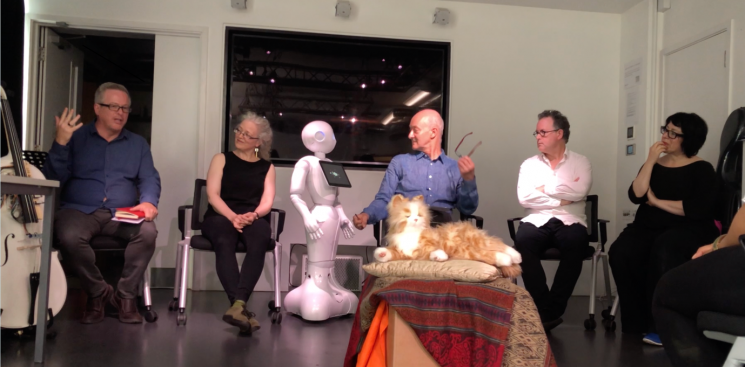
Post performance panel discussion. Left to right: robot cello, Ron Chrisley, Evelyn Ficarra, Pepper the robot, Nick Till, Anton Lukoszevieze, Loré Lixenberg. Foreground: Lou-Lou Louise the robot cat.
2018
- Czech Opera in the Post-Community Czech Republic
Czech Opera in the Post-Communist Czech Republic
A talk by Helena Spurná, University of Olomouc, Czech Republic
Wednesday 18 April 2018
The introductory statement for my exposition will be somewhat pessimistic: one cannot deny the fact that Czech operatic theatre, with certain exceptions, has not supported new art. The reasons for this cannot be easily explained by mere economic factors; despite the social-political changes after the year 1989, Czech culture has still not emerged from established models and approaches of the past. Yet a number of interesting operatic works have come about in recent years which I will discuss in this talk, including: Martin Smolka’s (*1959) opera Nagano, inspired by the victory of the Czech ice hockey team at the Winter Olympics twenty years ago; the so-called spoken opera Sezname, otevři se!, based on Umberto Eco‘s book The Infinity of List; and the “opera-trial” Tomorrow There Will Be…. by Aleš Březina (*1965) a documentary opera based on archive materials related to the political trial and execution of Milada Horáková at the beginning of the 1950s.Lorem ipsum dolor sit amet, consectetur adipisicing elit. - Minerva Scientifica
Minerva Scientifica - Workshop/Performance with Frances M Lynch, Artistic Director
23 May 2018
Launching a collaboration between the Centre for Research in Opera and Music Theatre, the School of Life Sciences, and the Minerva Scientifica women in music and science project.
Minerva Scientifica brings to light creatively the contributions of women scientists in the past and today, and aims to increase public engagement with science, and with the issues encountered by female scientists, through creative partnerships between women scientists and women composers and artists
Minerva Scientifica has developed a range of musical and theatrical projects and events. These have included collaborations with Kings College London, Newcastle University, and performance at events as varied as British Science Week, Southampton Science and Engineering Festival, Lyme Regis Fossil Festival and the Science Museum Lates Festival, as well as projects in schools throughout Britain.
The Centre for Research in Opera and Music Theatre is working in partnership with the School of Life Sciences to develop a funding bid that would bring the Minerva Scientifica project to Sussex with a major science-arts collaboration as part of the University’s commitment to the Athena SWAN programme.
Update 2021 - CROMT and Minerva Scientifica are running a two-day R & D workshop in June 2021 to explore current brain research on dementia by the Sussex Serpell Lab for an eventual science public engagement project on Dementia.
- Melancholy Artefacts
Technological Acceleration in the last moments of WW1
Devised by Tim Hopkins, a Music Theatre Development Project for 1418Now and Brighton Festival, with composer Judith Weir and sound design Danny Bright, for two formats: live performance and mobile mediated version (in container).
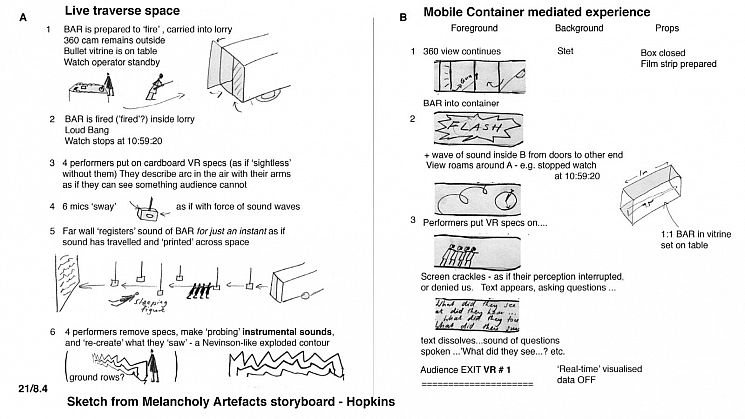
Image: From storyboard, showing live performance and mobile experience side by side.
2017
- The Operatic
The Operatic - an interdisciplinary symposium looking at the concept of "the operatic" in contemporary culture
19-20 May 2017
Organised by the Sussex Centre for Cultural Studies and the Centre for Research in Opera and Music Theatre
Writing in their book "Opera's Second Death" (2001) Slavoj Žižek and Mladen Dolar argue that opera is dead, but that it lives on as the un-dead: "If opera were simply over it could be assigned a neat place in cultural archaeology and thus properly buried. The astounding thing is the enormous operatic institution's stubborn, zombielike existence after its demise. The more opera is dead, the more it flourishes. Opera remains a huge relic, an enormous anachronism, a persistent revival of a lost past, a reflection of the lost aura, a true postmodern subject par excellence."
This symposium considered the post-demise dispersion of opera in the cultural forms of the "operatic": those aspects of contemporary culture that borrow from opera to signify categories such as the "high", the "kitsch", the "camp", the "sublime", the “queer”, the "histrionic"; the use of "operatic" as a critical term (Adorno - Hamlet is "operatic"; Coppola's and Scorsese's films are "operatic"; Kusturica's early work is "an operatically weird blend of magic realism, punk aesthetics and Yugoslav history"); Gramsci's critique of the "operatic conception of life" in relation to Italian politics; re-mediations of opera in popular culture (e.g. as music for films and advertisements); opera as signifier of transcendence, disease or death in films such as Shawshanks Redemption, Philadelphia, Fatal Attraction; operatic voices as backing tracks for pop songs; reality TV shows like Pop Star to Opera Star; the operatic "scoring" of experience - music as heightened soundtrack to everyday life; the operatic in soap opera, horse opera and space opera. What and why does modern culture draw from the afterlife of opera?
KEYNOTE.
John Storey (Emeritus Professor of Cultural Studies and former Director of the Centre for Research in Media and Cultural Studies, University of Sunderland). Opera in Cultural Studies
The focus of my paper is the culture of opera. To understand what I mean by this, and why I became interested in opera and the operatic and the extent of my interest, it is first necessary to explain what cultural studies means by culture. Once I have done this I will draw from my own research on opera to suggest what opera might look like as an object of study in cultural studies. My research has tended to gravitate to two historical moments, the 1990s and the nineteenth century. As I hope to demonstrate, this historical focus enables me to locate opera and the operatic in the critical concerns of cultural studies, especially the relationship between culture and power.
PAPERS
Operatic Film
Maria Euchner (Edinburgh University). Life and its Discontents: Richard Wagner’s Tristan in Lars von Trier’s Melancholia.
Lars von Trier’s Melancholia (2011) is accompanied by a soundtrack that limits itself to the prelude of Richard Wagner’s 1859 Tristan und Isolde, although it is never played in its entirety. The film is not only presented in an “operatic” way, but von Trier employs many of Tristan’s major themes and symbols – a reluctant bride, night-time in a garden, the blurring of individual identities, a longing for death and the annihilation of all suffering in the ultimate Liebestod – to tell the story of the end of the world as it plays out for the depressive Justine, her sister Claire, and Claire’s son Leo. The tedium of everyday life is mirrored in the repeated playing of sections of the prelude.
Julia Sirmons (Columbia University). History and the “Cinematic Operatic” in the Work of Patrice Chéreau.
This paper defines “the operatic” in the cinema of Patrice Chéreau. Directing opera for the stage, Chéreau “revivified” opera through a process of historical excavation; from the 1976 Ring onwards, his operatic productions sought to represent the historical gaps between text and spectator within the mise-en-scène. Strange, then, that his cinematic historical drama Queen Margot (1994) approaches this same challenge not by deconstructing myth and melodrama, but by using an expressive visual style to heighten them. Through this “histrionic” use of cinematic tools, Chéreau crafts an operatic mode within cinema, in which markers of camp and excess promote a dialectical spectatorship, thematizing the subject’s place in history and time.
John Greyson (York University, Canada). Once is Not Enough: Lyrical Repetition and the Operatic.
Why say it twice? The incessant repetition of a lyric phrase (spoken or sung) has been a foundational touchstone of 'operatic' creation (defined here broadly as interdisciplinary spectacle) across cultures and millenias, from Greek choruses and Indian ragas to Robert Lepage's Lipsynch and Drake's latest Vine memes. Anthems in stadiums may leverage lyrical repetition for purposes of nation building, but artists like Gertrude Stein repeat 'pigeons on the grass alas' to purposely unbuild fixed meanings.
The Baroque compositional tradition (think Handel's Hercules) may have mind-numbingly insisted on singing every line a dozen times (the better to demonstrate bravura vocal dexterity), and Caryl Churchill may sub out in every word of her play Blue Kettle until the text becomes nothing but a rich tapestry of 'blue kettles' -- but both are only participating in a wider cross-cultural tradition across disciplines that says it twice for varied aesthetic tactics of emphasis and abstraction, polyphany and cacaphony, performative complexity and expressive repression. Freud identified it as the 'repetition compulsion', focusing on our repressed need to name what is unheimlich (un-secret) again and again, with unheimlich elaborating that paradox of repression and expression (the 'undecidable' in Derrida's sense) that engages the uncanny. However, artists as diverse as Glass, Beyonce, Lepage, Cork/Blythe, and Steyerl all employ lyrical repetition in their operatic spectacles in ways which exceed the unconscious.
This idiosyncratic survey of varied examples from the 'operatic' will be counterpointed with brief examples from my own recent digital opera-documentaries which likewise engage with lyrical repetition, often through formal innovations: Fig Trees, Last Car Jericho and Towel. Fig Trees features an oratorio of four overlapping short sung loops tattooed onto four necks that endlessly repeat with no beginning nor end. Last Car (a murder mystery about transgender and transit issues) obsessively returns to the haunting Eurydice refrain and lyric from Gluck's classic counter-tenor aria, but the meaning of the words changes with each repetition. Towel operatically performs the same official police press release four times, repeating the claim that the Somali refugee did not suffocate from the towel that police held over his mouth for ten minutes.
Operatic Opera
Takayuki Nitta (Tokyo University). The Critically Operatic in Contemporary Opera Staging
In contemporary opera staging, the directors tend to get rid of the "operatic" offered by conventional productions, especially by the beautiful costume and set design. But some of them emphasize the "operatic", in this case the kitsch. Most interestingly, the Norwegian director Stefan Herheim critically reinterprets the defining elements of opera. His mise-en-scene blurs the identities of characters by enhancing the power of operatic allegory, originally caused by the voice which neither belongs to the singer, nor to the character. The story narrated by Herheim in flashback is a postmodern version of Orpheus, the archetype of operatic narrative.
Thanos Polymeneas (University of Sussex). The Operatic Bot.
In this presentation I will talk about a scene from my latest immersive music theatre performance A Magnificent Crossbreeding of Protein and Tinplate to initiate a discussion about operatic processes, aesthetics and voices in the postdigital era. The scene I will talk about did not involve any performers; the only performative aspect of the scene was a form of computational technology based on a generative algorithm, which controlled Virtual Studio Technology Instruments (VSTi), i.e. sound library instruments and vocal synthesizers (also known as Vocaloids). The result was an operatic scene without singers, musicians or performers, but with computerised disembodied voices instead. This presentation will start by examining notions of posthumanism in current music production practices, which in turn define contemporary music aesthetics, while pointing to the music practice of the future., I will demonstrate how I have employed those into my music theatre work; and how my practice engages with operatic aesthetics and voice from a posthuman perspective. Reflecting on Žižek and Dolar’s argument on the contradiction between opera’s death and the way cultural institutions have “zombified” opera, this presentation asks whether an approach to the operatic voice that is in tune with the current technoscience could be more sincere in an ever-expanding posthuman context.
The Global Operatic
Donato Somma (Capetown University). White Elephant or Gift Horse: a site-specific reflection on the operatic in 21st century Africa.
Opera houses continue to play a role in at least two major African cities. Cape Town and Cairo both feature second incarnations of their nineteenth-century opera houses. In Cape Town today the Artscape Complex battles to reconnect to the city through the façade of the alienating, Apartheid-era Nico Malan Theatre, exclusionary and intimidating by design. Cairo's famed house, risen from the quite literal ashes of its first iteration, struggles under the weight of 'command performances' of Aida to a contemporary, largely expatriate elite who now occupy the pasha's former pleasure island of Gezira.I argue that both houses are caught between two conceptions of what a modern opera house can be: the first is a largely unreconstructed perception of opera, its works and culture, as unapologetic privilege, the accessible end of 'high art', virtuous in and of itself and not requiring any justification for its existence and funding. The other conception speaks to the 'operatic', the dispersion of the signifying power of opera into contemporary life. To varying degrees in Cape Town and Cairo this informs a shift in the role of the house, seeking new voices, stories and vernaculars to occupy and recode the symbolically loaded opera house in the heart of each city. Opera houses in Africa continue to operate and signify between the extremes of each conception, in some ways continuing the historic work of the opera house to signal power through cultural capital, but also providing the space for expanded views of what counts as opera in rapidly changing postcolonial states.
With the vibrancy of its afterlife now the subject of scholarly research, the material relics of opera loom as disquieting spectres. This paper explores two African houses' continuing search for relevance.
Lena van de Hoven (University of Bayreuth). The Operatic as Cultural Practice in South Africa: Moving Images from The Isango Ensemble.
With the end of the Apartheid era opera, that symbol of Western dominance/colonial imposition, seemed to be dead in South Africa – but in fact it flourishes as something of an anachronism. While western contemporary cultures often borrow forms of the “operatic” as a pejorative or othering adjective, to signify categories of the “high” or the “kitsch”, my paper will show that the South African contemporary culture uses the concept of the operatic differently. Operatic elements in fact serve as a point of reference to locate indigenous South African identity, because operatic singing practices are considered to be deeply rooted in the black community in South Africa. As a case study I will present different “transculturational” (James Davies 2010) attempts by the Isango Ensemble to bring the operatic into moving images and to present opera themes as contemporary South African narratives. Through the further examples of the well-known U-Carmen eKhayelitsha (2005), Unogumbe – Noye’s Fludde (2013) and Breathe Umphefumlo (2015), I will argue that opera “lives on as the un-dead”, opening up a new perspective on the potential of the “operatic” in post-colonial cultures.
Operatic Genres
Justin Grize (University of Sussex). Space Opera: Opera as Speculative Fiction.
By the late eighteenth century, the notion of wonder had become literally synonymous with the experience of opera, through the merveilleux, representations of the impossible through technological means, which blurred the boundaries between science and magic.
This essential element of the operatic, viewed with suspicion or derision by the rational Modern, would find an equally fitting, equally paradoxical home in SF, where the sense of wonder has become a critical commonplace.
Efforts to garner more serious critical attention to the genre have led commentators to dismiss such wonders, unsubtleties, and extravagances as “space opera”, a term that invites exploration of the shared heritage of these two seemingly unrelated forms.
Operatic dramaturgy, in which the boundaries between thought, speech, and song, between music and silence, do not apply, posits an alternate universe along classic SF lines. The very term “space opera” acknowledges indispensable low-culture elements that the elitist social context of opera cannot conceal.
Sid Wolters Tiedge (University of Bayreuth). The "operatic" in cabaret songs.
The presentation will try to show the complex relation between the operatic and some musical numbers from British comedy and German Kleinkunst. If going beyond the reproduction of clichés like conceited opera singers, songs may evoke an entire evening in the opera including intermission chat (Georg Kreisler: Opern-Boogie), or develop an improvised cadenza into a full-blown opera scene for two (Annamateur); thus, following Bakhtin, laugh at opera and subvert it. At the same time, apart from mere criticism of the high-brow, the use of operatic devices shows an assimilation of the mechanisms of art music.Juliana Hodkinson (Composer, Copenhagen). The spectacular and the everyday: Operatic Gaming.
Every day millions of gamers immerse themselves for hours in imaginative audio-visual events situated far away in time and space, pursuing long-drawn-out heroic quests against dramatic backgrounds. Technologies of augmented and virtual reality create transformative emotional experiences whose aesthetics and dramaturgies mature year by year. Meanwhile opera in the 21st century has undergone the same transformation as public service radio, its large institutions changing from powerful state propaganda tools to commercial assembly-lines for standardized products; all scope for novelty seems manageable only for a fragmented and peripheral network of independent creatives. Apparently, it is always time to recall and reassess critiques of mass media and the spectacle, while looking to the everyday to find engaging artistic responses to the question of how to resist the instrumentalisation of the spectacular.
Jelena Novak (Universidade Nova, de Lisboa). Out of the Comfort Zone: Installing the Operatic.
Looking for the traces of opera out of its common world is intriguing and rewarding adventure. The state of being out of its own institutional frame discovers some new strengths, possibilities and tendencies. It becomes more clear what operatic is when it is found out of the opera. Encounter with the operatic (understood here as 'being of the opera') in a series of installations pertaining mainly to visual arts brings fresh meanings and poses relevant questions about the status and function of (post)opera in contemporary Western society.
Series of recent 'operatic installations' that come from/in the context of visual arts and that I would like to discuss include staging of "Einstein on the Beach"(1976) as an installation conceived by Berthold Schneider and Veronika Witte (2001, 2005), "Opera for a Small Room" by Janet Cardiff and George Bures Miller (2005), "Sirens Taken for Wonders" (2009) by Paul Elliman, "The Opera of Prehistoric Creatures" (2012) by Marguerite Humeau, desk opera "Remember me" (2012) by Claudia Molitor and video installation - AAA (Mein Herz), (2016) by Katarina Zdjelar. I will make an attempt to define what is undeniably operatic once when opera is installed as its own signifier.
The Operatic Phantom (panel)
John Snelson (Royal Opera). The Phantom of the Operatic?: 80 years of dissemination and distortion in ‘Phantom of the Opera’ films around the world.
Through film, The Phantom of the Opera has been disseminated around the world, faithful in varying degrees to Leroux’s source novel. Yet all versions preserve a duality perceived as inherent to the nature of opera: the natural and authentic in opposition to the constructed and false. This has its summary expression in the Phantom, whose identity hovers between perfection and deformity. Almost a century of Phantom films illustrate how the operatic has been interpreted and distorted as the films range through a shopping mall, a deserted Chinese theatre, glam-rock at its most camp and opera at its most coloratura clichéd.
Annette Davison (Edinburgh University). Glamming it up: Brian De Palma’s Operatic Phantom.
Brian De Palma’s Phantom of the Paradise (1974) transplants Gaston Leroux’s Phantom of the Opera into the popular music domain of the USA. The Paradise is an opulent new popular music venue planned by Swan, an unscrupulous producer “drawn from the legends of both Phil Spector and Dick Clark” (Hampton 2004, 261). This satire of the music industry is played out against a backdrop of glam rock and surf music, Faustian pacts, lightning bolts and psychedelic orgies. Operatic and kitsch? Certainly. In its presentation of the notion of the artist versus the system it is also downbeat and cynical.
Cormac Newark (Guildhall School of Music and Drama). The opera(tic) ghost.
Among the most stubborn revenants of the operatic is the Phantom, despite the narrator’s prayers over his remains at the end of Leroux’s 1909-10 novel Le Fantôme de l’Opéra: he is a walking repository of clichés about the art form in subsequent novels, plays, musicals (of course) and films. This paper will examine how the notion of the operatic in popular culture changed as the Phantom of the Opera migrated to different cultural traditions and media over the course of the next century, from the Paris Opéra to, for example, Mexican lucha libre (Santo vs El Estrangulador, 1963) and Bollywood song and dance (Om Shanti Om, 2007).
- Robot Opera - Opera takes a robotic turn
Robot Opera - Opera takes a robotic turn
Talks, discussion and performances. Thursday 15th June 2017
Long the domain of popular science fiction, robots increasingly permeate every aspect of society. How will this impact the creative and performing arts? This research strand, initiated by the Centre for Research in Opera and Music Theatre (CROMT) and supported by the Centre for Research in the Creative and Performing Arts, explored the ramifications of robot presence through encounters with music and operatic performance.
This research project built on our previous CROMT events Opera and the Media of the Future (2014) and The Operatic (2017) and examined the specific meanings and challenges of involving robots in operatic performance. Focusing on issues of stage presence, embodiment, machine learning and vocality, we asked – what can we learn from opera’s robotic turn? The symposium consisted of talks, discussion and exploratory creative practice.
Primary Research Questions:
Robots and Performance - what happens if we put a Robot on a stage? How does an audience 'read' its presence? Is puppeteering the most relevant model, given the current state of embodied AI? Clearly the robot does not ‘know’ it is performing, or could you say that on some level a robot is always performing?
Embodiment - computer music has a long history involving artificial intelligence and creativity, and we already have computers that can improvise / compose / play music. If a robot is essentially a computer that can move around, how does embodiment affect or change the acquisition / expression of these skills?
Vocality - how would a robot sing if it sang like a robot rather than being programmed to sing like a human? i.e. what about its physicality would provoke / create sound? What does it ‘mean’ for a robot to sing?
External coverage:
Meet Pavarobotti – first Robot Opera is bad news for temperamental tenors (i-news)
Pavarobotti: the opera performed by robots (Evening Standard)
Swipe | Robot opera & how tech affects your love life (Global Herald)
Presentations
Evelyn Ficarra, Lecturer in Music
Why Robot Opera?
A brief introduction outlining the research strands embedded within the Robot Opera project: robot voices, embodiment and performance. What is unique about opera that makes a robot encounter particularly resonant?
Thanos Polymeneas-Liontiris, PhD Researcher, Composition in Music Theatre
Voices without bodies: the operatic bot in an immersive performance
This presentation is about an operatic scene I devised for my latest music theatre performance A Magnificent Crossbreeding of Protein and Tinplate (ACCA, February, 2017). In this presentation I will talk about how I developed a scene by interpreting and adapting the qualities of the “robotic” for an operatic context. The scene was based on the combination of generative processes, virtual instruments and vocal synthesisers; it did not feature any performers physically, only the sounds of virtual performers. I will present the musical and dramaturgical reasons behind the choices of the technologies and processes I have used to devise the scene. I will also talk about notions of anthropomorphy and anthropophony in regard to robotic singing and how these informed the process. To close the presentation I will make a brief demonstration of the processes as they were used during the performance.
Chris Kiefer, Lecturer in Music Technology
Learning and Performing with AIs.
This talk will explore these issues:
- AIs and humans adapting to each other in rehearsal and performance
- choreography and the process of training machine learning processes
- customising interactive creative systems to respond to specific human
Ron Chrisley Director, Centre for Cognitive Science
What would it be for a robot to sing?
Drawing on my experiences from investigating this question in the context of a Nao robot, I outline a number of relevant dimensions such as dis/embodiment, playback vs. synthesis, skill, and the potential for lyricism. I focus on the role that a singing robot’s own listening capability can/should play in its performance and/or acquisition of singing skills.
The symposium included work-in-progress performances of two 5-minute robot operas.
Performers included Red 2 & Blue 3 (Robots) and Alice Eldridge (cello)
Director: Tim Hopkins
Opposite of Familiarity
for two Nao Robots, cello and piano
Music: Ed Hughes / Libretto: Eleanor Knight / Programming and Co-devising: Ron Chrisley
O, One
for two Nao robots and cello
Music & Libretto: Evelyn Ficarra / Programming and Co-devising: Ron Chrisley
Post-performance discussion was led by Nick Till, Professor of Opera and Music Theatre
- Empathy Machine
Research and Development with V&A Museum, Glyndebourne Opera and Artists and Engineers
Tim Hopkins and Rob Thomas
Empathy Machine - Could participatory opera in virtual reality address conflict?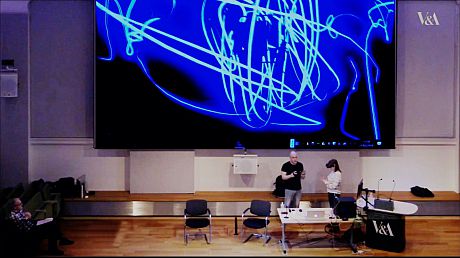
Image: Composer Robert Thomas demonstrates systems with soprano Catherine May, V & A Museum London, 2102 2018.
- Within a Forest Dark
A two day research workshop, leading to an experimental performance, was held in the Brighton and Sussex Medical School and the Attenborough Centre for Creative Arts at the University of Sussex. It explored the experience of transition into a care home towards the end of life, and how the challenges of this new world can be expressed through music and words.
Co-devised by Prof Jackie Cassell, Prof Ed Hughes and theatre maker Peter Cant.
Music by Ed Hughes.
Libretto by Peter Cant.
Directed by Peter Cant.
The workshop involved professional and amateur musicians with personal experience and knowledge of care homes, dementia and scabies at the end of life.
We want to develop this work into a participatory musical experience focussing on the common yet hidden experiences of dementia, and of outbreaks of infection in care homes for the frail elderly. We hope to explore how the forms of narrative and music can be used to understand and address these existential challenges of closed communities, from multiple perspectives.
This video is a record of the research workshop’s practice research outcome - an initial reading of the music theatre piece, as an indication of potential for development.
Synopsis
DIANA, a retired schoolteacher, is facing challenges. She no longer recognises her surroundings and thinks she is in a dark forest, expressing her confusion in the words of Dante which she taught during her career. Her husband, JEFFREY, recounts growing difficulty to his daughter JUDITH.
JEFFREY recalls DIANA’s fall which led to her decline. JOY the care home assistant reassures JEFFREY, but then alerts JUDITH to a new problem - DIANA is feeling itchy. JOY recalls her own experience of being treated for scabies as a small child.
DIANA, now suffering intolerable itching and increasingly confused, expresses her agony through a vision of people scratching uncontrollably in Dante’s Inferno Circle 8 where this is the punishment of alchemists and quacks. JOY, JUDITH and JEFFREY try to understand what she is saying. JUDITH recounts the nursing home’s unavailing efforts at solving the problem. DIANA, desperate for relief, expresses her longing for death as knocking on the door of the earth to be let in, drawing on Chaucer’s The Pardoner’s Tale.
Finally in an epilogue a JUNIOR DOCTOR describes visiting the scene in the home and finally declaring the scabies outbreak, allowing the spell of itching to be broken at last.
DIANA (wife): Melanie Sanders
JEFFREY (husband): John Hancorn
JUDITH (daughter): Liz Webb
JOY (care-home assistant): Katie Hawks
JUNIOR DOCTOR: Liz Kelly
Piano: Will Hancox
Lighting: Lee Kennedy
Composer: Ed Hughes
Librettist and Director: Peter Cant
Supported by
The Research Opportunities Fund (University of Sussex)
The Brighton and Sussex Medical School
The Attenborough Centre for Creative Arts
2015
- Stephanie Pan - Implied Manifesto #1
Stephanie Pan - Implied Manifesto #1
Thursday 26 November 2015
Stephanie Pan gave a concert in the Meeting House which included abstracted pop songs, live improvisation, inarticulateness, wineglasses, Suzuki Omnichord, Nebulophone and live sampler.
This was followed by a talk on ‘The Performing Body’ in the Recital Room in which Stephanie presented subjects related to her practice and body of work in the context of modern performance and music.
Finally Stephanie led a workshop in which participants worked with a pre-set, limited choice of objects/instruments to construct a short performance abstracting personal statements.
www.stephaniepan.com - Following My Ears in Dreams of Wires
Following My Ears in Dreams of Wires
Laetitia Sonami
Your Presence is Required: Performance, Control, and Magnetism
Tuesday 8 December
Composer, performer and sound artist Laetitia Sonami presented an overview of work carried out over three decades, including her legendary lady’s glove, wire writings, hijacked plungers and current attraction to uncontrollable interfaces. This was followed by a concert and reception in the Meeting House.
2014
- Opera and the Media of the Future
Opera and the Media of the Future
Prompted by discussion of the ever-growing phenomenon of ‘live cinecasts’ of opera, we expanded our remit to ask questions about a whole range of new media platforms and devices and the impact that these may have on both modes of audience engagement and the forms of opera itself.
To launch this project we held a two day research event entitled Opera and the Media of the Future at Glyndebourne Opera from 24-25 October 2014 to examine the challenges and opportunities of new media technologies for the future of opera, bringing academics, artists and opera professionals together to examine a wide range of issues from opera cinecasts and webcasts to the use of new media platforms for audience development, marketing and education, and the potential of new media for the forms of opera itself.
The three central questions we looked at were:
1. What opportunities and challenges are presented to opera companies by new modes of performance broadcast, and new digital technologies and platforms?
2. How will such modes of broadcast, and technologies and platforms, change the way we think about the concept of the operatic 'audience' and our notions of 'liveness'?
3. How might newmodes of broadcast, technologies and platforms, impact upon new forms of opera for the digital age?
2013
- Mary Armentrout Dance Theater
Mary Armentrout Dance Theater
Choreographer/Performance Artist Mary Armentrout had a mini-residency at the Centre for Research in Opera and Music Theatre, from 8-11 March.
Mary Armentrout is a performance artist / choreographer who works primarily with repetition and duration to uncover aspects of intentionality and presence. Her recent pieces,reveries and elegies and the woman invisible to herself were both site-specific projects involving collaborations with composers Pamela Z, Evelyn Ficarra and Merlin Coleman, and video artist Ian Winters. Influenced by contemporary philosophical concerns as well as the ongoing critical investigations started by the Judson Church dance deconstructions, she makes works that embody the contradictions of contemporary life, both our conflicted, fractured sense of self, and our discontinuous, collage sense of being-in-the-world. Her choreography consists of small fragments of everyday movement, words, and environments that are distilled, distorted, polished, and stripped down to reveal the layers of ambiguity, pathos, and absurdity underneath the surface. These actions are set in industrial corridors, against urban skylines, on the beach… a compelling mix of location, media and performance.
During the residency Mary Armentrout talked about her work, with a focus on recent site-specific projects. This was followed by panel discussion, chaired by Evelyn Ficarra, including collaborator/video artist Ian Winters. There was also a work in progress research sharing in which participants gained further insights into Mary and Ian's creative process and how they relate to issues of the site-specific.
Mary and Ian also spent time at large in Brighton, collecting visual material - explorations towards future Brighton site-specific work for 2014
You can find out more about Mary Armentrout Dance Theater here: http://www.maryarmentroutdancetheater.com
Press Quotes
The queen of Bay Area post-modern dance is back with her newest performance installation, 'reveries and elegies'. ... a multi-section, site-specific, mobile work that will live and breathe in four different spaces over the next three months… 'reveries and elegies' invites the viewer on a multi-disciplined journey of process and discovery."
- Dance Commentary, Heather Desaulniers, accessed 22nd Feb 2013
http://www.heatherdance.com/2012/12/reveries-and-elegies.html
"Mary Armentrout is a choreographer of keen perception and sharp intelligence. As an artist, her pieces are witty and wonderfully theatrical - yet they also explore important ideas. ... The site-specific "the woman invisible to herself" explores issues around identity even as it questions the very nature of performance - as a state of being and as a theatrical practice."
- Rita Felciano, The SF Bay Guardian, 9/15/10
"Mary Armentrout is a performance artist of tremendous range. She utilizes body language as well as verbal acuity: both vocabularies are so carefully attuned and so delicately melded, she seems to be inventing a new kind of dance theatre before our eyes."
- Christopher Correa, DanceViewTimes, 8/9/04
- Listening to the material
Listening to the material
The Listening to the Material Series of workshops examined different aspects of creating visual theatre in which objects become co-collaborators in the creative process.
In a series of three weekend courses over a nine-month period participants learned techniques for devising theatre with objects, draw on the object's cultural and symbolic associations to transform its meaning and relationship to the human performer, and explore ways of integrating objects and sound so that neither music nor image is in service to the other.
These workshops were conceived as a performance laboratory, combining skills development with experimentation and reflection to make a bridge with participants' personal practice.
The series consists of three weekend courses over a nine-month period. It is possible to take individual weekend workshops or sign up for all three to gain 30 hours of in-depth training in using objects in performance.
Further Information
Listening to the Material 1, 2 June 2013
An introduction to a method of devising visual theatre that takes the object as a starting point. Participants will learn different ways of brainstorming materials to generate images and theatrical moments, use both perception and analysis for meaning-making, discover the object's poetic and cultural associations, and will compose a visual script that can be used as a basis for rehearsal.
The Sound-Scope of Objects 26, 27 October 2013
A practical workshop for performers, directors, musicians and composers that looks at different aspects of combining sound and objects in visual theatre. The aim is to go beyond using music as support for performance or performance to illustrate music and reach a level of collaboration where both sound and object are partners in the theatrical experience. Tasks include manipulating objects to create live sound scapes and examining how sound can be used to support or subvert the expectations created by the object and vice versa.
From Prop to Protagonist 18, 19 January 2014
Beyond simply being an actor's prop, objects can articulate subtext, function as a symbol or metaphor, or come to life as an independent character. From Prop to Protagonist explores the different theatrical languages of objects, from realism to poetic theatre, and shows how to transform the object's meaning and relationship with the human performer through degrees of presence and focus.
Rene Baker is a theatre-maker who specialises in puppet and object theatre and in 22 years of professional experience has worked as a performer, designer, director, researcher and teacher/trainer/coach.
She trained by apprenticeship at the Little Angel Theatre (London) and worked as a freelance puppeteer for leading UK companies. From 1992-1998 she was a core member of the creative team at Norwich Puppet Theatre, devising and performing shows that have been invited to festivals around the world.
Since 1998 she has been developing training for puppeteers and actors that shows how anything and everything can be brought to life, looking at different aspects of combining actors and objects onstage, and offering an approach to devising performance with materials.
She has led workshops in drama schools, theatre festivals and rehearsal rooms in England, Norway, Finland, Spain, Estonia, Greece, Czech Republic and Russia. From 1998-2005 she was puppetry skills teacher at the Central School of Speech and Drama (London), from 2005-2008 she taught visual theatre at the Institut del Teatre (Barcelona) and since 2010 she has been teaching in the puppetry department of the Turku Arts Academy, Finland.
As a freelance director and workshop leader, she continues to investigate the dramatic use of materials in theatre … everyday objects, puppets, moving scenography, animated costume, sticks, stones, water, car parts, toys … and whatever else you might suggest …
http://www.puppetcentre.org.uk/develop/listening-material-rene-baker/
These events were presented by Puppet Centre in collaboration with The Centre for Research in Opera and Music Theatre (CROMT) and the Attenborough Centre for the Creative Arts at the University of Sussex
- The Memory Table
The Memory Table
Research Event: Memory Table v2: From Installation to Performance
Fresh from performances in Oakland and San Francisco: Tuesday 24 September in the Attenborough Centre for the Creative Arts, Creativity Zone),
This research event comprised of a performance followed by a panel discussion on the issues raised when turning a pre-existing installation into a performance based-work. Ian Winters (video), paige starilng sorvillo (movement) and Evelyn Ficarra (sound) discussed their work in a panel chaired by Professor Johannes Birringer (Brunel).
The Memory Table v2 : mnemonics devise Character-A (yellow) with a side of chance
We are slowly reverse-engineering Character A from fragmentary evidence found within the habit field of the memory table. In the absence, or a room, we are building a visually and sonically responsive environment whereby to study the permeable, uncertain, contingent and social nature of our own memories as well as the premise that core parts of our identity and relationships are formed in the most quotidian of environments, often by chance.
Nota Bene: Our current work on Mnemonics… is the explosion outward/inward of Ian Winters’ original Memory Table installation which was/is: a deceptively simple “social” installation where viewers interacting with an everyday table experience a visual and sonic mirror of their own present-tense experiences merged with table’s fragmentary/re-written “memories” of all the pasts that have transpired at this same table.
This work was supported by Zellerbach Family Foundation, NexMAP / Center for New Music, The MilkBar, plus CROMT and ACCA at the University of Sussex.
Ian Winters, Evelyn Ficarra, & paige starling sorvillo / blindsight
- Pamela Z
Pamela Z
7 November
Pamela Z gave a short presentation of works for voice and live electronics using gesture control and interactive software.8 November
Pamela Z gave a lecture / presentation of her work including excerpts of pieces for voice, live electronics and video, followed by a panel discussion, chaired by Cathy Lane, on issues arising from technically mediated solo performance.This was followed by a lecture / workshop aimed at students on the MA in Music and Sonic Media and students in digital media practice.
Further information www.pamelaz.com
- Musical Revisionism in Contemporary Mozart Production
Mozart and Czernowin's Zaide/Adama (2006)
Musical Revisionism in Contemporary Mozart ProductionAdeline Mueller, Junior Research Fellow in Music, New College Oxford
Friday 14 JuneThe 2006 Salzburg Festival staged all twenty-two of Mozart's operas and opera fragments. Among them was Mozart's unfinished Singspiel Zaide, for which a companion piece, or 'commentary', was commissioned of the Adama, composed by Chaya Czernowin. The resulting composite elides political and aesthetic forms of trauma, with Czernowin's trespassing on the soundworld of Zaide most violently at moments of maximum tension in Adama's allegory of ethnic intolerance.
2012
- "Astonished and Terrified": operar and the transformation of the world by technology
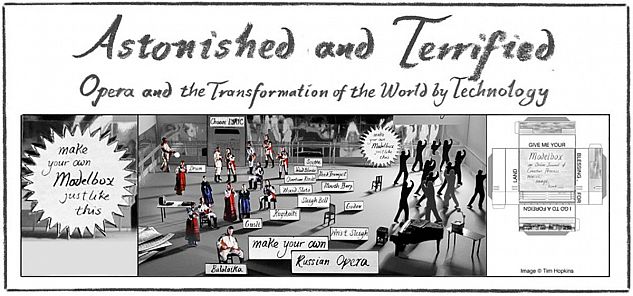
“Astonished and Terrified”: opera and the transformation of the world by technology
An event to mark the end of Tim Hopkins' AHRC Fellowship
Creativity Zone, 22-23 June 2012
(“Astonished and somewhat terrified” - Sir Arthur Sullivan’s recorded response to a demonstration of the new Edison phonograph in 1888).
Digital technology is now widely incorporated into the creative practice of many artists working in contemporary performance. In the case of opera this has multiple manifestations and implications:
- changes in modes of presentation within the traditional technological environment of the stage, such as unprecedented amounts of moving image and discreet / overt sound design
- changes in who makes the work and how, where the processes of assembly have moved away from the artefact of the commissioned composers' score / libretto, towards mobilisation by other elements traditionally at work in opera's 400 year history (such as concept, dramaturgy, scenography)
- uses of digital media to export opera's constituents beyond collective experiences in theatres, such as uses of pervasive, locative media and live streaming to relocate / reconfigure relationships between music, narrative, audience, etc.
- new understandings of concepts such as “live" and “mediated”, etc.
- works that may use no contemporary technology devices, but thematise their presence
These developments have informed Tim Hopkins' AHRC Fellowship project, entitled ‘Some uses of new technology in lyric theatre, in relation to intermedial mise en scene in theatrical staging, and the remediation of operatic media’. Some of the outcomes of the research were exhibited at this event.
Speakers included:
Nicholas Till - artist, Director of CROMT, Artistic Director of Post-Operative
Tim Hopkins - artist, UK - an account of recent research projects - 1/3. The Lost Chord, TV Opera, Give Me Your Blessing For I Go To A Foreign Land, Music Walk or Hunting for Mushrooms - performance pieces thematically concerned with technological transformation, and a personal artistic interest in sensations of threshold between one world and another. Each occupies a diversity of contexts and collaborations - performance in theatres and elsewhere, printed image and text, moving image, and online. They imagine particular cultural environments / historic registers / physical locations as places of transition: the late Victorian creative imagination and the moment of the electro-mechanical; Russian folk / ritual song and its recreation in opera, as an image of migration; Opera on TV - loss and gain in translation between media; contemporary interventions in the landscape using mobile media systems.
Claudia Molitor - composer, UK - will present work-in-progress on 'Remember Me…,' "- a desk-based opera that re-imagines the dramatic extravagance of the large - scale operatic production in an intimate form, as an instance of a consciously 'post-disciplinary' approach , where the artistic practice can be explored with any relevant media, from pencil to digital camera, where digital media is not "in addition to" the opera, but an integral and quite natural aspect of the work. "
Jorge Balça - performer, director - University of Portsmouth, UK - "throughout history, opera has tracked theatrical developments. However, …in the 20th Century, while the work of Meyerhold, Copeau and, later, Lecoq led theatre practitioners increasingly to value the body as a dramatic tool, these developments failed to find resonance in opera, which thus remained a predominantly aural experience. This moment of rupture with theatre history coincides with …sound recording. This paper examines how, … the recordings of opera helped to cement its music-centrism. Considering the impact opera recordings had on production styles, production practices, concepts of authorship and performance training, this paper argues that a paradigm shift took place centred on these recordings’ ontological mutation from representing opera to being opera. Further pursuing the analysis of technology's power to change the nature of an art form, the paper concludes by asking: if vinyl and CDs contributed to the disembodiment of opera performers, might they now find the way back to their dramatic bodies through the power of DVDs and Blu-Ray?"
Simon Katan - composer, UK - a live experiment with digital co-dependent score and performance, with Catherine May, soprano.
Caroline Wilkins - composer, UK – (links to project - video 1, video 2 - biog) The theatrical use of the digital voice and hyper-instruments in a sound-led interdisciplinary performance work by Caroline Wilkins and Oded Ben-Tal Zaum: - Beyond Mind: (for voice, instruments, interactive electronics, film, choreography, lighting ) A consideration of how technology becomes a fundamental element in this genre - creating virtual sound characters, determining augmented perceptions of time-space, extending aural and visual parameters of stage events.
Craig Vear - composer, UK - ‘A Sentimental Journey’, is an attempt by an experimental composer to articulate through praxis a growing interest in defining what a ‘digital opera’ might be. Using examples from the performances of this work, Vear will illustrate certain principles he developed through the compositional processes - dimensionality, remote audience, liminal performance space, computer generated visual scores, autonomous computer soundscapes and an attempt at a ‘total’ compositional approach. He will also stream a version of the complete composition as a performance. (Delegates wishing to experience this please bring headphones and mobile internet device - smartphone or laptop.)
Christopher Morris - School of Music and Theatre, University College Cork, Ireland. "I want to take Sullivan's words as a springboard for a discussion of the impact of digital technology on spectatorship. More specifically, I want to consider how we, as spectators, respond to the new operatic media and how we communicate and mediate that response through language. What, to put it another way, is the role and value of words about media experience? And what are the potentials and limitations of media theory in addressing these questions?"
Andreas Breitscheid - composer, Germany, former Artistic Director of Forum Neues Musiktheater, Stuttgart Staatsoper. What challenges for Opera and Lyric Theatre are proposed by the invention / production conditions of today's media forms. How does opera / lyric theatre specify itself in relation to other media theatre, for example in terms of the phenomenon of singing, and the function of space? How does the composer as a key creator of opera navigate aspects of an altered technological situation?
Jelena Novak, theorist and dramaturge - ASCA, University of Amsterdam; CESEM, Universidade Nova de Lisboa. Body and Voice, Divided: Singing Corporeality in the Age of Media - A consideration of how the mutual relationship between body and voice is reinvented in recent opera practice. The reinvention in question assumes the changes that came as the result of the impact of new media and technology, a de-synchronization between image and sound, or a redefinition of sex-gender-voice relationships in postopera.
Rolf Wallin - composer, UK/Norway - thoughts around an opera commission-in-progress, involving a science fictional imagining of the future.
Tansy Davies - composer, UK - reflection on her artistic practice
Alexis Kirke - composer, creative technologist, Interdisciplinary Centre for Computer Music Research, University of Plymouth UK - Open Outcry - systems on the edge of control - a work in progress which places singers in a real time money market, translating their musical expression into data that drives electronic trading.
Daniel Somerville - dance artist, University of Wolverhampton, UK - a consideration of how we might formulate a notion of technology as essentially 'operatic' - drawing on Heidegger's concept of techne, Dr R Adjani's image of the Japanese Tea Ceremony as a model for contemporary immersive multimedia/live art, a kinship between Gesamtkunstwerk as non-anthropecentric art and Buddhust thinking around 'dependent origination', and the 'operatic' in relation to the dynamics of gender performativity.
- When the flame dies
When the flame dies [+ images]
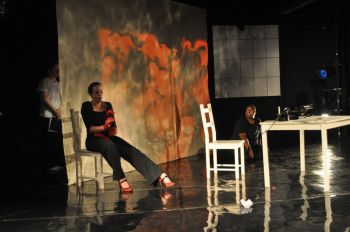 Composer - Ed Hughes
- Librettist - Roger Morris
- Video - Will Reynolds and Poppy Burton-Morgan
- Featuring the voices of Andrew McIntosh (baritone); Lucy Williams (mezzo); Peter Kirk (tenor); Emily Phillips (soprano); Ben Williamson (counter-tenor); also video artist Loren O'Dair.
- Ensemble - The New Music Players
- Advisers: Tim Hopkins and David Chandler (Professor of Photography, University of Plymouth).
- Duration: 70 minutes
The Poet faces a choice: his writing or getting his dead lover back. He dreams of the Underworld where he meets the characters of his past and his imagination. He must choose between love and creativity.
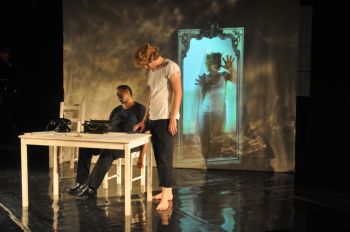 This new opera was created during Autumn 2011 and Spring 2012 working towards a full scoring for a cast of five singers and ensemble (The New Music Players) with live electronics. A public presentation was made in 2013. The project explored the use of specially created video, and archive stills and footage in the wake of World War II, in order to add new textures to the concert performance of opera, and to find fresh ways of contextualising works with historical and mythical resonances in performance.
Ed Hughes has been previously commissioned by The Opera Group and City of London Festival (The Birds); Brighton Festival (Memory of Colour); and other groups/ensembles. His works have been extensively toured by the New Music Players which he directs, as well as released on CD and DVD (Tartan, BFI).
Roger Morris’s novels have been published by Macmillan and Faber and widely translated. His book A Vengeful Longing (Faber, 2008) was shortlisted for the CWA Duncan Lawrie Award.
Will Reynolds Recent set and lighting designs include Waiting (Southbank Centre), Otieno and Blood Wedding (Southwark Playhouse), Saturday Night (Arts Theatre), Moonfleece (National Tour) and La Boheme (Palestinian Tour). Projection designs include Prima Donna (Sadlers Wells), The Gambler (Royal Opera House), Das Rheingold (National Reisopera, Holland) and Home (Theatre Royal Bath).
The New Music Players have recorded for BBC Radio 3, and performed in festivals and venues across the UK and abroad. Their commissions have included James Wood, Rolf Hind, Michael Finnissy and many others. Recent releases include a special 5.1 realisation of Ed Hughes's score to Eisenstein's classic film Battleship Potemkin (for Tartan Video).
Ed Hughes | Selected Press
‘A fine example of the hidden gems the Brighton Festival can produce’
Evening Argus 12 May 2004 on Memory of Colour
‘Pure magic...A rip-roaring vital spectacle...a show of terrific vitality and verve’
Independent 1 July 2005 on The Birds
‘truly emotional...an atmosphere of deeper resonances’ Times 1 July 2005 on The Birds
2011
- Visiting Research Fellows
Visiting Research Fellows
Katie Tearle, Head of Education at Glyndebourne Opera, was Visiting Research Fellow in the Spring Term.
Laurel Zeiss, Baylor University Texas, was Visiting Research Fellow in the Summer Term.
- Research seminars 2011-12
Research seminars 2011-12
In 2011 Glyndebourne's Education Department was 25 years-old. To mark this anniversary, the Head of Education, Katie Tearle, who founded the department, spent one day a week as a Research Fellow with the Centre for Research in Opera and Music Theatre. As part of the Fellowship, Katie organised a special seminar series on New Opera and Participation.
Glyndebourne has a strong history of commissioning new work; the majority of Glyndebourne's commissioning since 1990 has been led by the Education Department, with main stage work for young performers and audiences being part of Glyndebourne's artistic policy. Glyndebourne has commissioned large-scale operas for the community and young people to participate in and build wider audiences for opera. The first community opera involved over 300 people on Hastings Pier (1990) and was composed by Jonathan Dove, who went on to write 2 more community operas for Ashford (1993) and Peterborough (1995). The youth operas Misper (1997/98) and Zoë (2000) (John Lunn/Stephen Plaice) and the Hip Hop version of Così fan tutte - School 4 Lovers brought the community to Glyndebourne with the operas presented on the main stage.
The latest youth opera, Knight Crew by composer Julian Philips, a doctoral student in the Music Department at Sussex, was performed in March 2010 at Glyndebourne. The opera was based on a novel by Nicky Singer, updating the King Arthur myth. This high-profile project involved around 700 people in development, participation and work-related learning projects. As well as four performances of the opera, including one performance for schools and colleges, the work was featured in a BBC 2 series Gareth Malone Goes to Glyndebourne that reached 2 million viewers.
SEMINAR PROGRAMME
Wednesday 19 January
Graham Vick, Artistic Director of Birmingham Opera Company
Graham Vick CBE is one of the foremost opera directors of our times. His productions have been seen at La Scala, Milan; Metropolitan Opera, New York; Mariinsky Opera, St Petersburg; Maggio Musicale, Florence and many more. His production of Verdi's Falstaff opened the newly re-furbished Royal Opera House and between 1992 and 2000 he was Director of Productions at Glyndebourne Opera. He has won many international awards including the Premio Abbiati in Italy (3 times) and The South Bank Show Award (twice). He is a Chevalier de L'Ordes des Arts et des Lettres, Honorary Professor of Music at the University of Birmingham and was Visiting Professor of Opera Studies at Oxford University. He was awarded the CBE for services to Opera in the Queen's Birthday Honours List in June 2009.
Throughout his career Graham has created projects designed to reach new audiences. At Scottish Opera in the late 1970s he founded a small touring company with funds from a government job creation scheme to take opera to remote communities in the Highlands and Islands. In the 1980s he worked with a group of 300 unemployed young people to bring to life Leonard Bernstein's West Side Story in an abandoned mill in Yorkshire and in 1987 founded Birmingham Opera Company. Graham views his work in Birmingham as entirely complementary to his international directing career and is adamant that excellence and accessibility are not at odds. Although a small operation, Birmingham Opera Company is now seen to be at the forefront of the modernisation of opera, and a pioneer in its development as a 21st-century artform.
Wednesday 2 February
Katie Tearle, Head of Glyndebourne Education
'History of Opera and Participation and the Glyndebourne Experience'
Benjamin Britten, and the work which is arguably the first community opera Noyes Fludde - The Chester Miracle Play set to music - written in 1958 for the Aldeburgh Festival and premiered in Orford Church, have dominated the world of Opera and Participation over the last 50 years. This seminar will explore Britten's pioneering work to set the stage for an overview of Glyndebourne's youth and community commissions up to the latest work Knight Crew.
Wednesday 2 March
Julian Philips and Dr Richard Ings
'Knight Crew: the process and evaluation'
'My contention is that this project exemplified a growing understanding that education work - which comes with a plethora of labels, from participatory to inclusion to community to outreach work - is no longer an add-on to artistic development but intrinsic to it. The Cinderella has come to the Ball.' Richard Ings, Knight Crew Evaluation.
The framework for the Knight Crew evaluation was to explore the paradox of maintaining Glyndebourne's high professional standards whilst widening access by engaging non-professionals in our work. In this session Julian Philips and Richard Ings will discuss these issues.
Julian Philips was appointed Glyndebourne's first Composer in Residence in October 2006 as part of a Collaborative Doctoral programme with the University of Sussex funded by Arts and Humanities Research Council and the Alan and Karen Grieve Charitable Trust. The residency enabled Julian to investigate different approaches to the creation of new opera and music theatre as an aspect of the broader artistic, educational and audience development activities of Glyndebourne Festival Opera as part of his research. His career to date in theatre, ballet and opera includes composing scores for 10 theatre productions with the director Michael Grandage, chamber operas for the WNO Max Department and a commission for a full-length ballet. He is currently Head of Composition at the Guildhall School of Music and Drama.
"Three years ago, I embarked on a creative residency at Glyndebourne, which allowed me to shadow a broad range of the company's work and develop a number of projects of my own. Through Glyndebourne I could focus and develop my skills in a thriving operatic environment while also having the space to try things out, improvise, take risks. Through Sussex University's music department and specifically the Centre for Research in Opera and Music Theatre, I could equip myself with a more rigorous critical framework for my creative ambitions, balancing pragmatic compositional solutions with freer, more experimental thinking. I would allow me to invest in the next stage of my professional development and harness my garnered experience with fresh creative ideas and the diverse contexts in which to realise them." Julian Philips.
Dr Richard Ings. Richard Ings has worked in the cultural sector as a funder, evaluator, researcher, writer, editor, teacher and consultant for over 25 years. He has been freelance since 1991, working for a wide range of clients, including the national and regional offices of Arts Council England, the Calouste Gulbenkian Foundation, the Esmée Fairbairn Foundation, The National Youth Agency, CapeUK, Youth Clubs UK, Artswork, the Isle of Wight Children's Fund, Lewisham Education Arts Network, NESTA, Creative Partnerships London North and, in recent years, a growing number of producing arts companies. Having run seminars and lectured on both the arts and American visual culture in a number of universities, most recently in the School of American and Canadian Studies at the University of Nottingham, Richard is currently an associate lecturer at the University of the Arts.
The common threads in much of this work are Richard's interest in participatory practice in the arts, his involvement in evaluating, promoting and disseminating good practice and his belief that everyone - and especially young people at risk - should have access to the risks and pleasures of high quality creative activity.
Wednesday 9 March, 2012
Stephen Plaice, playwright and librettist.
'On devising and writing libretti for participatory opera'
Stephen has recently collaborated with Harrison Birtwistle on Angelfighter, an oratorio for this year's Bach Festival in Leipzig. He wrote the libretto for Birtwistle's chamber opera The Io Passion in 2004. A new chamber opera with Birtwistle, based on the original Faust Chapbook, working title Certain Circles, began its development at Dartington this summer. Stephen has written the libretto for Ludd and Isis, the community opera which will open the new ROH Production Park in Thurrock in December 2010. Paint Me, a chamber opera with the Portuguese composer Luis Tinoco, will be produced at Culturgest in Lisbon in late 2010. Stephen's children's opera Confucius Says, created with the composer Richard Taylor, received a Royal Philharmonic Award in 2008. In 2007 Stephen wrote the libretto for Orlando Gough's community opera The Finnish Prisoner, a co-production between The Paddock and Finnish National Opera, directed by Susannah Waters. With the composer John Lunn, Stephen has written three youth operas for Glyndebourne, Misper (1997), Zoë (2000) ,Tangier Tattoo (2005) and also, with Jonathan Gill and Charlie Parker, School4Lovers (2006), a hip hop reworking of Mozart's Cosi Fan Tutte.
2010
- (re)Performing the Posthuman
(re)Performing the Posthuman
A conference on performance arts and posthumanism - University of Sussex, Brighton, 21-22 May 2010.
2009
- Beckett and Music
Beckett and Music
26-27 February 2009
Samuel Beckett had a deep fascination with music. Several of his works incorporate canonical musical texts: Schubert's string quartet 'Death and the Maiden' in All That Fall; the same composer's Lied 'Nacht und Träume' in the TV drama of the same name; Beethoven's 'Ghost' Trio (op. 70) in the TV drama The Ghost Trio. In two of his radio plays, Words and Music and Cascando, Beckett engages directly with the problematic of music and language, and he supplied a text for the American composer Morton Feldman's opera Neither. Beckett was also interested in the philosophical aesthetics of music, in particular the writings of Schopenhauer, and critics have often noted the 'musicality' of his approach to writing and theatrical composition. Beckett's works have also inspired many composers, including Luciano Berio, Geörgy Kurtág, Philip Glass, Heinz Holliger, Michael Finnissy, Roger Marsh and Richard Barrett.
This symposium provided an opportunity to review work that was undertaken on Beckett and music since the publication of the 1998 collection of essays Samuel Beckett and Music edited by Mary Bryden (OUP), and to extend that conversation to consider the ways in which Beckett's engagement with music is conveyed across a range of practices and disciplines.
Speakers included: Catherine Laws. '"Headaches Among the Overtones": Thinking Through Music in Beckett.', Noel Witts. 'Beckett and Schubert.', Diana Kupfer. 'Unspeakable Sounds: Language Criticism in Musical Settings by Morton Feldman and Earl Kim.', Kevin Ó Branagáin. 'Text and Hemi-text in Beckett's Radio 1: Richard Rijnvos's Enrichment of an Impoverished Text.', Katarzyna Orjzynska. 'Music and Musicality in the Soundscape of Early Beckettian Plays for the Radio.', Maria Ristani. 'Music from Within: Samuel Beckett's Eurythmic or Arhythmic text-scores.', Anthony Barnett. '"Only Poet, Shining Whore": Henry Crowder's settings of poems by Samuel Beckett and Nancy Cunard'. Shirin Nowrousian. 'On Trajectories and Soundings of the Experience of Unspeakabilities: Neither on the Ways of its Different Spaces.', Thomas Mansell. '"Don't imagine that ballet is music": Beckett's Symphonic Dances.', Brynhildur Boyce. 'Reading Music Reading Words'. Mary Bryden. 'Apertures and Overtures in Beckett.', Celine Surprenant. 'Beckett, Proust and Schopenhauer.'
Musical and Theatrical Performances included
Ben Oliver. New work for prepared piano and electronics.
Paul Rhys. 'Not I' for solo piano. Pianist Ian Pace.
Stefano Gervasoni. Pas si. Teatrino ambulante for two actors and accordion (1998/2008).
Directed by Nicholas Till.
Peter Copley. Music for Cascando - a radio play for two voices and music.
Tom Hall. New work for solo violin. Mifune Tsuje, violin.
Fung Lam. ‘Something There’ for two sopranos and solo instrument.
Hilary Mullaney "Electronic songs unspoken", an audio-visual installation ran throughout the symposium
- MA in Opera and Music Theatre past projects
MA in Opera and Music Theatre past projects
Students 2008-9
Adele Bates. "This MA is giving me the opportunity to focus on vocal practice within a theatrical context, both theoretically and practically, supported by a knowledgeable group of tutors. As a theatre practitioner it is also giving me the chance to collaborate with skilled musicians, directors and performers who are leading my research into otherwise inaccessible areas."
Riikka Jokelainen. "I'm a director and performer with a particular interest in authenticity, the sensual and poetic in performance. This is what lead me to music-based theatre, dance and opera. This course has hugely expanded my thinking in this area, and I've been able to develop my practice in many ways that I couldn't even have imagined. It is a challenging but inspiring course with a supportive department and great collaboration opportunities with other students."
Greg Mickelborough. "My research interests involve the preconceived relationships between audience and performer, and how these constructed roles can be challenged or changed within a theatrical context or setting. Alongside this, I am interested in how our perceptions of a performance from audience perspective, and vice versa, changes when mediatized using personal-stereos. I aim to create a theatrical installation where participants are invited move through a space by choosing to when listen to music on one of a choice of static headphones, essentially composing the work based on which headphones they listen to, when and for how long, whilst also performing for any other observers within the space through their own individual movements and journey through the installation.
The MA in Opera and Music Theatre has been both an academic challenge, with the theoretical and practical study of a significant range of theorist and practitioners, and yet immensely enjoyable due to lively debate, and a no-holds-barred attitude to creative practical work. The opportunity to research current music theatre practice through practice-based study was one not to be missed, and the course has more than lived up to its expectations."
Students on the course have benefitted from the following artistic and professional opportunities offered by the course:
- A staged performance of Samuel Beckett's Cascando at the "Beckett and Music" symposium, directed and performed by students on the course, 2009.
- Assistant Director for Tim Hopkins’ staging of The Mask of Orpheus, BBC Proms, 2009.
- Documentation of the Britten-Pears School Jerwood Opera workshop at the Snape Maltings, 2009.
- Multi-camera video documentation of The Lost Chord, Opera North, Leeds, 2010.
- Music theatre performance composed, directed and performed by students on the course, Postgraduate Showcase, The Basement, Brighton, 2010.
2008
- Opera Indigene Conference
Opera Indigene Conference
The representation of non-western cultures in opera has long been a focus of critical inquiry. Within this field, the diverse relationships between opera and First Nations and indigenous cultures has received far less attention. 'Opera Indigene' will take this subject as its focus, and examine it in three different aspects:
- Historical and contemporary representations of colonised peoples at a distance from Europe;
- Historical and contemporary representations of colonised peoples from within post-colonial nations with inherited history of colonisation; and
- Artistic collaborations initiated by or including First Nations' cultures.
This conference examined how representations of indigeneity are negotiated in opera, and how these representations of First Nations' cultures relate to historical and contemporary constructions of cultural and national identity. The separation of the word 're/presenting' in our title seeks to address this distinction between how representations of indigenous identity have been constructed in opera by non-indigenous artists, and how indigenous artists have utilised opera as an interface to present their cultural traditions in more recent collaborations. In its focus on First Nations cultures, this conference specifically considered operas and music theatre work about settler-invader colonies including Australia, Canada, The United States, Mexico, South Africa and South America.
In relation to current postdramatic and post-operatic developments in music theatre practice, it was useful to question the place of opera in an artistic future where drama and music are not subject to the same hierarchical assumptions in the imaginations of creators, audiences and scholars of the operatic past and present. As demonstrated in several recent operatic collaborations, First Nations artists have increasingly begun to use the multidisciplinary potential of the opera in order to present the integration of storytelling, dance and song central to their cultural practices. More than simply a site at which non-indigenous creators have represented indigenous culture, opera has thus become a further avenue for the active expression and expansion of indigenous cultural practices. The conference provided a forum to discuss this shift towards the notions of collaboration, collusion and participation of a wider community of artists in opera.
Speakers included: Nicholas Till (Sussex), Michael Halliwell, (Sydney Conservatorium of Music, University of Sydney), William Lane (Artistic Director, Grenzenlos), Maria Alice Volpe (Universidade de Brasília, Universidade Federal do Rio de Janeiro), Tara Browner (The University of California, Los Angeles), Michelle Wick Patterson (Mount St. Mary's University), Jane Taylor (University of the Witwatersrand), Victoria Vaughan (Real Time Opera, Oberlin College Conservatory), Robert McQueen (Stage Director, Vancouver Opera), Marion Newman (Mezzo-soprano, Vancouver Opera), Alan Lechusza (The University of California, San Diego), Fiona Richards (Open University), Anne Boyd (Sydney Conservatorium of Music, University of Sydney), Mary Ingraham (University of Alberta), Colleen Renihan (University of Toronto), Alison Greene (University of Victoria), Catherine Parsons Smith (University of Nevada Reno), Natalia Anderson (University of Western Ontario, Canada), Tarcisio Balbo (Istituto Superiore di Studi Musicali, Modena), Björn Heile (Sussex)
- Production of Stefano Gervasoni's 'Pas si'
CROMT production of Stefano Gervasoni's Pas si'
The piece was directed by Nick Till, and presented in association with Electric Voice Theatre (Frances M. Lynch and Margaret Cameron), with accordionist Ksenija Siderova. Projections were by Lorna Heavey and costumes by Tina Waugh. The production was developed with the support of the Arts and Humanities Research Council.
- Clore Research Fellow
Clore Research Fellow
Conductor Oliver Gooch, Artistic Director of Opera East, was appointed as the Clore Leadership Programme Research Fellow at CROMT for two years from June 2008. Oliver's research was into the role of the conductor as leader.
2007
- 'Wagner Dream' Study Day
Wagner Dream Study Day
A Study Day on Jonathan Harvey's new opera Wagner Dream.
Presented by the Institute of Musical Research in association with the Centre for Research in Opera and Music TheatreJonathan Harvey's new opera Wagner Dream opened at the Grand Theatre Luxembourg on April 28 2007, with further performances by the Netherlands Opera in June. Formerly Professor of Music at the University of Sussex, Harvey was one of Britain's most respected composers, noted for his interest in spirituality, and for the use of electronics in his music. Wagner Dream was his third opera with a libretto by Jean-Claude Carrière, scriptwriter for Buňuel's last five films and for Peter Brook's Mahabharata. The events of the opera take place on the day of Wagner’s death in Venice, and deal with Wagner’s late interest in Buddhism and eastern philosophy.
Speakers included Arnold Whittall (Kings College, London), Michael Clarke (Huddersfield), Michael Downes (Cambridge), Klaus Bertisch (Dramaturg for Wagner Dream, Netherlands Opera) and Jonathan Harvey in discussion with Julian Johnson (Oxford)Lorem ipsum dolor sit amet, consectetur adipisicing elit.
- AHRC Fellow in the Creative and Performing Arts (2007-2012)
AHRC Fellow in the Creative and Performing Arts (2007-2012)
TIM HOPKINS was AHRC Fellow in the Creative and Performing Arts researching the use of new technologies in lyric theatre, in relation to intermedial mise-en-scene in theatrical staging, and the remediation of operatic media.
Aims and objectives
Communication technologies based on the principle of digital signal processing permit new forms of exchange between different expressive media, such as sound and image. In this project I aim to explore some opportunities this may present for what I define as lyric theatre. I argue that new technologies offer new ways of making lyric theatre, in terms of how it is made, who can make it, and how and where work is experienced by audiences.
I will investigate how new technologies can challenge and extend the traditional forms of opera as the proto-typical form of lyric theatre, reinvigorating its historic ambition to create lyric relationships between the expressive media of space and time, sound, image, singing and performance. However, traditional forms of opera embody hierarchical structures in both creation and performance. My aim is explore how intermedial exchanges offered by digital technology might challenge these hierarchies.
For example, devices which translate sound into image in real-time, whereby a musician can direct a visual outcome, or a visual artist a musical one, have clear potential for extending the intermedial relations of opera. Such relationships confront models of authority at work in traditional opera performance, since, in theory, the functions of conductor, singers, orchestra, scenic context etc can be reassigned across all the participants.
This challenge is extended by the potential for new media to overcome boundaries of time and space. The traditional aesthetics of opera are a function of the evolving technology of the theatre. Opera's conventional time-space constituents, such as proscenium arch, the orchestra pit, the audience sharing a single point of view, enshrine specific metaphysical assumptions (e.g at Wagner's Bayreuth). New opera houses, such as Valencia (2005) perpetuate these time-space relations. However, new media create spaces that offer alternative time-space paradigms for lyric theatre, e.g. where audiovisual connection via the web allows for exchange between different sites, performers and audiences.
This tension between technological potential and traditional operatic paradigms is my central concern. My objective is to explore it from three perspectives, engaging my practice as both an interpretive artist and author of new forms of lyric theatre.
- the reconfiguration of intermedial mise-en-scene in theatrical contexts;
- the remediation of lyric theatre into non-theatrical technological environments such as the web;
- the exploration of intermedial relationships in hybrid contexts that mix live and mediated performance, real time and non-real time, immediate and remote space.
This will involve using specific digital applications to evolve real-time relationships between sound, image and performance, in particular dramaturgical contexts. Private experimental investigation will lead to development of three performance works, each referencing opera, that elaborate a range of intermedial relationships relevant to the issues above.
Through ongoing contact with practitioners researching related areas, I will debate issues arising from the work: via networking and presentation, a website dedicated to the research, and contact with dedicated academic and professional contexts.
Research Questions
1. How can new technologies allow the hierarchical media-relations of conventional opera to be re-configured to new expressive and communicative ends?
2. How do new technologies allow the expressive and communicative energies of lyric theatre to be translated into new environments such as the web?
3. How do new technologies allow new relations to be made between the conventional time-space constituents of lyric theatre?
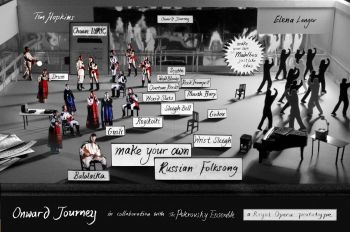 Research Context
My questions arise from a number of contexts: my own experience of using media technologies within lyric theatre; developments in related fields; and wider social reflection on technological transformation. They also relate to issues arising from my 2002-4 Nesta Fellowship award for artistic development.
Opera is arguably the most virtuosic form of theatrical collaboration, working at the limits of the media of theatre. My approach as a director/designer/deviser is based on an audience's capacity to absorb information in real time and space. This involves a notion of 'lyric space,' conceived as a point of tension between abstraction and concreteness, a mobile beacon by which an audience navigates itself through the different modes in play: space against sound, presence against absence, completeness against suspense, in light, colour, movement, music, singing, etc. The choices made across these media constitute the voice of the production. Any technological intervention in opera has to negotiate with this existing 'intermedial' activity, whether the result is theatre-based work or the export of opera material to a different environment.
My use of intermedial mise-en-scene began with a production of Judith Weir's opera Blond Eckbert, (English National Opera, 1994) integrating live performance with 35mm film, shadow-play and diorama. This layering of media was a metaphor for underlying crisis in the narrative. In The Forest Murmurs (Opera North, 2001,) I turned to creating original work using intermediality itself as a thematic metaphor, in a work using singers, chorus, orchestra, original and archive film and sound, describing the evolution of the Romantic imagination. This became the subject of academic debate, (F. Chapple, "Digital Opera: intermediality, remediation and education" in Intermediality in Theatre and Performance, Manchester 2002) which introduced me to the potential of theoretical research contexts for my artistic concerns. Other important theoretical contexts for my work include Bolter and Grusin's concept of "remediation" in Remediation: Understanding New Media (MIT, 2000), and Manovich's The Language of New Media (MIT, 2002), both of which place new medial relations within historical understandings of mediality.
Both of the theatre works described relied on moving image technologies delivering events at fixed rates over time, in tension with the flexible temporality of live performance. Other works in this mode include Reich/Korot's Three Tales (2002) and Viola/Sellars' Tristan und Isolde (Paris, 2005.) However, recent audio-visual translation devices, and web-based communication, break though these frameworks. This is a vast practice and research area, including artists with whom I have worked/consulted such as Tom Betts (whose Pixelmap translates sound into projected imagery in real-time), and Derek Richards (using digital media for telematic performance between remote sites.) Elephant and Castle (Aldeburgh Festival/LAP 2007) is a collaboration between myself, DJ Mira Calix, composer Tansy Davies and architect Pippa Nissen, using audiovisual technology to connect audiences at the Aldeburgh Festival and a Shopping Centre in London, to explore contrasting space.
Current projects (Channel 4 Mozart Lovers, broadcast/webcast; Royal Opera Owen Wingrave), have confirmed the importance placed by cultural institutions on the medial potential now offered by new technologies. But they can only undertake research into this sparingly. As well as an opportunity to engage with academic and artistic research contexts, the Fellowship will offer a sustained opportunity to address this professional context. It will demand fundamental development across the range of disciplines that comprise my practice: research, authorship, direction, design, film and moving image, and performance.
Research Methods
To answer my research questions I need to engage particular types of digital media in contexts that illuminate a range of intermedial and dramaturgical potentials. My research methods involve a progress from studio investigation, through the exploration of ideas in practical workshops with performers and relevant technological equipment, to fully realised projects.
Initial studio-based research will employ digital tools, building on previous experience with sound/image translation devices MaxMsp/Jitter and Isadora, to create intermedial relationships between recordings or my own performance of work by Stravinsky, Mozart and Sullivan, and visual material e.g. archive stills, animated diagramming of the sound world, and video capture of performance. The diverse choice of composers allows me to frame a range of inter-related research issues in different creative contexts. The work of these artists has been a recurring presence in my artistic development, with its dynamic between traditional practice and innovation.
From this initial research three new lyric theatre pieces, based on particular works by the composers, will be developed, each addressing one of the research questions and inter-related issues. Since audience relation to the work is a crucial aspect of the research, the works will be shown publicly.
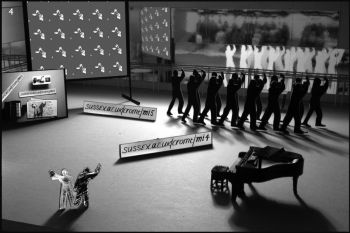 Project 1. Les Noces
Stravinsky's Le Noces (1923) conveys an ambivalent perception of technological transformation. It depicts how a peasant wedding ritual mediates individual desires in favour of a group, through strategies that subvert traditional intermedial lyric theatre relations: text sung by a chorus from the orchestra pit, ballet stressing gravity not weightlessness, orchestration conceived for 4 onstage pianolas.
This project takes Stravinsky's deconstruction of hierarchical relations as a thematic starting point for the evolution of a series of 10 minute 'chapters', linked to form a performance work. These chapters would investigate different intermedial models, reconfiguring hierarchical relationships between constituents of lyric theatre: dancer, singer, pianist, conductor, scenic artist. Different strategies would be explored: each chapter might retell the same narrative, or exchange roles between performers - a dancer conducting from the pit, a pianist enacting ritual movement. This would be extended through technological intervention: translation devices producing image from sound, intermedial relationships between new media devices and devices they appear to replace.
This project sees Stravinsky's work as he saw the peasant wedding, as a ritualised artistic object that has become 'historic'; as material that can be reconfigured through technological transformation.
The outcome could be presented as a complete work, or as complement to Stravinsky's ballet, and assumes a traditional concert hall or theatre, as familiar contexts subjected to disruption.
Project 2. Opera on the small screen
To address question 2 I propose to import historic operatic material into a non-theatrical technological environment. The intention is to create a context to explore how qualities of operatic singing and performance physicality can translate into a non-theatrical space, such as a gallery piece, web-site object, or broadcast TV. It moves away from two existing models: the reportage-style relay of live stage performance, and expensive narrative fiction film. It proposes instead that opera experienced on screen should create a visible boundary of possibility against which the presence and virtuosity of the performer can register for the viewer.
Through rehearsal, 4 singers will be trained to combine two activities simultaneously: the dance technique Contact Improvisation (stressing physical communication and spatial eloquence) and basic camcorder operation. The aim is to produce a single image comprised of four images from the singers' cameras, each obliged to deliver their story, driven by their interpretation of the musico-dramatic text, presented together in real time. This process is intended to generate a series of real-time events in a single space towards a small screen outcome that would be a function of performance, not a report of one. Further development could offer viewers choices between different interpretations, to reform the lyric relationships themselves.
Provisionally, the musical material would be the quartet from Mozart's opera Die Entführung aus dem Serail. This has been chosen as a starting point, because a) its content relates to the task, as it depicts quarrelling emotional perspectives b) it comes from a work in the mixed theatrical mode of Singspiel, c) its has a formal status as the longest single ensemble in Mozart's oeuvre.
Project 3. The Lost Chord
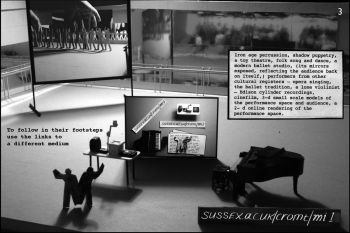 To address question 3, I aim to develop a performance event that disrupts the conventional time-space constituents of lyric theatre through technology. This would decontextualise proscenium spectacle and divert its elements into other modes, e.g. an immersive, installation-type experience. It would introduce real-time web-technology elements and physical computing (motion sensors configured to drive sound or video,) to extend time-space relations and intermedial activity.
The starting point would be experimental remediations of Sullivan's The Lost Chord. Sullivan has been chosen because, although he has come to represent an idea of obsolete creativity, his song The Lost Chord is a powerful image of transcendental intermedial connection that became popular through Edison recordings. His fascination with new electromechanical communication media, e.g. the telephone, evokes an ambivalence in Victorian responses to technological transformation, resonating with my central enquiry.
At this point, I envisage an arts centre infrastructure, where different presentation paradigms exist under one roof. Audiovisual links would exchange status between spaces: exhibition areas hosting performance; exterior spaces assuming artistic consequence. Core operatic constituents could be reassigned: eg the role of conductor dispersed among different media drivers (such as performer motion;) embedding an operatic chorus in an audience; accessing remote performance via web technology.
These suspensions of function aim to place the audience in an ambivalent relation to time and space. I want to explore this thematically, exploring the potential of remediation for reframing historic material, creating new lyric theatre work that can infer / reveal lost content, and enliven or question our sense of the past and present.
Give Me Your Blessing for I go to a Foreign Land: A multimedia adventure about love in era of technological change.
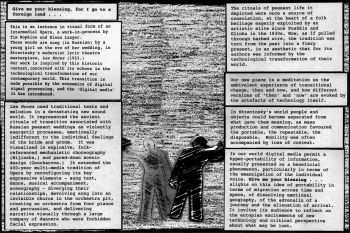 CROMT Research Fellow Tim Hopkins works with Russian-born composer Elena Langer and members of the Moscow based Prokrovsky Ensemble on a piece inspired by Stravinsky's 1923 ballet-cantata Les Noces (from which the title is taken).
The work combines live music for piano, voices, violin and folk percussion, dance for folk and ballet performers, moving image, historical technologies, and online virtual space. The score incorporates fragments of music by Wagner, Lyadov, Rimsky-Korsakov, and Stravinsky himself.
Two public performances of a workshop version of the piece took place at the Clore Studio, Royal Opera House, in February 2009.
2006
- Battersea Arts Centre "BURST"
Battersea Arts Centre "BURST"
In association with Post-Operative Productions, CROMT curated a programme of new works-in-progress in the 2006 "Burst" season for experimental music theatre at the Battersea Arts Centre in London. The programme included works in development by composers Paul Barker and Andrew Lovett, and extracts from the CROMT New Media Pocket Opera project.
- Clore Research Fellow (2006-08)
Clore Research Fellow (2006-2008)
Opera director John Fulljames was Clore Leadership Programme Research Fellow at CROMT for two years from January 2006. John undertook research into the use of the chorus in 21st-century opera.
- Dramaturgie Musicale Contemporaine en Europe Project
DMCE Project
The DMCE (Dramaturgie Musicale Contemporaine en Europe) was an EU initiative co-ordinated by the University of Paris 8 to establish a comprehensive on-line database for works of music-based theatre produced in Europe during the 20th and 21st centuries. The Centre has acted as UK co-ordinator for the project. We also participated in the series of four annual symposia on contemporary music theatre in Europe organised by DMCE in Paris between 2005-9. The contents of each of the symposia have been published in four separate books
- New Media Pocket Opera
New Media Pocket Opera
The project was a practice-based exploration of new interactive audio-visual technologies for opera and music-theatre, investigating the dramaturgical implications of combining the real and virtual within music-based theatre. The project employed live performance, voice-synthesizing programmes and projected sound and images to examine the phenomenon of the technological uncanny, investigating cultural anxieties about mechanisation in modernity, and in particular cultural representations of the mechanically disembodied voice from the nineteenth century to the present. The project was part of a collaboration between the Centre for Research in Opera and Music Theatre, Forum Neues Musiktheater of Stuttgart Opera, The Steim Centre in Amsterdam and Tempo Reale Studio in Florence, with each centre contributing a new piece of work made to the same brief but employing different technologies or programs.
- Project Director: Nick Till
- Sound: Ed Hughes/Tom Hall
- Visuals: Kandis Cook
- Performer: Frances M. Lynch
- Audio-Visual Processing: Alice Eldridge
The project was funded by the Arts and Humanities Research Council
Forum Neues Musiktheater Project Brief
All four commissioned compositions and their stagings are subject to the same conditions for the instruments and performers employed and the working materials. The challenge of a deliberately small cast with at most three singers, instrumentalists, dancers or actors is joined with a conscious limitation of technological means (two laptops, eight-channel sound system, one camera, two video projectors) which is intended to encourage and focus reflection on the essential conditions of narrative forms in musical theater and how they are communicated by means of technology. The possibilities of performance in non-conventional or not established theatrical settings should also be considered.
Each institute develops its project independently. The developmental process is, however, accompanied by an exchange of technological know-how and of the tools developed by the institutes, in particular a library of interactive audio-visual Max MSP and Jitter programmes developed by the FNMT, as well as through joint meetings of the producers to discuss aesthetic and dramaturgical questions.
The Project Content
The project sought to investigate the effect of the "technological uncanny" that arises with use of interactive technologies in live performance.
The technological uncanny arises through the blurring of nature/culture distinctions, both at the phenomenal level (the electronic that sounds human, or vice versa; the anthropomorphism of machines) and the conceptual level (do we hear technologically produced sounds/images as phenomena of nature or culture; "mediated" or "immediate" ?). Cultural representations of the technological uncanny include the image of the "double" and the idea of the "ghost in the machine" - the notion that the machine itself might have a life of its own. This latter phenomenon is increased by the use of live interactive technologies when it becomes difficult for the audience or viewer to be sure of who is in control of the performance.
The project is based upon a found text, a page of musical notation described as "Transcription of the phonogram of a schizophrenic, 1899".
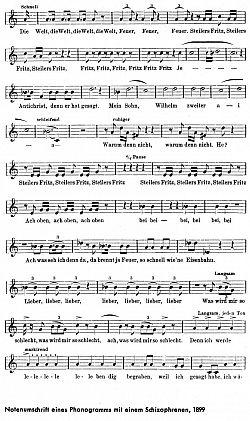
Translation of text
The world, the world, the world, the world, Fire, Fire.
Steilers Fritz, Steilers Fritz, Steilers Fritz Fritz, Fritz, Fritz, Fritz, Fritz, je
Antichrist, for he has said so.
My son, Wilhelm II, aia.
Why not then, why not then, hey?
Steilers Fritz, Steilers Fritz, Steilers Fritz.
Steilers Fritz, Steilers Fritz, Steilers Fritz
Ah, above, ah above, ah above
Near, near - near, near, near, near
Ah, what do I see there, fire burns there, yes, as fast as a train
Rather, rather, rather, rather, rather, rather, rather
Why do I feel so bad, why do I feel so bad, why do I feel so bad?
For I will be buried alive, because I have said, I would...
This page of music is published in Friedrich Kittler's book Grammophon, Film, Typwriter (1986), a book about the way in which new technologies change our relationship to the world.
The mysterious page of music was valuable as a starting point for our project:
It provides a "score" that obviates the need for construction of a narrative and character-based libretto, which is usually required to enable the expressive word-and-drama setting of conventional opera, whose musico-dramatic redundancy we want to avoid. In addition, we are interested in exploring forms of vocality that challenge the familiar assumptions of subjectivity, interiority and transcendence usual in western musical drama.It connects to the project's main issues of technology and mediation.It connects the uncanny effect of technologically reproduced voices to the familiar condition of "hearing voices" of schizophrenia.
The content of the speech is familiar from the literature and iconography of schizophrenia: extreme paranoid anxiety (the fear of being buried alive - which is also a familiar trope of gothic literature); hallucinatory voices; reference to apocalyptic religious themes (the Antichrist); belief in relationship to royalty (reference to Kaiser Wilhelm II).
There is little personal to be learned from the text about the man or woman whose speech is documented. We have been unable to find a source for the page of music, or indeed any reference to the practice of using phonographs to record the speech of schizophrenic patients. So we start with a puzzle. Indeed, the project involves a series of puzzles.
The first diagnosis of what we now recognise as schizophrenia was made in the 1890s by the German psychiatrist Emil Kraepelin, and published in a series of books after 1896.
Kraepelin's main concern was to establish secure grounds for diagnosis of the disease (rather than seeking cures). To this end he listed the symptoms exhaustively, from physical and gestural traits to behavioural and mental symptoms such as speech disturbance. In his book entitled Dementia Praecox & Paraphrenia Kraepelin devotes 10 pages to abnormal speech traits under headings such as: "Derailments in Linguistic Expression", "Derailments in Finding Words". His books are full of tables, graphs and diagrams that "measure" the physical symptoms of schizophrenic patients, and illustrations of the mechanical devices that were employed to secure these measurements.
Kraepelin's extensive catalogues of symptoms are characteristic of the general tendency in medicine towards scientific analysis of human of abnormality at the end of the 19th century. The Italian historian Carlo Ginzburg notes that the late 19th century art historian Morelli, Sherlock Holmes and Freud all use similar methods of analysing insignificant clues to reveal concealed meanings; Morelli, Freud and Conan Doyle were all trained as doctors.
Technology had an important role in such analysis. Photography enabled visual analysis of movement, and was used, for instance, by speech therapists to analyse the positions of the mouth in speech. The French psychiatrist Charcot used photography to document different kinds of psychic disorder, and the English scientist Francis Galton based his attempts to establish the physiognomy and genetic characteristics of criminal behaviour on analysis of photographs of criminals.
The use of a phonograph to record the speech of a schizophrenic patient is therefore very much in accord with such practices. What is less clear is how someone might have come to think of using musical notation as part of the analysis. However, we can observe that there was a movement at the end of the 19th century towards what was described as "realism" in the setting of language to music - an attempt to set words in a way that was closer to the pace, rhythm, pitch and intonation of natural speech. The composer best known for this was Leo Janáèek, who notated the everyday speech that he overheard in his notebooks, often offering an analysis of the presumed emotional state of the speaker from what was recorded. Janáèek even dispassionately notated the words of his dying daughter. The complimentary method of Sprechgesang, first developed in the 1890s by the composer Engelbert Humperdinck, and employed by Schoenberg in Pierrot Lunaire, relates the text to the soundworld of expressionism, which itself evolved to convey extreme psychic states.
So what we may suggest in relation to our fragment is that both art and science are being employed to effect an objective analysis of the condition a mental patient. The psychiatrists who made this document are less interested in who the patient is, or in trying to decipher the meaning of his or her speech, than in the method of analysis.
Our piece is not about madness (although acknowledging the long history of the representation of madness in opera - in particular female madness). It is about the depersonalisation of an individual through the technologisation of his or her illness.
Musical and Dramatic Form
The form of the piece is constructed around a series of investigations of the musical "score". We present a performer trying to make sense of this fragment of text. In doing so she uploads her interrogations and interpretations into the modern machine of reproduction, in the same way that the schizophrenic patient of 1899 was required to record her speech into a phonograph. The text offers a number of possibilities: a lost song from Pierrot Lunaire; confused memories of a song by Schumann; a representation of the voices in a schizophrenic patient's head....
As the singer uploads her voice into the machine the machine itself responds. It has its own life. And it also seems to contain fragments and memories of the original patient. As the piece progresses the voice and physical being of the performer are increasingly absorbed into the machine, until she is completely technologised.
All of the sound and musical material in the piece derives from the fragment of score, from the voice of the performer, and from a few key elements which are invoked from the memory bank of the machine (e.g the sound of a piano).
On the limitations set by the Pocket Opera project
Technologies of sound and video have been used in the theatre for almost 100 years. For Stanislavski sound was an essential aspect of realist scenography. For Piscator and Brecht visual technologies challenged representational realism and introduced extra-theatrical documentary material into the theatrical event.
In general, artists employing sound and video technologies in the theatre have employed technology as an expansion of the sonic and scenic canvas, rather than an independent dramaturgical element. One of the aims of our project is to consider how complexities of time-space and presence-absence relations brought about by the introduction of the virtual technologies into the theatre space impact upon the fictions of liveness and music-dramatic continuity that underpin the dramaturgy of most music theatre. The real and virtual occupy different ontological spaces, and the juxtaposition of these different ontological spaces of representation demands, we believe, more careful attention. In particular, when audio-visual media are employed in ways that draw attention to the gap between presence and repetition/reproduction they deconstruct the underlying metaphysical fiction that the sound accompaniment to the live voice in conventional operatic forms is "noumenal" (ie, unheard to the character) rather than "phenomenal".
For this reason the challenge of the New Media Pocket Opera project to work with restricted means does not provide a limitation. Instead it offers opportunities for more careful investigation of the dramaturgy of presence and absence in works that employ new technologies of sound and vision.
2005
- Glyndebourne Opera Composer-in-Residence
Glyndebourne Opera Composer-in-Residence
Supervisors
- Sussex: Dr Nicholas Till; Prof. Martin Butler
- Glyndebourne: Katie Tearle (Head of Education and Community Projects); Vladimir Jurowski (Music Director)
Glyndebourne OperaFounded in 1934, Glyndebourne Opera is one of the UK's foremost international opera companies, with a reputation for detailed musical and dramatic preparation, high production standards, and top-class performance. Glyndebourne presents two seasons of works from the main opera repertory annually: Glyndebourne Festival Opera in the summer, and Glyndebourne on Tour in the autumn. In addition to artistic activities ancillary to the main programme, Glyndebourne also has an extensive development, education and community programme, running professional development events and educational activities from talks, study-days and workshops related to the main repertory, to work in schools and prisons, a youth opera group and specially commissioned new works for young people. Glyndebourne is particularly noted for its commitment to the development of young artists.
The project
Aims and Objectives
The project aimed to investigate different approaches to the creation of new opera and music theatre through contemporary engagement with the historical forms of opera as an aspect of the broader artistic and audience development activities of a professional opera company. In particular, the project asked how specific forms, media, techniques and skills derived from the traditional genre of opera might be re-energised through engagement with different cultural forms and contexts, and with new technologies and media.
Intellectual Issues
The project asked how a mainstream opera company, concerned primarily with presenting works from the historical repertory, can engage with the diversity of artistic forms through which people relate to the modern world in contemporary culture. In many of these forms music is brought into dynamic relationships with drama, visual media, site, spatial installation, and new sound technologies in ways that extend the multi-medial possibilities of opera (itself the quintessential multi-media art form). During the 19th century and the early part of the 20th century it was customary for composers to learn their craft as opera composers within the context of working opera companies. However, the almost exclusive emphasis upon historical repertory in modern opera companies, and increased division of labour between composition and performance, means that it is now not customary for opera companies to support composers as part of their artistic team. As a result, there are very few opportunities for composers to develop skills specific to working in opera and related forms of music theatre within the context of a working opera company, creating a wide gap between academic/theoretical and practical experience. In addition, opera companies have very limited opportunities for investigating the possibilities of new musical and theatrical forms. Glyndebourne Opera used to commission new operas from major composers such as Michael Tippett and Harrison Birtwistle on a regular basis, but in the current climate the company is now only able to commission new works approximately every five years. This situation leads to a vicious circle in which lack of opportunity for audiences to experience new works leads inevitably to further declining audience interest in new work. This project seeks to explore new methods for sustaining a culture of innovation and experiment alongside the main repertory.
Glyndebourne Opera has a well-established and highly regarded education programme that is involved in all aspects of audience development. This project explored how a composer might work from within an opera company to make contact with a wide range of different constituencies through such an education programme, finding appropriate methods of enabling these constituencies to engage creatively with the established works presented as part of the main repertory, and exploring new forms of opera-based work that engage with the social and cultural interests of specific communities. An example of the former is Glyndebourne's School 4 Lovers - a Hip H'Opera, a hip-hop adaptation of Mozart's Così fan tutte; an example of the latter is Glyndebourne's three-year residency in Thanet working with local people to create and perform their own music theatre productions in local venues. Central to the proposed composer-in-residence project is sustained further exploration of these approaches, investigating how existing forms may be re-imagined musically and/or theatrically (or indeed, through other media altogether) to create bridges between historical and contemporary art forms.
Some of this research was facilitated through the Jerwood Chorus Development scheme, established at Glyndebourne in 2005. This scheme aims to develop the professional skills of chorus members by providing a range of practical workshops and performing opportunities. Aspects of the programme include gaining experience of contributing to the process of the development of new work in opera and music theatre, and experience in undertaking education projects. The Glyndebourne composer-in-residence will work with members of the chorus and music staff as part of his/her programme of activities to investigate the possibility of developing and bringing such skills into a productive relationship, supported by the professional and academic supervisory teams. [Since 2010, the focus of this development programme has been on nurturing four or five exceptionally talented singers from the Glyndebourne Chorus selected each year as Jerwood Young Artists]
Julian Philips’ opera The Yellow Sofa, written as part of his doctoral project as composer-in-residence at Glyndebourne, was presented at Glyndebourne in August 2009.
Proposed research projects
- The Voice of Modernity
The Voice in Modernity
Aims
The project aims to understand the social and cultural meanings of the human voice in modernity, with particular reference to the implications of such understanding for the use of the voice in contemporary arts, especially opera, music theatre and other forms of performance and digital arts foregrounding voice.
The premise of the project is that perceptions and representations of the voice undergo radical changes in modernity, as the experience of subjectivity and inter-subjectivity changes, and as technologies such as the phonograph or telephone alter people's relationship to their own and other voices. The hitherto intimate connection between the voice and subjectivity is radically dissevered, and disembodied voices assume their own autonomy.
The debate around the position of the voice in modernity first arises in discussions of the transition from oral to literary (and hence visual) cultures in early modernity, as charted by cultural historians such Spengler, Marshall McLuhan, Walter Ong and Michel de Certeau. In the case of each writer it is perhaps unclear whether the claim is being made that the 'scopic regimes' of modernity have indeed suppressed oral culture, or whether they have simply caused us to overlook the role of orality in culture. Both McLuhan and Ong identify a 'secondary orality' arising from communication technologies such as radio and telephone, although the implications of such a culture are not always clear. In philosophy various strands of phenomenology (and post-phenomenology) have re-imagined the relationship of voice to body and of voice to philosophical metaphysics, in particular in Derrida's identification of the metaphysics underpinning the phonocentrism of Plato, Rouseau, Hegel and Husserl. Lacanian psychoanalysis has identified the voice, along with the gaze, as one of the primary constituents of subjectivity.
Many artists and musicians in the twentieth century have revaluated the musical, performative and tele-phonic voice, and encounters with non-western vocal practices have also revealed different potentialities of the voice. But as composer Trevor Wishart writes of his Vox project of 1983-1988 'the voice is not just another "musical instrument" [It is] The meeting point of animal expressivity (laughing, screaming, crying), personality (and more basic indicators of age, health, status, and so on) and intent (the language-games of love and power), language (and therefore poetry and drama as well as the phoneme stream itself) and song.' The creative component of the project will engage with these and other aspects of the voice in modernity, and will question accepted paradigms of the lyric voice that derive from nineteenth-century vocal techniques, and the metaphysics of subjectivity, interiority and transcendence (themselves oddly contradictory) that are associated with these.
This project will examine the cultural and social forms of the voice in modernity, and will consider the implications of changing cultural and aesthetic understandings of the voice for voice-based music, art and performance in the 21 st century.
Project outcomes will include creative practice (live or digital performance), conferences, and a range of publications.
Contexts
The voice foregrounded in literature and film: Orpheus legend; Rabelais; Cervantes; E.T.A Hoffmann; Poe; Hans Christian Anderson; Villiers de l'Isle Adam; Alfred Jarry; George du Maurier (Svengali); Willa Cather; Cocteau (La voix humaine); Lady in the Dark; Singin in the Rain; The Conversation; Riddles of the Sphinx (Mulvey/Wollen); Passion (Godard)
Artistic Engagements : Schwitters; Artaud; Burroughs; Henri Chopin and performance poetry; Charles Amirkhanian; Roy Hart Theatre; Scanner; Carl von Hausswolf; Societas Raffaello Sanzio (Giulio Cesare, Voyage au bout de la Nuit).
Experimental Voices in Music: Luciano Berio; Cathy Berberian; Milton Babbitt; Peter Maxwell Davies; Trevor Wishart; Meredith Monk; Diamanda Galas; Joan la Barbara; Pamela Z, Phil Minton.
Opera and Music Theatre: muted voices (Debussy); anti-lyric voices (Schoenberg and Sprechtgesang; Aperghis, Sciarrino); dispersed voices (Stravinsky; Berio); reproduced voices (Kagel to Laurie Anderson).
The Voice in Modernity: Suggested Research Topics
- Physiologies of the voice
- Traces, theories and representations of the voice in pre-modernity
- Voices and vocality in non-western cultures
- The voice and subjectivity: psychoanalytical approaches from Charcot and Freud ("the talking cure") to Wolfsohn and Lacan
- Voice and power
- Metaphors of voice ("the composer's voice"... "le corps parlant")
- Amplified Voices
- Reproduced Voices
- The Erotics of the Voice
- Gendered voices
- Collective voices
- Suppressed, silenced and disciplined voices
Theoretical Frameworks
Carolyn Abbate, Unsung Voices: Opera and Musical Narrative in the Nineteenth Century (Princetion: Princeton University Press, 1991)
Theodor Adorno, 'The Curves of the Needle', in Richard Leppert (ed), Essays on Music (Berkeley, Los Angeles, London: UC Press, 2002)
Giorgio Agamben, Language and Death: The Place of Negativity (Minneapolis: Minnesota University Press, 1991)
I. Anhalt, Alternative Voices: Essay on contemporary vocal and choral composition, (Toronto: University of Toronto Press, 1984)
David Applebaum, Voice (Albany: State University of New York, 1990)
Roland Barthes, 'The Grain of the Voice', 'Lesson in Writing', in Image, Music, Text, trans Stephen Heath (London: Fontana, 1977)
- The Pleasure of the Text (New York: Hill and Wang), 1975
Marie-France Castarède, La voix et les sortileges (Paris: Les Belles Lettres, 1987)
Michel de Certeau, The Practice of Everyday Life (Berkeley, Los Angeles, London: University of California Press, 1984)
- "Utopies vocales: glossolalies" Traverses 20, 1980, 16-37
Michel Chion, La voix au cinéma (Paris: Cahiers du Cinéma/ Editions de l'Etoile, 1982)
Henri Chopin, Poésie sonore internationale (Paris, Jean-Michel Place, 1979)
Steven Connor, Dumbstruck: A Cultural History of Ventriloquism (Oxford: OUP 2000)
- 'Echo's Bones: Myth, Modernity and the Vocalic Uncanny', in Michael Bell and Peter Poellner (eds), Myth and Making of Modernity: The Problem of Grounding in Early Twentieth Century Literature (Amsterdam: Atlantia Georgia: Rodopi, 1998)
- 'Violence, Ventriloquism and the Vocalic Body', in Patrick Campbell and Adrian Kear (eds) Psychoanalysis and Performance (London and New York: Routledge, 2001)
- "The Decomposing Voice of Postmodern Music" New Literary History, Vol. 32, No.3, Summer 2001
Jacques Derrida, Speech and Phenomena (Evanston, Ill: Northwestern University Press, 1973)
- Of Grammatology (Baltimore: Johns Hopkins University Press, 1976)
- 'La parole soufflée', in Writing and Difference (London: Routledge, 1978)
Mary Ann Doane, 'The Voice in Cinema: The Articulation of Body and Space', Yale French Studies, 60 (1980), 47-56
Leslie C.Dunn and Nancy A. Jones, Embodied Voices: Representing female vocality in western culture (Cambridge: Cambridge University Press, 1994)
M. Duncan, 'The operatic scandal of the singing voice: Voice, presence, performativity', Cambridge Opera Journal, vol.16, issue 3 (2004)
Evan Eisenberg, The Recording Angel: Explorations in Phonography (New York: McGaw Hill, 1987)
Barbara Engh, 'Adorno and the Sirens: Tele-phono-graphic bodies' in Dunn and Jones
Ivan Fonogy, La vive voix: Essais du psychophenétique (Paris: Payot, 1983)
Felicia Miller Frank, The Mechanical Song: Women, Voice and the Artificial in Nineteenth-Century French Literature (Stanford: Stanford University Press, 1995)
David Gradol and Joan Swann, Gender Voices (Oxford: Blackwell, 1989)
Don Ihde, Listening and Voice: A Phenomenology of Sound (Athens: Ohio University Press, 1976)
Claire Kahane, Passions of the Voice: Hysteria, Narrative and the Figure of the Speaking Woman 1850-1915 (Baltimore & London: Johns Hopkins, 1995)
Douglas Kahn and Gregory Whitehead (eds), Wireless Imagination: Sound, Radio and the Avant-Garde (Cambridge Mass: MIT Press, 1994)
Cheris Kramarae (ed), Technology and Women's Voices: Keeping in Touch (New York & London: Routledge, 1988)
Friedrich Kittler, Gramophone, Film, Typewriter (Stanford: Stanford University Press, 1999)
Julia Kristeva, Desire in Language: A Semiotic Approach to Literature, ed. Leon S. Roudiez (New York: Columbia University Pess, 1980)
Donald M. Lowe, History of Bourgeois Perception (Brighton: Harvester, 1982)
Jacqueline Martin, The Voice in Modern Theatre (London: Routledge, 1991)
Marshall McLuhan, The Gutenberg Galaxy: The Making of Typographic Man (London: Routledge, 1962)
Walter Ong, The Presence of the Word (New Haven & London: Yale, 1967)
- Rhetoric, Romance and Technology (Ithaca: Cornell, 1971)
- Orality and Literacy: The Technologising of the Word ( London: Methuen, 1982)
Michel Poizat, The Angel's Cry: Beyond the Pleasure Principle in Opera (Ithaca: Cornell University Press, 1992)
- La voix du diable (Paris: Métaillé, 1991)
John Potter, Vocal Authority: Singing Style and Ideology (Cambridge: CUP, 1998)
Jonathan Ree, I See a Voice: A Philosophical History, (London: Harper, 1999)
Guy Rosolato, 'La Voix: entre corps et langage', Revue francais de psychoanalyse, 38, 1 (1974)
Philippe-Joseph Salazar, Le culte de la voix au XVIIe siecle: formes esthetiques de la parole a l'age de l'imprime (Paris: Champion, 1995)
Renata Salecl and Slavoj Zizek, Gaze and Voice as Love Objects (Durham and London: Duke University Press, 1996)
David Schwarz, Listening Subjects: Music, Psychoanalysis, Culture (Durham and London: Duke University Press, 1997)
Kaja Silverman, The Acoustic Mirror: The Female Voice in Psychoanalysis and Cinema (Indiana University Press, 1988)
Gary Tomlinson, Metaphysical Song: An Essay on Opera ( Princeton: Princeton University Press, 1999)
Allan S Weiss, Breathless: Sound Recording, Disembodiment, and the Transformation of Lyrical Nostalgia (Bloomington: Indiana, University Press, 1988)
Trevor Wishart, 'The Composer's View: Extended Vocal Technique', The Musical Times, vol.cxxi, no.1647, May 1980
- Sussex Bach Wedding
Sussex Bach Wedding
Bach's Cantata no.210 was written to be performed at a wedding. A solo soprano addresses the wedding couple and their guests in a sequence of five recitatives and arias in which she both celebrates and questions the role of music at such an occasion: music lifts the spirits, but in rousing earthly passions it leads away from the inner solemnity of the couple's sacred vows; music consoles, but its consolation is an inappropriate reminder of death. So music must lead us back to the joy of the occasion, effacing itself to serve its patron's pleasure. Bach's exquisite music alternates fast and slow, baroque formality with baroque eroticism.
The text (to be sung in a new English translation) establishes a complex dramatic interplay between the singer and the circumstances in which she finds herself, exploring the relationship of art and life and asking us to consider whether art redeems the banality of everyday life or reflects its unnoticed beauty.
The artistic aim of the project is to reconstruct dramatically a real context for the cantata, placing it amidst the preparations and celebrations for a very ordinary modern-day wedding party. Working to a script developed with a playwright, a cast of actors and non-actors will recreate the typical circumstances and incidents of such an occasion, playing the roles of bride and groom, families, children, guests, etc. The audience will also be present as "guests" at the wedding party. Beyond the commonplace banality of such occasions we will be reminded by the beauty of Bach's music of the touching expression of faith and hope, however fragile, that is always celebrated in such events.
The project was proposed as a collaboration between The Centre for Research in Opera and Music Theatre and one of the world's foremost period instrument ensembles the Hanover Band, which is based in Brighton.
The project is part of series investigating the use of dramatic performance for the recontextualisation of non-theatrical music written for specific social occasions or contexts.
- The Kreutzer Sonata
The Kreutzer Sonata
Tolstoy's story is a coda to the analysis of marriage and adultery that he explored in Anna Karenina. It is also representative of his later moral and aesthetic values, in which he became preoccupied with sexual and artistic indulgence. But the specific thematising of music and sexuality in the story is indicative of some much broader concerns about music and sexuality in western culture, and offers grounds for more extensive enquiry.
There is evidence that the novella was originally intended as part of a performance event. In her biography of her father Alexandra Tolstoy describes how the idea for The Kreutzer Sonata arose after a powerful performance of the Beethoven sonata in Tolstoy's home in Moscow, at which the painter Ilya Repin and the actor V. Andreyev-Burlak were also present: 'They spoke of how fine it would be if Tolstoy wrote a story on the theme of the Kreutzer Sonata, and Repin illustrated it and Andreyev-Burlak acted it'. Alexandra Tolstoy's account is ambiguous as to what precisely was proposed, but the reference to Andreyev-Burlak 'acting' the story implies a dramatic presentation that would surely have included a performance of the Beethoven violin sonata. Another account of the proposed event by Tolstoy's biographer Ernest Simmons mentions Andreyev-Burlak reading the story 'in the presence of a canvas of Repin inspired by the music'. Tolstoy wrote his story, but the planned performance never took place because Andreyev-Burlak died shortly afterwards.
In Tolstoy's story the Beethoven sonata can only be described verbally. This project attempts a modern interpretation of the original idea for a 'multi-media' presentation of The Kreutzer Sonata, placing a performance of Beethoven's sonata within a dramatised reading of Tolstoy's story, with accompanying visual material, so that story, visuals and music illuminate each other directly. The object is not to create a historical reconstruction of the originally proposed event, nor a simple dramatisation of the story, but a contemporary re-reading, bringing to bear upon the literary and musical texts in question the understanding of contemporary historical, cultural and critical approaches.
The project aims are:
To reconstruct the original plan for a performative version of The Kreutzer Sonata, with accompanying music and visuals, from a contemporary perspective.
To create a discursive context for both Beethoven's violin sonata and Tolstoy's story that reads these works across and against each other, and across and against wider understandings of the cultural meanings of Beethoven's music and Tolstoy's story.To gain better understanding of the likely form of the original proposal in the context of domestic theatrical events in the nineteenth-century.
Research Questions
- How might a performative reading of The Kreutzer Sonata illuminate the themes of Tolstoy's narrative?
- How might a performance of Beethoven's Kreutzer Violin Sonata in the context of Tolstoy's story illuminate the cultural meanings of Beethoven's work?
- Why did Tolstoy choose Beethoven's Kreutzer Sonata as the fulcrum of his story: what were its meanings in the nineteenth-century, and what did it mean to Tolstoy?
- What is the relationship between Tolstoy's moral, sexual and aesthetic theories and the broader moral, sexual and aesthetic attitudes of nineteenth-century western culture, in particular in relation to music?
Research Contexts
Tolstoy's late works, informed by his puritan morality and aesthetics, puts in fictional form the animus against the music of Beethoven and Wagner that is also outlined in his book on aesthetic theory entitled What is Art? (1896). The immediate research context is therefore Tolstoy's own fiction, and his moral and aesthetic theories, for which Rimvydas Ŝilbajoris Tolstoy's Aesthetics and His Art (1990) provides an invaluable starting point.
In Adultery in the Novel (1979), Tony Tanner suggested that for Tolstoy the transference of subjectivity that takes place in musical performance effects a transgression of conventional social relations that is comparable to that of adultery. The most interesting recent analyses of The Kreutzer Sonata have been undertaken by interdisciplanary cultural historians who have focussed on this nexus of music and sexuality in the story. Richard Leppert (The Sight of Sound: Representations and the History of the Body, 1993) notes the homoerotic nature of the story, in which the violinist is depicted as a man with a woman's or "hottentot"'s posterior, in what is therefore also a clear gendering and racialising of music as 'Other'. In a more extended analysis, Lawrence Kramer takes the story as one of four key nineteenth-century texts on music and sexuality, offering a reading of both Beethoven's sonata and Tolstoy's story in the light of nineteenth-century attitudes to gender and sexuality (After the Lovedeath: Sexual Violence and the Making of Culture, 1997).
Tolstoy finds the first movement of Beethoven's sonata to be troublingly powerful, and its transgression of the normal manners of the classical violin sonata is noted by Charles Rosen in The Classical Style (1970). Kramer suggests that for Tolstoy, Beethoven himself is the culprit, the 'murderer' in the story, a premonition of feminist musicologist Susan McClary's more notorious characterisation of Beethoven as a 'rapist' (Feminine Endings, 1992). The research will consider the reception of Beethoven's music, and in particular the Kreutzer Sonata, during the course of the nineteenth-century, drawing on key texts in the history Beethoven reception such as Alessandra Comini's The Changing Image of Beethoven (1987) and Scott Burnham's Beethoven Hero (2000), but also undertaking more specific research into the reception of Beethoven in Russia, drawing on work presented in the 'Rezeption der Wiener Schule im Östlichen' conferences at the University of Leipzig.
The research will also investigate domestic theatrical events that are comparable to that envisaged by Tolstoy, tracing the history of nineteenth-century entertainments such as the tableaux vivants described by Goethe or George Eliot to the magic lantern slide-shows that were popular in Tolstoy's day. Further research into the original accounts of the proposed event will be undertaken in an effort to clarify the intentions of those involved in the original project.
Ilya Repin was the most significant Russian painter of the late nineteenth century, painting historical and contemporary subject matter in a realist mode. His moral concerns chimed with those of Tolstoy, and he and Tolstoy had a number of significant encounters. The most important modern monograph on Repin in English, Elizabeth Valkenier's Ilya Repin and the World of Russian Art (1990), makes no mention of the Kreutzer Sonata project, and further research will be necessary to ascertain the likely form of Repin's contribution, examining in particular his illustrations of literary texts.
The project will also research the career and acting methods of the actor V. Andreyev-Burlak in the context of developments in Russian theatre in the 1880s (in particular the development of the naturalistic production styles that led to the foundation of the Moscow Art Theatre).
Finally, Tolstoy's story mentions that after the performance of the Beethoven sonata, a second piece, 'Ernst's Elegy' (identified as Elégie, op.10, 1840, by Heinrich Wilhelm Ernst), and 'a few small pieces' (unidentified), were performed. Further research into the Ernst Elégie, and into the kinds of lesser works that would have been performed (in particular those known to Tolstoy), will be undertaken, and such works will be incorporated into the finished performance piece.