Chemistry research
Our diverse research activities inspire our teaching, so our students learn from experts currently working in the field. We have an established reputation and collaborate with scientists from other disciplines at universities across the world.
Research areas
Our research spans the traditional areas of inorganic, organic and physical chemistry as well as more interdisciplinary activities, including nanoscience, bioinorganic and medicinal chemistry.
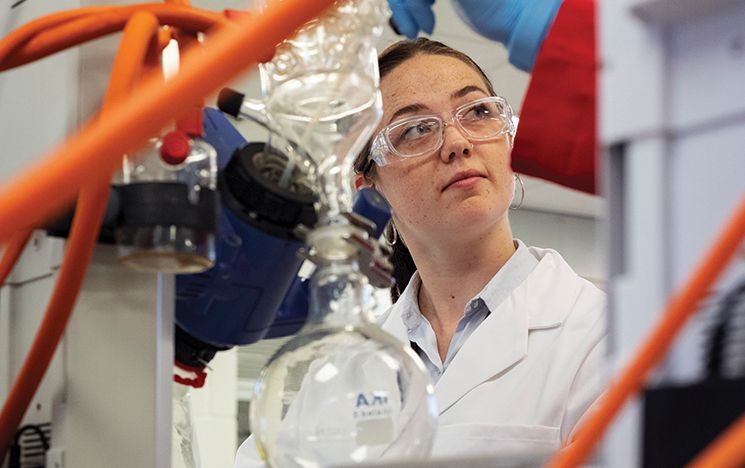
Key to our research activities are our excellent facilities including a fully equipped NMR suite, a Mass Spectometry Centre, small molecule and protein X-ray crystallography, nano-labs with scanning tunnelling, electron and atomic force microscopy facilities and a laser-lab supporting ultra-sensitive spectroscopy and single molecule optical microscopy.
- Organic and medicinal chemistry
Research in this area includes the development of new drugs, developing novel methods for undertaking microwave assisted and flow chemistry, new synthetic methods for organic molecules and organic and bio-inorganic catalysis, polymer chemistry.
Our faculty
- Mark Bagley: Heterocyclic chemistry
- Barnaby Greenland: Responsive polymeric and supramolecular materials
- Haitham Hassan
- Storm Hassell-Hart
- Deborah Sneddon
- John Spencer: Transition metal catalysis and microwave-mediated synthesis
Find out about the work we are doing in our Sussex Drug Discovery Centre.
- Materials and catalysis
We use chemistry to develop new materials for use in catalysis, energy and biological applications. Current research includes inorganic materials, energy materials, organometallic chemistry, single molecule magnets, theoretical studies of new materials and catalysis and heterogeneous and nano-structured catalysis.
Our faculty
- Qiao Chen: Application of nanomaterials and nanotechnology
- Ian Crossley: Development and study of electronically distinctive molecules
- George Kostakis: Synthesis of molecules using coordination chemistry basic principles
- Richard Layfield: f-block and transition metal organometallic chemistry, including single-molecule magnets
- John Turner: Discovery of new forms of matter and strongly correlated many body systems
- Fundamental chemical processes and interactions
The fundamental molecular processes are what underlies all chemistry. Our research includes fundamental surface reactions and interactions, the development of new theoretical methodologies, single molecule spectroscopy with applications in biological imaging and photochemistry of nano materials, reaction mechanisms, sensitivity enhancement for NMR spectroscopy.
- Wendy Brown: Reactions on grain surfaces in space
- Hazel Cox: Computational/theoretical inorganic chemistry
- Alfredo Vargas
Who we work with
Our work is funded by grants from the:
- EPSRC
- European Research Council
- EU Marie Curie Scheme
- Leverhulme Trust
- Royal Society
- Wellcome
- Wordwide Cancer Research
- Niemann Pick Research Foundation
- Great Ormond Street
- Industry partners.
We have many important internal collaborations with:
- the Sussex Drug Discovery Centre
- Biochemistry and Biomedicine Subject Group
- Ecology and Evolution Subject Group.
We also work closely with many external research partners from across the UK and abroad.
Outreach
We work closely with schools and colleges to bring the expertise of our academics to a younger audience.
Head of Department of Chemistry
Contact
If you have any queries, contact our Head of Department: Professor Wendy Brown at W.A.Brown@sussex.ac.uk.