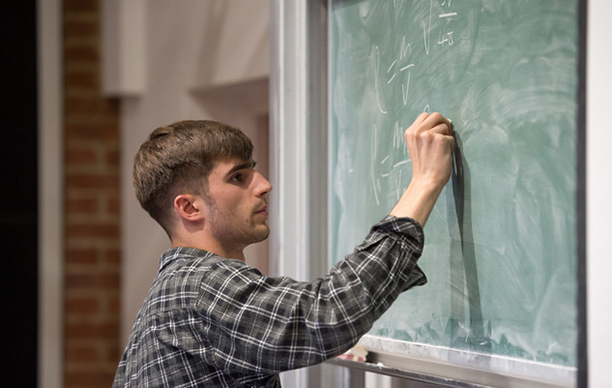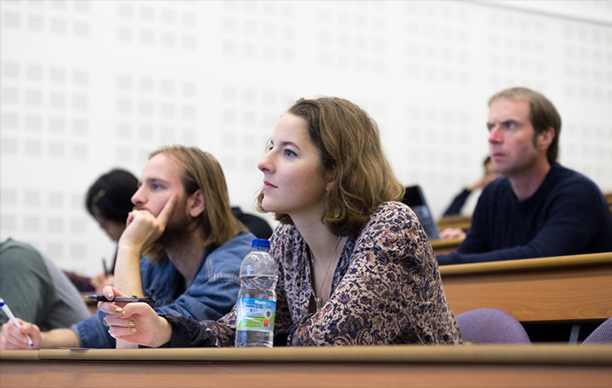
Throughout the year, the University of Sussex is host to an exciting series of public lectures that illustrate the breadth and quality of research being conducted at the University.
Most lectures are recorded and made available here in a number of formats.
Professorial Lecture: Blowing in the wind: desert dust in the Earth's climate system
06 December 2011
Speaker: Professor Martin Todd, Professor in Climate Change - School of Global Studies
Description
The Earth's climate is a complex and interconnected system
incorporating the atmosphere, ocean, land and ice surfaces. These
components are linked together through a myriad of physical,
chemical and biological processes, which together constitute the
whole Earth System. To make predictions of climate in the coming
years and decades requires that we understand, and can model, as
many components of the Earth System as possible. This lecture
focuses on one component, which exemplifies this complexity:
desert dust particles, or aerosols, and the role they play in the
climate system.
Vast plumes of desert dust are are transported in the atmosphere
many tens of thousands of kilometres around the world; these
plumes have important, but relatively poorly understood, direct and
indirect effects on the Earth's climate system through physical and
bio-chemical processes. In this lecture, Professor Todd draws on his
involvement in recent international projects to provide a summary of
the state-of-the-art in the science of climate and aerosol processes.
More information about Professor Martin Todd
Serotonin, satiety and the challenge of obesity
22 November 2011
Speaker: Professor Pete Clifton, Professor of Psychology - School of Psychology
Description
Serotonin is an important brain neurotransmitter involved in the
regulation of many functions, including mood and appetite. As with
all neurotransmitters, it exerts its effects by binding to specific
receptors and then changing brain function. A key challenge in
neuroscience is to understand the distinct roles that different
neurotransmitter receptors play in influencing our behaviour.
This lecture will explore actions of serotonin that affect different
aspects of feeding, including our feelings of satiety and the way in
which environmental cues may arouse hunger. It will also discuss
how such studies can suggest new approaches to the
pharmacological treatment of obesity and describe some of the
pitfalls that arise in translating preclinica.
More information about Professor Pete Clifton
Issues in Criminal Justics Lecture: Reforms in criminal justice
27 October 2011
Speaker: Nick Herbert MP - Minister of State for Policing and Criminal Justice
Description
Nick Herbert was elected MP for Arundel &
South Downs in May 2005. Prior to being
appointed Minister of State for Justice, he
held positions as Shadow Minister for
Police Reform, Shadow Secretary of State
for Justice and most recently Shadow
Secretary of State for Environment, Food
and Rural Affairs. Prior to his election as
an MP, Nick was the Director of Reform, an
independent think tank that he co-founded
in 2002. He was Chief Executive of
Business for Sterling from 1998 to 2000.
The art of the possible
11 October 2011
Speaker: Professor Peter Boxall, Professor of English - School of English
Description
The phrase 'politics is the art of the possible' is used to justify
political pragmatism, particularly when a pragmatic solution to a
political problem requires us to compromise a dearly held ideal or
principle. The practice of such a narrow realpolitik, however, belies
another tradition of thought, which sees art itself as the place in
which new and previously unimaginable possibilities emerge.
This lecture will offer a brief history of the relationship between art
and possibility, from Thomas More to Samuel Beckett, before going
on to look at the fate of possible worlds in the contemporary arts.
Under increasing financial pressure, and the enforced conventional
categorisation of writers by publishing houses, it appears that the
scope for the arts to invent becomes increasingly narrow. However,
this lecture will suggest that the historical currents that drive us
towards pragmatic and instrumental thinking can nevertheless
produce new conjunctions between art and the possible.
More information about Professor Peter Boxall
Issues in Criminal Justice Lecture: Rape: a unique crime?
08 June 2011
Speaker: Baroness Stern CBE
Professorial Lecture: Prophecy, prediction, approximation and computation
24 May 2011
Speaker: Professor Erik Burman, Professor of Mathematics - School of Mathematical and Physical Sciences
More information about Professor Erik Burman
Asa Briggs in converstion with Michael Farthing, plus Q&A session
22 May 2011
Speaker: Asa Briggs and Michael Farthing
Professorial Lecture: The Republican Party and the secession crisis of 1860-61
17 May 2011
Speaker: Professor Robert Cook, Professor of American History - School of History, Art History and Philosophy
More information about Professor Robert Cook
Issues in Criminal Justice Lecture: Privy Council and death penalty - a buried treasure of jurispridence
04 May 2011
Speaker: Edward Fitzgerald CBE QC
David Miliband in conversation with Tim Bale, plus Q&A session
03 May 2011
Speaker: David Miliband and Tim Bale
Issues in Criminal Justice Lecture
02 March 2011
Speaker: Kier Starmer QC
Professorial Lecture: Byzantine Art: all that glitters is gold
22 February 2011
Speaker: Professor Liz James, Professor of History of Art - School of History, Art History and Philosophy
More information about Professor Liz James
Issues in Criminal Justice Lecture
09 February 2011
Speaker: Dominic Grieve QC MP
Professorial Lecture: Challenges of producing cleaner energy from gasified coal and solid waste
08 February 2011
Speaker: Professor Abdulnaser Sayma, Professor of Computational Fluid Dynamics - School of Informatics
More information about Professor Abdulnaser Sayma
Professorial Lecture: Symmetries, scales and the origin of everything
25 January 2011
Speaker: Professor Philip Harris, Professor of Physics - School of Mathematical and Physical Sciences
Description
One of the greatest mysteries of cosmology for the last half century
has been the question of why the Universe contains so much matter
but little or no antimatter. Just after the Big Bang, matter and
antimatter were created in equal amounts – about a billion times as
much as there is matter today. These then interacted and
annihilated, leaving behind background radiation that floods the
Universe. But it also left behind a tiny excess of matter, which
constitutes all of the planets and stars and galaxies that we see
around us. Why did this happen?
Professor Harris's research centres around a beautiful and subtle
experiment – widely regarded as one of the most important projects
in UK particle physics – that links a structural asymmetry of
fundamental particles, on the tiniest scale imaginable, to the grand
cosmic asymmetry that is responsible for the existence of all of the
matter in the Universe.
More information about Professor Philip Harris