People

The SCMR community is at the heart of our work. By including colleagues and students from across the University (and beyond), SCMR explores migration issues from a diverse range of viewpoints.

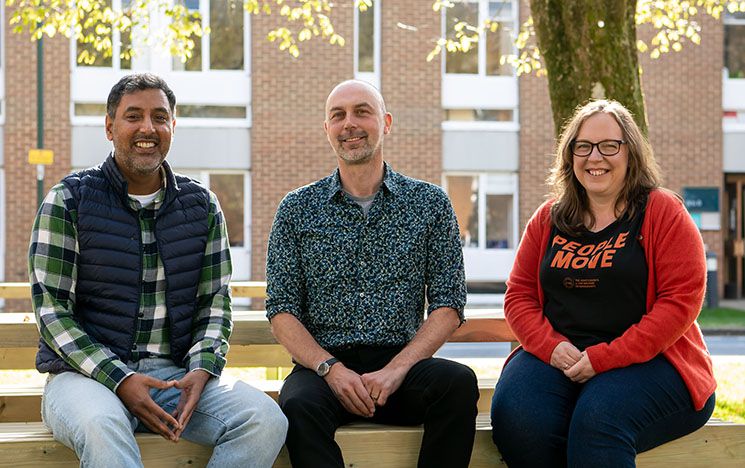
The Director and Co-Directors of SCMR; from left to right, Tahir Zaman, Paul Statham and Ceri Oeppen

The Director and Co-Directors of SCMR (Photo: University of Sussex, 2021)

SCMR is managed by a Director (Professor Paul Statham) and two Co-Directors (Dr Tahir Zaman and Dr Ceri Oeppen). Faculty members come from across the University of Sussex. 

Below are short profiles of key permanent members, but the SCMR membership is much wider, including other faculty, doctoral researchers and MA students, and SCMR research associates.

  • Paul Statham

    Title: Professor of Migration, Director of SCMR, Editor-in-Chief JEMS

    What areas of migration are you most interested in?

    My editorial work on the journal brings me in contact with a full range of issues, topics, regions in the migration and ethnic relations field as well as across the disciplines. This keeps me on my toes and up to date on trends and directions and I confess to having broad interests, as well as liking both qualitative and quantitative approaches. My own intellectual journey started out looking at contested citizenship in a comparative way across Europe. Over the last decade I have researched Islam and Muslims in Europe, using large quantitative data-sets across six countries, as well as conducting qualitative biographical research on the lives of Thai women and Transgender people who hook up with Westerners in search of a better life. So, I guess I’m broadly interested in everything.

    List three of your most significant publications relating to migration 

    Statham, P. (2020). Living the long-term consequences of Thai-Western marriage migration: The radical life-course transformations of women who partner older Westerners. Journal of Ethnic and Migration Studies, 46(8), 1562–1587. DOI link to paper.  

    Statham, P. (2024). Challenging the Muslimification of Muslims in research on ‘liberal democratic values’: why culture matters beyond religion. Journal of Ethnic and Migration Studies50(1), 203–232. DOI link to paper.

    Koopmans, R. and Statham, P. (1999). ‘Challenging the Liberal Nation-State? Postnationalism, Multiculturalism, and the Collective Claims Making of Migrants and Ethnic Minorities in Britain and Germany.’ American Journal of Sociology 105(3): 652-696. DOI link to paper

    Do you have a particular regional or national focus to your work on migration?

    Yes, I set up the Sussex Mahidol Migration Partnership with colleagues at the Mahidol Migration Center at the IPSR and RILCA, Mahidol University, Thailand. This has led to a number of collaborative research projects, and a PhD, so far, and it has been exciting for me to learn and write about a pivotal country in SE Asia and the Global South, alongside Thai colleagues. Prior to this most of my research had been focused on European countries, especially the UK, Germany, France, the Netherlands and Switzerland, as well as the EU. 

    In recent years, I have also rekindled an interest in perspectives on integration and assimilation and how these can differ in Europe and the US, partly through collaborating on a volume dedicated to Richard Alba – see Statham, P., & Foner, N. (2024). 'Assimilation and integration in the twenty-first century: where have we been and where are we going?' Introduction to a special issue of Journal of Ethnic and Migration Studies, in honour of Richard Alba. DOI link to paper

    Email: paul.statham@sussex.ac.uk

    Read more about Paul

  • Ceri Oeppen

    Title: Reader (Associate Professor) in Migration Geography and Co-Director of SCMR

    What areas of migration are you most interested in?

    All! But I’m particularly interested in forced migration, return and reintegration, asylum-related migration management, and the interactions between transnationalism and integration.

    List three of your most significant publications relating to migration 

    Erdal, M. B., & Oeppen, C. (2018). Forced to leave? The discursive and analytical significance of describing migration as forced and voluntary. Journal of Ethnic and Migration Studies, 44(6), 981–998. DOI link to paper.

    Oeppen, C. (2016). ‘Leaving Afghanistan! Are you Sure?’ European Efforts to Deter Potential Migrants through Information Campaigns. Human Geography, 9(2), 57–68. DOI link to paper.

    Erdal, M. B., & Oeppen, C. (2013). Migrant Balancing Acts: Understanding the Interactions Between Integration and Transnationalism. Journal of Ethnic and Migration Studies, 39(6), 867–884. DOI link to paper.   

    Do you have a particular regional or national focus to your work on migration?

    Yes, I am particularly interested in Afghanistan and the Afghan diaspora.

    Email: c.j.oeppen@sussex.ac.uk

    Read more about Ceri

  • Tahir Zaman

    Title: Associate Professor in Human Geography and Co-Director of SCMR 

    What areas of migration are you most interested in?

    Forced migration, social and cultural understandings of displacement processes with a particular focus on the role of faith and religion, decolonising migration studies, and refugee led/partnered responses to displacement.

    List three of your most significant publications relating to migration 

    Zaman, T., Collyer, M., Sabates-Wheeler, R., & Szyp, C. (2023). Beyond rights-based social protection for refugees. Global Social Policy, 23(2), 224-246. DOI link to paper.

    Zaman, T. (2020). Neighbourliness, conviviality, and the sacred in Athens’ refugee squats. Transactions of the Institute of British Geographers, 45(3), 529–541. DOI link to paper

    Zaman, T. (2016). Islamic Traditions of Refuge in the Crises of Iraq and Syria. Palgrave Macmillan USA. DOI link to book

    Do you have a particular regional or national focus to your work on migration?

    Yes, I am particularly interested in West Asia and the Eastern Mediterranean. 

    Email: tahir.zaman@sussex.ac.uk  

    Read more about Tahir

  • Ali Ali

    Title: Associate Professor in Human Geography (and course convenor for the MA in Migration and Refugee Studies)

    What areas of migration are you most interested in?

    Many, especially coming from a transnational family! 

    Recently, I’ve been engaged in research on international student mobilities and how they intersect with the need to escape armed conflict and political persecution. I’m working on a British Academy funded project about Cyprus - the ‘de-facto’ Turkish Republic of Northern Cyprus - exploring its role as a desirable higher education destination, but also as sanctuary for students facing threats from war, persecution, or structural exclusion in their country of origin.

    My past research has explored how places and social relations are transformed by war, insecurity and economic crises, and the resulting coercion which can force people to leave. It can sometimes immobilise them. I’m interested in what coercion itself means and what it means for people to be coerced into relocation - not just across borders but within cities and regions of their country of origin. I’ve also shown how coercion doesn’t always lead to movement and that people can be displaced in place.

    I’ve been interested in displacement resulting from acute political and economic transformations in the contemporary ‘Middle East’, such as the invasion of Iraq and the Syrian uprising, and Lebanon’s financial collapse. I’ve also conducted research about local and national government policies towards Syrian refugees in Jordan and Lebanon.

    List three of your most significant publications relating to migration

    Ali, A. (2022). Conceptualizing displacement: The importance of coercion. Journal of Ethnic and Migration Studies, 0(0), 1–20. DOI link to paper

    Ali, A. (2021). Disaggregating Jordan’s Syrian refugee response: The ‘Many Hands’ of the Jordanian state. Mediterranean Politics, 0(0), 1–24. DOI link to paper

    Ali, A. (2020).: The coercion and systemic discarding of the Mandaeans and Palestinians of Iraq 2003–2010. In K. Sakai & P. Marfleet (Eds.), Iraq since the Invasion: People and Politics in a State of Conflict. Routledge. Link to publisher's book page

    Do you have a particular regional or national focus to your work on migration?

    Yes, broadly speaking the Arab Mashreq, and eastern Mediterranean, which includes Iraq, Jordan, Lebanon and Syria. I’ve also done research in Turkey and more recently I spent time in Northern Cyprus.

    Email: a.a.ali@sussex.ac.uk

    Read more about Ali

  • Ödül Bozkurt

    Title: Professor of Work and Employment

    What areas of migration are you most interested in?

    I am a sociologist of work. A whole array of topics at the intersection of work and migration. This could be in relation to well-established terrain such as migrant labour markets and / or the experiences of migrant workers, or in relation to relatively newer themes such as temporary migration, work-related mobility vs migration etc. That includes making connections between the migration literature and fields where migration has not been sufficiently discussed, such as the literature on employment in multinational corporations, international human resource management etc. Migration is also a key theme in studies of work generally- for example in retail employment, a sector I work on, it is critical.

    List three of your most significant publications relating to migration 

    Chung, C., Brewster, C., & Bozkurt, Ö. (2020). The liability of mimicry: Implementing “global human resource management standards” in United States and Indian subsidiaries of a South Korean multinational enterprise. Human Resource Management, 59(6), 537–553. DOI link to paper

    Bozkurt, Ö., & Mohr, A. T. (2011). Forms of cross-border mobility and social capital in multinational enterprises. Human Resource Management Journal, 21(2), 138–155. DOI link to paper

    Bozkurt, Ö. (2006). Wired for work: Highly-skilled employment and global mobility in mobile telecommunications multinationals. In M. P. Smith & A. Favell (Eds.), The human face of global mobility: International highly skilled migration in Europe, North America and the Asia-Pacific. Transaction Publishers. Link to publication information in Sussex repository

    Do you have a particular regional or national focus to your work on migration?

    My PhD included fieldwork in Sweden, Finland and Turkey, I have other work related to Japan and South Korea, and was trained in the USA.

    Email: o.bozkurt@sussex.ac.uk

    Read more about Ödül

  • Mike Collyer

    Title: Professor of Geography 

    What areas of migration are you most interested in?

    Forced migration, undocumented migration and borders, urban migration/mobility, citizenship, political transnationalism.

    List three of your most significant publications relating to migration 

    Collyer, M. and Shahani, U. (2023). Offshoring refugees: colonial echoes of the UK-Rwanda migration and economic development partnership. Social Sciences12(8). DOI link to paper.

    Collyer, M., Te Lintelo, D., Mutambasere, T. and Zaman, T., (2024). Social Assistance and Forced Displacement: A New Solution to an Old Problem?. Refuge40(2), pp.1-16. DOI link to paper.

    McGregor, J., Alikhan, M., Masimba, G., Omer, A. and Collyer, M. (2025). 'Evictability - A Relational Comparison: Fears, Manoeuvres and Regimes of Housing Insecurity in Rapidly Urbanising Cities'. Transactions of the Institute of British Geographers. DOI link to paper

    Do you have a particular regional or national focus to your work on migration?

    The areas I know best as a result of long term residence and fieldwork are Europe (particularly the UK and France), North Africa (particularly Morocco and Egypt) and South Asia (particularly Sri Lanka and Bangladesh) but I have also conducted research across sub-Saharan Africa and North America.

    Email: m.collyer@sussex.ac.uk

    Read more about Mike

  • Priya Deshingkar

    Title: Professor of Migration and Development

    What areas of migration are you most interested in?

    Forced migration, undocumented migration, human smuggling, trafficking, debt migration and gender and migration.

    List three of your most significant publications relating to migration   

    Deshingkar, P. (2022). Cultural capital and constrained agency in debt-migration for construction work in India. Cultural Studies, pp.1-21. DOI link to paper.

    Deshingkar, P. (2022). Navigating Hyper-Precarity: Im (mobilities) during the Covid Pandemic in India. Social Change52(2), pp.175-186. DOI link to paper.

    Deshingkar, P. (2019). The making and unmaking of precarious, ideal subjects – migration brokerage in the Global South. Journal of Ethnic and Migration Studies, 45(14), 2638–2654. DOI link to paper

    Do you have a particular regional or national focus to your work on migration?

    Yes, I am particularly interested in migration within and from India and Ethiopia.

    Email: p.deshingkar@sussex.ac.uk

    Read more about Priya

  • Moira Dustin

    Title: Assistant Professor (Law)

    What areas of migration are you most interested in?

    Asylum in relation to gender, sexual orientation and gender identity.

    List three of your most significant publications relating to migration 

    Dustin, M. (2022). Pathways to Refugee Protection for Women: Victims of Violence or Genuine Lesbians?, Refugee Survey Quarterly, 41(3), 393–419. DOI link to paper.

    Danisi, C., Dustin, M., Ferreira, N., & Held, N. (2021). Queering Asylum in Europe: Legal and Social Experiences of Seeking International Protection on grounds of Sexual Orientation and Gender Identity. Springer. Link to publisher page

    Dustin, M., & Ferreira, N. (2021). Improving SOGI Asylum Adjudication: Putting Persecution Ahead of Identity. Refugee Survey Quarterly, 40(3), 315–347. DOI link to paper 

    Email: m.dustin@sussex.ac.uk

    Read more about Moira

  • Anne-Meike Fechter

    Title: Professor of Anthropology and International Development

    What areas of migration are you most interested in?

    I’m interested in all kinds of mobility, but specifically in the intersection of Anthropology, Migration and Humanitarianism. I’m also keen on what migration makes visible in terms of social change, mobility justice, mutual support practices among people, including those on the move.

    List three of your most significant publications relating to migration 

    Oeppen, C., Ali, A., Collyer, M., Deshingkar, P. & Fechter A-M. (eds.) (2025). Refugees in a World without Aid. Open Press University of Sussex. Open access link.

    Etzold, B. & Fechter, A.-M. (2022). Unsettling Protracted Displacement: Connectivity and Mobility Beyond 'Limbo'Journal of Ethnic and Migration Studies, 48(18), 4295-4312. DOI lik to paper.

    Fechter, A.-M. (2007). Transnational Lives: Expatriates in Indonesia. Routledge. Link to publisher page

    Do you have a particular regional or national focus to your work on migration?

    Broadly speaking, Southeast Asia, with particular fieldwork expertise relating to Indonesia, Cambodia and Myanmar.

    Email: a.fechter@sussex.ac.uk

    Read more about Meike

  • Nuno Ferreira

    Title: Professor of Law

    What areas of migration are you most interested in?

    I’m particularly interested in forced migration, especially involving sexual and gender minorities, as well as issues related to free movement within the European Union.

    List three of your most significant publications relating to migration 

    Dustin, M., Ferreira, N., Matin, K, Rezaei-Toroghi, M., & Soloaga, I. (2026). Decolonizing Queer Migration: Iranian Voices in Exile. Bristol University Press. Link to publisher page

    Danisi, C., Dustin, M., Ferreira, N., & Held, N. (2021). Queering Asylum in Europe: Legal and Social Experiences of Seeking International Protection on grounds of Sexual Orientation and Gender Identity. Springer. Link to publisher page

    Ferreira, N. (2023). Utterly unbelievable: the discourse of ‘fake’ SOGI asylum claims as a form of epistemic injustice. International Journal of Refugee Law 34(3-4):303-326. Link to publisher page

    Do you have a particular regional or national focus to your work on migration?

    My work tends to focus mostly on the European context, but I have also done work focussing on certain national contexts (such as Portugal) and other regional contexts (such as Africa).

    Email: n.ferreira@sussex.ac.uk

    Read more about Nuno

  • Tony Fielding

    Title: Emeritus Professor in Geography

    What areas of migration are you most interested in?

    Both international and internal migration, but especially the links between migration and social mobility, formerly in the UK and the EU, now in Japan and East Asia.

    List three of your most significant publications relating to migration 

    Fielding, T. (2016). Asian Migrations: Social and Geographical Mobilities in Southeast, East, and Northeast Asia. Routledge. Link to publisher page

    Fielding, T. (2021). Migration in a Post-global Era. In K. Kourtit, B. Newbold, P. Nijkamp, & M. Partridge (Eds.), The Economic Geography of Cross-Border Migration. Springer. Link to publisher page

    Fielding, T., & Ishikawa, Y. (2021). COVID-19 and migration: A research note on the effects of COVID-19 on internal migration rates and patterns in Japan. Population, Space and Place, 27(6), e2499. DOI link to paper.

    Do you have a particular regional or national focus to your work on migration?

    Yes, I am particularly interested in East Asia, especially Japan, South Korea, China PRC and Taiwan (I have published journal articles or book chapters on each of these), but also Southeast Asia.

    Email: a.j.fielding@sussex.ac.uk

    Read more about Tony

  • Melissa Gatter

    Title: Assitant Professor in Anthropology and International Development

    What areas of migration are you most interested in?

    I am interested in the political, technological, and temporal dimensions of forced displacement, attending to the experiences of people who live in camps and sanctuary cities and the people who manage them. Through ethnography, I explore how power is executed, distributed, and negotiated through humanitarian aid regimes, camp systems, border practices, and surveillance technologies. 

    List three of your most significant publications relating to migration 

    Gatter, M. (2023). Time and power in Azraq refugee camp: a nine-to-five emergency. American University in Cairo Press. Link to publisher page.

    Gatter, M. (2025). Resilience for whom? resiliency humanitarianism and everyday resistance in a carceral camp. EthnosDOI link to paper.

    Gatter, M. (2026). Camp time: heterochronies in ‘other spaces’. Journal of Population, Space & PlaceDOI link to paper

    Do you have a particular regional or national focus to your work on migration?

    My work focuses mainly on camp refugees in Jordan, Syrian returnees, and sanctuary cities in the US.

    Email: m.gatter@sussex.ac.uk

    Read more about Melissa

  • James Hampshire

    Title: Professor in Politics, Deputy Editor of JEMS

    What areas of migration are you most interested in?

    The governance of international migration, especially the politics of immigration and immigration policymaking. I'm interested in how migration is governed, what factors shape migration policy, and the effects policies have on migrants.

    List three of your most significant publications relating to migration 

    Hampshire, J. (2024). 'Full-Fat, Semi-Skimmed or Skimmed?’ The Political Economy of Immigration Policy since Brexit. The Political Quarterly, 95(2), 234-242. DOI link to paper.

    Hampshire, J. (2014). The Politics of Immigration: Contradictions of the Liberal State. Wiley. Link to publisher page

    Boswell, C., & Hampshire, J. (2017). Ideas and agency in immigration policy: A discursive institutionalist approach. European Journal of Political Research, 56(1), 133–150. DOI link to paper

    Do you have a particular regional or national focus to your work on migration?

    I've focused mainly on Europe and especially the UK, to date, though my current work will likely take me to other regions.

    Email: j.a.hampshire@sussex.ac.uk

    Read more about James

  • Pamela Kea

    Title: Professor of Social Anthropology

    What areas of migration are you most interested in?

    Return migration,  histories of migration, transnational relations of care, asylum, displacement and refugees, decolonising migration studies.

    List three of your most significant publications relating to migration 

    Kea, P. (2024) 'Mapping hidden journeys of Gambian migration and return'. Africa. 93(5): 634-651. DOI link to paper.

    Kea, P. (2017) 'Challenging global geographies of power: sending children back to Nigeria from the UK for education. Comparatives Studies in Society and History. 59(4): 818-845. DOI link to paper.

    Kea, P. (2013) 'Producing Victim Identities: Female Genital Cutting and the Politics of Asylum Claims in the United Kingdom. Identities 20(1): 96-113. DOI link to paper.

    Do you have a particular regional or national focus to your work on migration?

    West Africa and the UK 

    Email: p.j.kea@sussex.ac.uk

    Read more about Pamela

  • Russell King

    Title: Emeritus Professor of Geography

    What areas of migration are you most interested in?

    I am interested in all aspects of migration but especially labour migration, student and youth migration, international retirement migration, return migration, and migration and development. I am also keen on theorising migration alongside allied fields such as mobility, transnationalism and diasporas.

    List three of your most significant publications relating to migration 

    Kılınç, N. and King, R. (2025) A Place in the Homeland? Turkish-German Return Migration. Edinburgh University Press. Link to publisher page.

    King, R. and Kuschminder, K., eds (2022) Handbook of Return Migration. Edward Elgar Publishing (2nd edition due out in late 2026 or early 2027). Link to publisher page.

    Gëdeshi, I, King, R. and Ceka, A. (2024) The emigration of medical doctors from Albania: brain drain vs return and cooperation. Central and Eastern European Migration Review, 13(2), 5–25. DOI link to paper.  

    Do you have a particular regional or national focus to your work on migration?

    Most of my research has been on Europe, with a special interest in Southern Europe and the Balkans.

    Email: r.king@sussex.ac.uk

    Read more about Russell

  • Dom Kniveton

    Title: Professor of Climate Science and Society

    What areas of migration are you most interested in?

    All! But, particularly interested in (im)mobility in the context of climate change and disasters.

    List three of your most significant publications relating to migration 

    Kniveton, D., Smith, C., & Wood, S. (2011). Agent-based model simulations of future changes in migration flows for Burkina Faso. Global Environmental Change, 21, S34–S40. DOI link to paper

    Black, R., Kniveton, D., & Schmidt-Verkerk, K. (2011). Migration and Climate Change: Towards an Integrated Assessment of Sensitivity. Environment and Planning A: Economy and Space, 43(2), 431–450. DOI link to paper

    Ayeb-Karlsson, S., Kniveton, D., & Cannon, T. (2020). Trapped in the prison of the mind: Notions of climate-induced (im)mobility decision-making and wellbeing from an urban informal settlement in Bangladesh. Palgrave Communications, 6(1), Article 1. DOI link to paper

    Do you have a particular regional or national focus to your work on migration?

    Sub-Saharan Africa and South Asia.

    Email: d.r.kniveton@sussex.ac.uk

    Read more about Dom

  • Rachel Larkin

    Title: Assitant Professor in Social work

    What areas of migration are you most interested in?

    All aspects of state response to child and youth migration. Particularly interested in gender and sexuality and how notions of girlhood impact migration.  

    List three of your most significant publications relating to migration 

    Larkin, R., and Woodcock Ross, J. (2024) ‘Unaccompanied Migrant Girls: Navigating Religious Girlhood in the UK’. Ethnic and Racial Studies 0, no. 0 (2024): 1–21. DOI link to paper.

    Larkin, R. (2022) Separated Migrant Young Women in State Care: Living in Contested Spaces. Studies in Childhood and Youth. Palgrave Macmillan. Link to publisher page.

    Larkin, R (2026) Rights-Based Social work with Unaccompanied Children and Young People  in Dedotsi, S., Cabiati, E., & Gómez-Ciriano, E. J. (Eds.). (2026). The Routledge Handbook of Social Work and Migration: Theory, Practice, Education and Research (1st ed.). Routledge. Link to publisher page.

    Do you have a particular regional or national focus to your work on migration?

    My work has focussed on the UK and Europe but I am looking to expand this to consider youth migration and social work in other regions.

    Email: r.larkin@sussex.ac.uk

    Read more about Rachel

  • Aleksandra Lewicki

    Title: Reader in Sociology, Co-Director of the Sussex European Institute, Associate Editor of JEMS

    What areas of migration are you most interested in?

    Race and Racism, Political Mobilisation, Institutional Racism and Inequality, the Politics of Citizenship and Immigration, East-West mobilities within Europe, Postcolonial and Postsocialist Peripheries.

    List three of your most significant publications relating to migration 

    Lewicki, A. (2023). ‘East-West Inequalities and the Ambiguous Racialization of ‘Eastern Europeans’, Journal of Ethnic and Migration Studies, 49(6) 1481-1499. DOI link to paper.

    Lewicki, A. (2022). The Material Effects of Whiteness: Institutional Racism in German Care Institutions, The Sociological Review, 70(5), 916-934. DOI link to paper.

    Lewicki, A. (2021). The Christian Politics of Identity and the Making of Race in the German Welfare State, Sociology, 55(6), 1128-1244. DOI link to paper.

    Do you have a particular regional or national focus to your work on migration?

    The United Kingdom, Germany, and East-Central Europe.

    Email: a.lewicki@sussex.ac.uk 

    Read more about Aleks

  • JoAnn McGregor

    Title: Professor of Human Geography

    What areas of migration are you most interested in?

    My interests include forced migration, the politics of borders and detention, mobility, citizenship and urbanization. I am also interested in histories of interconnection between Britain and Africa, in transnational politics and lives, memories and creative responses to displacement.

    List three of your most significant publications relating to migration 

    McGregor, J., Alikhan, M., Masimba, G., Omer, A. and Collyer, M. (2025). 'Evictability - A Relational Comparison: Fears, Manoeuvres and Regimes of Housing Insecurity in Rapidly Urbanising Cities'. Transactions of the Institute of British Geographers. DOI link to paper

    McGregor, J. (2008). Abject spaces, transnational calculations: Zimbabweans in Britain navigating work, class and the law. Transactions of the Institute of British Geographers, 33(4), 466–482. DOI link to paper

    McGregor, J. (2011). Contestations and consequences of deportability: Hunger strikes and the political agency of non-citizens. Citizenship Studies, 15(5), 597–611. DOI link to paper

    Do you have a particular regional or national focus to your work on migration?

    Yes, I am interested in Southern Africa, and African diasporas in Britain.  Much of my work has focused on Zimbabwe and its diaspora.

    Email: j.mcgregor@sussex.ac.uk

    Read more about JoAnn

  • Laura Moroşanu

    Title: Reader in Sociology, Associate Editor of JEMS

    What areas of migration are you most interested in?

    Many! I’m broadly interested in migrants’ social lives and work trajectories, the identities they articulate, and the connections they establish across different places and societies. I have also looked at return migration, particularly how working-age returnees view future migration, and how migration shapes their vision of the 'good life'. Beyond this, I have started a new project on children of migrants in professional workplaces, and their experiences of worth and belonging there.

    List three of your most significant publications relating to migration 

    Moroşanu, L., & Șerban, M. (2025). Then and Now: Romanian Returnees Contemplating Future Migration. International Migration Review. DOI link to paper.

    Moroşanu, L., King, R., Lulle, A., & Pratsinakis, M. (2021). ‘One improves here every day’: The occupational and learning journeys of ‘lower-skilled’ European migrants in the London region. Journal of Ethnic and Migration Studies, 47(8), 1775–1792. DOI link to paper

    Moroşanu, L. (2018). Researching migrants’ diverse social relationships: From ethnic to cosmopolitan sociability? The Sociological Review, 66(1), 155–173. DOI link to paper

    Do you have a particular regional or national focus to your work on migration?

    Yes, I am particularly interested in intra-European migration/mobility.

    Email: l.morosanu@sussex.ac.uk

    Read more about Laura

  • Linda Morrice

    Title: Professor of Education and Migration

    What areas of migration are you most interested in?

    My research interests sit at the intersection of education with refugee and migration studies. This includes both formal learning and informal learning through everyday social practices. I am interested in integration, and how we can create spaces which are more inclusive and welcoming for all.

    List three of your most significant publications relating to migration 

    Phillimore, J., Morrice, L. and Strang, A. (2024) Walking a tightrope between policy and scholarship: reflections on integration principles in a hostile environment. Journal of Ethnic and Migration Studies, 50(20), 4943-496. DOI link to paper.

    Morrice, L. (2021). The promise of refugee lifelong education: A critical review of the field. International Review of Education, 67(6), 851–869. DOI link to paper

    Morrice, L., Tip, L. K., Brown, R., & Collyer, M. (2020). Resettled refugee youth and education: Aspiration and reality. Journal of Youth Studies, 23(3), 388–405. DOI link to paper

    Do you have a particular regional or national focus to your work on migration?

    No; I am interested in understanding learning and displacement across both global north and south (and dissolving boundaries between the two).

    Email: l.m.morrice@sussex.ac.uk

    Read more about Linda

  • Ben Rogaly

    Title: Emeritus Professor of Human Geography

    What areas of migration are you most interested in?

    I’m interested in people’s stories of moving and staying put both historically and in contemporary times, and the relationship of these to broader structural processes, including colonialisms and their legacies, and neoliberalism. I’m specifically engaged with the entanglements between the state, capitalist employment relations and racialization of people, including migrants and their descendants. How people resist, individually and collectively (and materially and culturally), as well as the possibility of solidarity work outside and inside the academy are just as important to me as (and are inter-related with) my involvements with migration research. My current research project, ‘Facing the Trouble’, a collaboration with Samuel Solomon, investigates a diasporic silence among Yiddishland cultural workers in the context of Israel’s genocide of Palestinians.

    List three of your most significant publications relating to migration 

    Senker, C., Rogaly, B. & Clarke, A. (2024). Brighton Bound: Stories of Moving To, Around and Out of the City, 1920s – 2020s. QueenSpark Books. Find out more at Sussex Big Read.

    Rogaly, B. (2020). Stories from a migrant city: Living and working together in the shadow of Brexit. Manchester University Press. Link to publisher page

    Rogaly, B., & Taylor, B. (2010). ‘They Called Them Communists Then … What D’You Call ‘Em Now? … Insurgents?’. Narratives of British Military Expatriates in the Context of the New Imperialism. Journal of Ethnic and Migration Studies36(8), 1335–1351. DOI link to paper.

    Do you have a particular regional or national focus to your work on migration?

    I’ve worked mainly in India and the UK and, more recently, in the non-territorial space of Yiddishland.

    Email: b.rogaly@sussex.ac.uk

    Read more about Ben

  • Sarah Scuzzarello

    Title: Associate Professor in Geography, Associate Editor of JEMS

    What areas of migration are you most interested in?

    My research has always focussed on the interface between migrants' agency and the opportunity structures they face in the recipient society. Specifically, I am interested in how institutional frameworks, public discourses, and social norms and practices shape migrants’ identification processes and life chances. My current research adopts an intersectional lens to understand how sexuality, class and race shape migrants' experiences of mobility and settlement. I have often worked within a cross-national comparative framework, and conducted empirical research in Europe and South East Asia.

    List three of your most significant publications relating to migration  

    Scuzzarello, S. & Moroşanu, L. (2023) Integration and intersectionality: boundaries and belonging “from above” and “from below”. Introduction to the special issue, Ethnic and Racial Studies. DOI link to paper.

    Statham, P., & Scuzzarello, S. (2023). Transgender Kathoey and gay men using tourist-zone scenes as ‘social opportunities’ for nonheteronormative living in Thailand. Gender, Place & Culture, 30(2), 183-210. DOI link to paper

    Scuzzarello, S. (2020). Practising privilege. How settling in Thailand enables older Western migrants to enact privilege over local people. Journal of Ethnic and Migration Studies, 46(8), 1606–1628. DOI link to paper

    Do you have a particular regional or national focus to your work on migration?

    My work focusses on migration and integration issues in the UK, Sweden, Italy and Thailand.

    Email: s.scuzzarello@sussex.ac.uk

    Read more about Sarah

  • Selin Siviş

    Title: Research Fellow (Sociology and Criminology)

    What areas of migration are you most interested in?

    Forced migration; high-skilled migration; workforce and employment dynamics; different forms of inclusion and exclusion; deservingness; aspirations, belonging, and citizenship; and labour market integration.

    List three of your most significant publications relating to migration

    Siviş. S. (2026). Are Refugee Workers ‘Peers’, ‘Competitors’, or Both? Socioeconomic Justifications of Boundary Work Through the Lens of Native Employees. Sociology Compass, 20(1). DOI link to paper.

    Siviş. S. et al. (2024). ‘Europe was a dream for me. This dream came true but remains unfulfilled at the same time’: Navigating life aspirations among forced migrants in Austria and Italy. Migration Studies, 12(3). DOI link to paper.

    Siviş, S. 2023. The use of cultural repertoires of everyday nationhood and citizenship in national identity boundary-drawing: The case of Syrian refugees in Turkey. British Journal of Sociology, 74(4). DOI link to paper.

    Do you have a particular regional or national focus to your work on migration?

    My primary regional expertise lies in Turkey, followed by Europe, particularly Austria, Germany, and the UK, with additional research experience in Southern Europe, including Italy and Spain.

    Email: s.sivis@sussex.ac.uk

    Read more about Selin

  • Ron Skeldon

    Title: Emeritus Professor of Geography

    What areas of migration are you most interested in?

    Migration and development; Demographics of migration; Evolution of migration systems; Migration policy.

    List three of your most significant publications relating to migration 

    Skeldon, R. (2021). Advanced Introduction to Migration Studies. Edward Elgar. Link to publisher page

    Skeldon, R. (1997). Migration and Development: A Global Perspective. Routledge. Link to publisher page

    Skeldon, R. (1990). Population mobility in developing countries: A reinterpretation. Belhaven Press. Link to WorldCat page.

    Do you have a particular regional or national focus to your work on migration?

    I like to think that my approach is global, although I have specific interests in the Andean region of Peru and across the Asia and Pacific region. More recent work has focused on the Caucasus region.

    Email: r.skeldon@sussex.ac.uk

    Read more about Ron

  • Charlotte Taylor

    Title: Professor of Discourse and Persuasion

    What areas of migration are you most interested in?

    As a linguist, I am particularly interested in migration rhetoric because we know that language and society are in constant dialogue, thus influencing each other. The kinds of questions I might ask are: How do different naming choices construct different categories of people? How are immigration and emigration construed as discursively distinct processes? How are people who move framed through metaphor? To what extent do contemporary migration discourses replicate those of past periods? More broadly, I am interested in both the kinds of movement typically described as emigration and immigration and the discursive constructions from different time periods and languages.

    List three of your most significant publications relating to migration 

    Taylor, C. (2021). Metaphors of migration over time. Discourse & Society, 32(4), 463–481. DOI link to paper

    Taylor, C. (2020). Representing the Windrush generation: Metaphor in discourses then and now. Critical Discourse Studies, 17(1), 1–21. DOI link to paper

    Taylor, C. (2015). Immigrants, Undocumented: Criminalization. In D. Bearfield A., E. Berman, & M. Dubnick J. (Eds.), Encyclopedia of Public Administration and Public Policy. Taylor & Francis. Link to publisher page

    Do you have a particular regional or national focus to your work on migration?

    I have mainly focussed on the UK but am interested in looking at different contexts.

    Email: charlotte.taylor@sussex.ac.uk

    Read more about Charlotte

  • Katie Walsh

    Title: Reader in Human Geography

    What areas of migration are you most interested in?

    Home; Intimacy; Ageing; Emotion; Gender; Privilege; UAE; British migration; Highly Skilled; Lifestyle Migration.

    List three of your most significant publications relating to migration   

    Walsh, K. (2018). Transnational Geographies of The Heart: Intimate Subjectivities in a Globalising City. Wiley. Link to publisher page

    Leonard, P., & Walsh, K. (Eds.). (2019). British Migration: Privilege, Diversity and Vulnerability. Routledge. Link to publisher page

    Walsh, K., & Näre, L. (Eds.). (2019). Transnational Migration and Home in Older Age. Routledge. Link to publisher page

    Do you have a particular regional or national focus to your work on migration?

    Yes, my own ethnographic research took place in Dubai and other GCC cities. And I have focused on British migrants in both this work and my work on return migration.

    Email: katie.walsh@sussex.ac.uk

    Read more about Katie

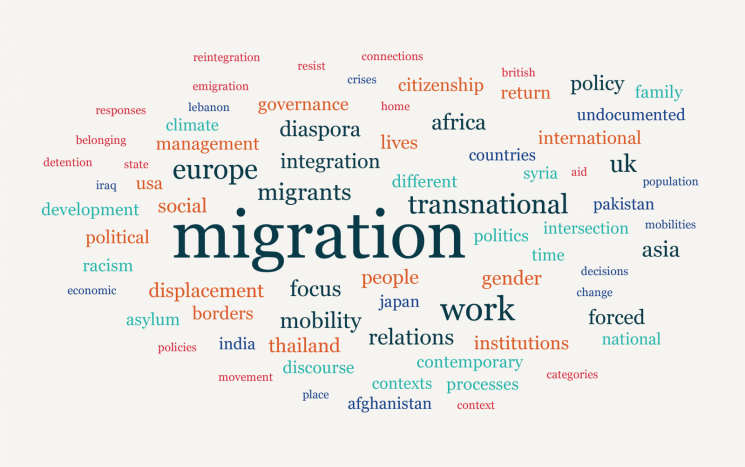
Word cloud of faculty research interests. Dominant words include transnational, integration, mobility, relations, diaspora, Europe, Africa, work, centred around the word migrationA 'word cloud' made of answers to the question "what areas of migration are you most interested in", asked of SCMR researchers in 2021. Dominant words include migration, transnational, mobility, work, integration, diaspora, forced, policy, Europe, Africa, and Asia.