Language short courses
Discover short language courses open to everyone aged 18 and over, with a range of lunchtime and evening sessions on offer.
Find out about Modern Languages and English language teaching at Sussex, based within the Department of Language Studies, part of the School of Media, Arts and Humanities, and search for people who work there.
Our courses are taught by academics working in the Department of Language Studies. We offer a wide range of courses and modules throughout the calendar year in English Language Teaching and Modern Foreign Languages. International students can take a range of English language courses to prepare them for their studies.
We recognise that students from disciplines across the University will, as future global citizens, travel, live and work in countries across the world – that's why we've developed a flexible portfolio of language electives which students can take as part of their degree. Students can also study autonomously in our Resource Centre, which has a digital language suite and multimedia workstations for the private study of more than 50 world languages.
We believe that learning to speak a second or third language provides a window into another culture, and that cultural awareness and intercultural communication are essential for the promotion of peace, co-operation and understanding in the world today. In addition, the study of a language gives meaningful access to the media, films and literature in that language, opening up limitless paths of discovery.
We offer:
Discover short language courses open to everyone aged 18 and over, with a range of lunchtime and evening sessions on offer.
Study a language alongside your single-honours degree for up to three years.
Undergraduate students on a wide range of single-honours degrees can take modules in teaching English to speakers of other languages (TESOL).
Explore language and linguistics while preparing for the Trinity CertTESOL teaching qualification.
Teach English to speakers of other languages through our MA. Gain knowledge about the social functions and contexts of language use.
You can also develop your communication skills in practical ways and explore languages more broadly, on modules including:
Most of our single-honours courses across arts, sciences and social sciences offer language electives. Find out more on your chosen degree at Undergraduate courses.
These courses are for international students looking to improve their English language skills before studying a degree.
These courses are for any adult student aged 18 years or over, whose English language level is intermediate (CEFR B1).
This is for any adult student aged 18 years or over who is not a beginner and wants to spend part of their holiday improving their English.
Check out our free workshops, drop-in sessions and one-to-one tutorials throughout the academic year, for Sussex students whose first language is not English.
We can develop specialist language courses specific to your institutional or company needs.
Find out more about our language electives on your chosen degree at Undergraduate courses.

Find academics working within Modern languages and English language teaching.

Discover more about studying and life as a Languages and Linguistics student.
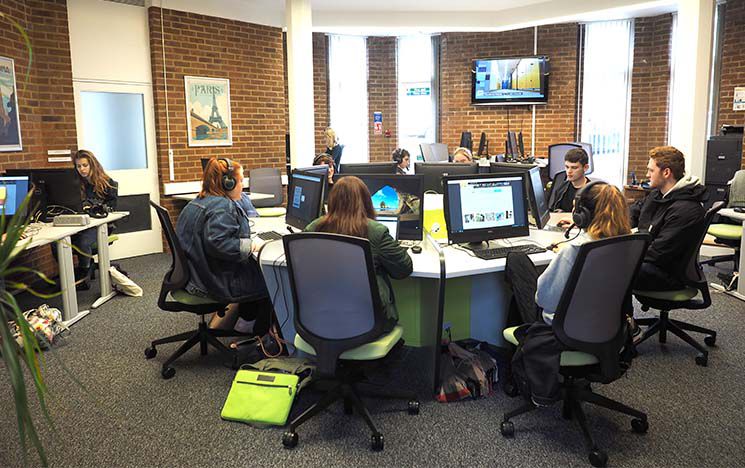
Learn about our open-access learning resources centre for self-study.