Sussex Centre for Global Insecurities Research (CGI)
The Centre for Global Insecurities is an interdisciplinary research centre at Sussex that rethinks the formations, geographies and embodied experiences of insecurities to reimagine pathways to security in our complex and interconnected world.



Latest news
Sussex and International Alert event on religion and conflict brings a ‘new idea’ on an old problem
Posted on behalf of: Sussex Centre for Conflict and Security Research
Last updated: Tuesday, 30 April 2013
The first Peace Talks event involving the School of Global Studies in partnership with peacebuilding NGO International Alert and the Royal Commonwealth Society was held last week (Monday 22 April) at the Commonwealth Club in London. The subject was ‘War, Peace and Faith: the ambiguous role of religion in 21st century conflict’. It was a success with a record turnout of over 150 people and positive write ups by participants, including the Guardian - Comment is Free, Belief.
The event featured Sussex Researcher Dr Fabio Petito, Senior Lecturer in International Relations, who works on religions, cultures and civilisations. Joining him on the panel were Rama Mani, Senior Research Associate at the University of Oxford's Centre for International Studies; Aaqil Ahmed, BBC's Head of Religion and Ethics; and Andrew Brown, Head of the Guardian's Comment is Free- Belief. Dan Smith, Secretary General of International Alert Chaired the discussion.

‘It was an interesting discussion’, commented Fabio Petito, ‘rather than simply restating the usual arguments I felt that we actually found a new angle on these issues’. This sentiment was echoed by Andrew Brown in the Guardian who in his blog stated ‘for once a new idea emerged from our exchanges.’ (link to blog article)
A short summary of the event:
Fabio Petito was invited to begin the discussion setting the context by explaining that there has been a resurgence of religion in world politics since the end of the Cold War which is a development that secular society has been both ill-equipped and largely unwilling to deal with.
A secular hostility to religion was noted, with the result that it is often excluded from peace attempts. All panellists agreed that the usual assumption that ‘where there’s religion, there’s violence’ was wrong – it was actually the other way around. The importance of religious literacy emerged, with panellists noting the connection between weak religious knowledge and extremism, the latter often resulting in violence. The importance of knowledge, reflexivity and depth in religion was deemed to be critical – weak religion was open to exploitation by political entrepreneurs aiming for conflict. It was agreed that the media had an important role to play in this, with Brown and Ahmed offering ‘insiders’ insights on how this might work.
Finally, the role of religion in peacemaking was discussed, with examples ranging from Desmond Tutu to democratisation in post-war and Soviet Europe. It’s peacemaking potential coming from the characteristics that made it different from, and feared by, secularism.
The ambiguity and paradox of religion, highlighted through it’s involvement in conflict, emerged as its greatest strength. The discussion concluded that this offered unique resources for conflict-resolution and the prevention of violence.
Following the success of this first collaboration, the School of Global Studies and International Alert have already started planning the next Peace Talks event to be held in June which will be focused on issues of conflict in Africa.
A video of the event is available here:
http://www.international-alert.org/whatyoucando/events/peace-talks-apr-2013
Latest events
That event item is not currently available.- Banner photo of barbed wire by Anton Dmitriev on Unsplash
-
News and events navigation block photo: Crime-scene style tape used by anti-arms trade activists in London. Photo: David Cliff via Reuters Connect
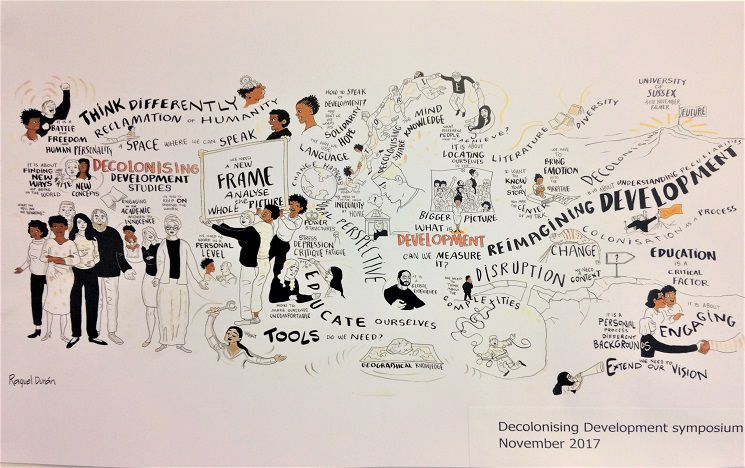
- Research navigation block photo: Decolonising Development Symposium 2017: Raquel Duron
Contact
If you have any questions, email cgi@sussex.ac.uk.