Research news
Bees under threat from disease-carrying bumblebee imports, research reveals
Posted on behalf of: School of Life Sciences
Last updated: Thursday, 18 July 2013
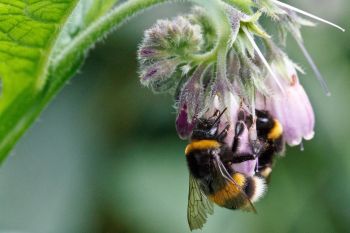
Bumblebees are important pollinators. Image: Dave Goulson
Stricter controls over bumblebee imports to the UK are urgently required to prevent diseases spreading to native bumblebees and honeybees, scientists have warned.
The call follows the discovery of parasites in over three-quarters of imported bumblebee colonies tested. The study – the first of its kind in the UK – is published today (Thursday 18 July) in the Journal of Applied Ecology.
While wild species of bees and other insects pollinate many crops, commercially reared and imported bumblebees are essential for the pollination of greenhouse crops such as tomatoes. They are also used to enhance the pollination of other food crops such as strawberries, and are now marketed for use in people’s gardens.
The trade is large and widespread: 40-50,000 commercially produced bumblebee colonies – each containing up to 100 worker bees – are imported annually to the UK.
The team of researchers from the universities of Leeds, Stirling and Sussex bought 48 colonies of buff-tailed bumblebees (Bombus terrestris) from three European producers. Some colonies were a subspecies native to the UK and others were non-native.
All were meant to be disease-free, but when they were tested using DNA technology, 77 per cent of the colonies were found to be carrying parasites. Parasites were also found in the pollen food supplied with the bees.
Lead author of the study, Peter Graystock of the University of Leeds explains: “We found that commercially produced bumblebee colonies contained a variety of microbial parasites, which were infectious and harmful not only to other bumblebees, but also to honeybees.”
The results suggest that current regulations and protocols governing bumblebee imports are not effective. Although Natural England licences require non-native colonies to be disease free, they do not apply to imports of the native colonies and there is no screening to ensure compliance.
The study also argues that producers need to improve disease screening and develop a parasite-free diet for their bees.
According to co-author of the study, Professor William Hughes of the University of Sussex: “If we don’t act, then the risk is that potentially tens of thousands of parasite-carrying bumblebee colonies may be imported into the UK each year, and hundreds of thousands worldwide.
“Many bee species are already showing significant population declines. The introduction of more or new parasite infections will at a minimum exacerbate this, and could quite possibly directly drive declines.”