Research at Sussex
Our research is contributing new knowledge, ideas and solutions, which is leading to real change in the world and making a difference to people’s lives.
Centres of Excellence
At Sussex, we support a diverse and multidisciplinary research environment where a challenge is only impossible until it’s done.
Browse our Centres of Excellence

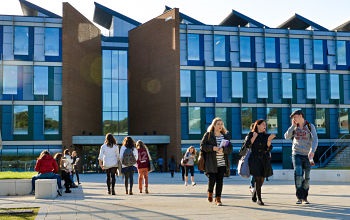
Changing the future with development research
We’re number one in the world for Development Studies for the ninth year running (QS World University Rankings by Subject 2025).
Our interdisciplinary research embraces our pioneering spirit and shapes the student experience as we seek to tackle the challenges facing us all.
Why we’re number one again for Development Studies
- Video transcript
[On screen text - ‘Dr. Saurabh Arora - SPRU - Science Policy Research Unit, University of Sussex’]
[Indie-guitar music fades up and plays throughout the rest of the video]
Dr. Saurabh Arora: Let me start off by talking about a quote from James Baldwin, the great American author, “Not everything that is faced can be changed, but nothing can be changed if it is not faced.”
And I think this is a motto at the heart of Sussex's education, particularly in terms of addressing critically the challenges that are facing the world.
[On screen text - ‘The University of Sussex has been ranked as the best in the world for Development Studies for the last six years by QS World University Rankings by Subject, 2017-2023]
[On screen text - ‘Prof. Andy McKay - Department of Economics, University of Sussex Business School’]
Prof. Andy McKay: I think Sussex's continued success in Development Studies reflects two things: the quality and diversity of faculty that are available here, and the quality of students that we're able to attract.
[On screen text - ‘Prof. Melissa Leach - Director, Institute of Development Studies’]
We've been at the forefront of really rigorous, robust research that tackles successive development challenges.
[On screen text - ‘Dr. Lyndsay McLean - Department of Anthropology, School of Global Studies’]
Dr. Lyndsay McLean: So we're not afraid to be critical about the roots of the international development sector, also about the way the system works today. But also, at the same time, we're very engaged.
Melissa: The U.N. Sustainable Development Goals provide a really important set of directions, a set of guidelines for all of humanity.
Saurabh: There are many challenges facing humanity -
[Montage of video clips showing deforestation, an indigenous tribes person, a flooded urban area and a homeless person in a city at night pushing their belongings in a shopping cart as Saurabh continues to speak]
ecological collapse that we are dealing with in many forms, biodiversity losses, climate disruptions all around the place, rampant inequality and poverty continuing to dominate.
We have to understand how they come about.
Melissa: Our futures depend on living well and thriving on a planet that's under pressure,
[Montage of video clips showing an aerial shot of a gas-fired power station and wind turbines on a large hillside as Melissa continues to speak]
and on fostering more forms of development that are more open, more inclusive and more equitable. And that's what really runs through all of our research.
Our research is always engaged with policymakers and practitioners because we seek to make a difference.
Saurabh: So this is not something that is coming at the end of the pipe. This is starting right from the first few months of the research project where we meet up with policymakers and civil society practitioners, sometimes business practitioners, in order to refine what we are going to do.
Lyndsay: And then we bring that work back into the classroom. So we'll bring those practical examples of how we've worked with the U.N., how we work with non-governmental organisations on developing issues
Melissa: … that everybody teaching is involved in research. They are at the cutting edge of their own research programs and projects so that what goes on in the classroom
[Montage of video clips showing students and a lecturer working through ideas on post-it notes as Melissa continues to speak]
and in seminars is directly shaped by front line research work.
Lyndsay: So in recent years I have, for example, been advisor to the House of Commons. They were doing an inquiry into the UK's work internationally to prevent violence against women.
Andy: Here in the Business School we've collaborated with others in the university in a number of respects. One example is where I worked with the Medical School on a neglected tropical disease in Ethiopia and also alongside an Ethiopian researcher.
Lyndsay: So at Sussex, in order for our students really to make a difference in international development, we feel it's really critical to help them to develop self-awareness about who they are
[Video clip shown of a student and lecturer engaging in conversation as Lyndsay continues to speak]
and their position in the world.
Saurabh: Great things are done by students and each one of them is a hero in that sense, bringing about the changes that we all need to see in the world.
Lyndsay: I have students that have gone on, for example, to work for the Swedish Embassy on gender and conflict in Mozambique.
Melissa: Amongst our alumni the (former) President of Costa Rica, who talks about his experiences at Sussex and the Institute as having absolutely shaped the way he both came to power and has sought to lead the world on climate and environmental justice.
Andy: Some of our students have succeeded in the Overseas Development Institute Fellowship Scheme which places Master's graduates for two years in a position of significant responsibility in the government of a developing country.
Melissa: And it's so exciting to see the multiple ways in which those who have learned with us then go on to change the world.
[On screen text as music fades - ‘Find out more, University of Sussex and Institute of Development Studies logo, sussex.ac.uk]
REF 2021
We’re proud of our performance in the latest Research Excellence Framework (REF) – 89% of research activity submitted was categorised as either ‘world-leading’ (40.6%) or ‘internationally excellent’ (48.4%).
See our REF 2021 results, learn the basics and discover our stories.
Find out more about REF 2021
Research. Innovation. Impact.
From groundbreaking quantum research and wildlife restoration, to shaping digital policies that protect children, discover how Sussex research is tackling some of the biggest challenges of our time.
Read our research booklet [5.4MB PDF]
Quantum scientists make computing breakthrough to solve big challenges of our time
Sussex researchers demonstrate how quantum bits can directly transfer between microchips.
Find out more
Shining a light on the impact of pesticides on bees
Professor Dave Goulson’s research into the impact of pesticides on bumblebees has been widely cited in the media, and has led governments to take action to better protect insects
Find out more about our pesticide research
Research at Sussex newsletter
Research at Sussex is our new fortnightly newsletter, delivering the latest research news, insights, and discoveries straight to your inbox.
Sign up
News
Contact us
Research development enquiries:
researchexternal@sussex.ac.uk
Research impact enquiries:
rqi@sussex.ac.uk
Research governance enquiries:
rgoffice@sussex.ac.uk
Postgraduate research enquiries:
researcher-school@sussex.ac.uk
Undergraduate research enquiries:
undergraduate-research@sussex.ac.uk
General press enquiries:
press@sussex.ac.uk