News
Common Sense at 250: Legacies of Democracy from Paine to Today
By: Meg Sweeney
Last updated: Wednesday, 21 January 2026
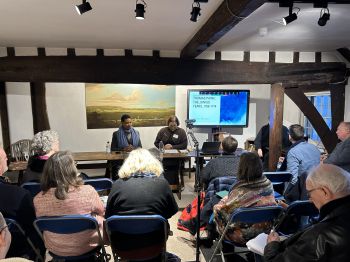
'Common Sense at 250' at Bull House, Lewes
What can Thomas Paine’s Common Sense (10 January 1776) tell us about the meanings of democracy and the ideals of active citizenship? Where did Paine’s revolutionary ideas come from, and how can those ideas help us understand the United States as it celebrates its 250th birthday?
These were some of the questions explored at the conference Common Sense at 250 (9-10 January 2026), co-organised by Dr Iain McDaniel (University of Sussex), Leanne O’Boyle (Thomas Paine: Legacy) and Professor Nora Slonimsky (Institute for Thomas Paine Studies, Iona University). Held over two days at the University of Sussex and at Bull House in Lewes (Paine’s home from 1768 to 1774), the conference re-examined Paine’s years in Lewes, his connections with British and American radicals, his revolutionary writing style and his vision for America’s future. The truly interdisciplinary conference included contributions from scholars, historians, literary specialists and creative writers from across the world: from Britain, France, Italy, the United States, Brazil and Réunion (Indian Ocean).
The conference generated wide publicity, involving a special episode of the Early American podcast Ben Franklin’s World and was featured as a news item on BBC South. The two keynote speakers, Professor Danielle Allen (Harvard University) and Professor Gregory Claeys (Royal Holloway) revealed the previously unknown extent of Paine’s political activities and authorship before his departure for America in 1774. Full details will be uncovered in Allen’s Radical Duke (forthcoming in summer 2026) and in Claeys’ new, six-volume edition of Paine’s Collected Writings (forthcoming in summer 2026).
This summer, students can continue these conversations through the British History Summer School module, which traces radical tradition in British political and cultural life. Beginning with the seminal writings of Paine, the module explores his enduring influence on later movements for political and social change, and includes a visit to Bull House in Lewes, where the conference was held. The course then follows these traditions into the twentieth century, examining youth and countercultural movements including the mods and rockers, punks and ravers, and their challenges to authority and establishment. Running over the 4 July celebrations, the Summer School offers a timely opportunity to reflect on Britain’s revolutionary legacies and their transatlantic impact at a moment when the United States marks its 250th anniversary.