


Your Professional Development
Planning your professional development as a researcher will help you learn the skills you need to manage your research, and maximise your professional prospects.
An important first step is to talk to your supervisors about your training needs - we recommend that you meet with your supervisors to do this within the first three months of starting your research degree.
During this meeting you should identify your needs and discuss ways of meeting them through the Researcher Development Programme, training provided by your Faculty, and wider activities. The Researcher Development Framework (RDF) is the key tool to inform this discussion.
Your Faculty will have a training needs analysis process to help you explore your options with your supervisors. This should be revisited as you progress through your degree and your development needs change.
Your training record can be found within the personal menu of Sussex Direct. This will help you track any training you attend, and to draft your CV, prepare for your annual review and write job applications. You will need to add any training or development activities you undertake to your own record – workshop attendance is not logged automatically.
Vitae Researcher Development Framework (RDF)
The RDF describes the knowledge, behaviour and attributes of successful researchers, and is a crucial guide to your development as a researcher. See the full version on the Vitae website.
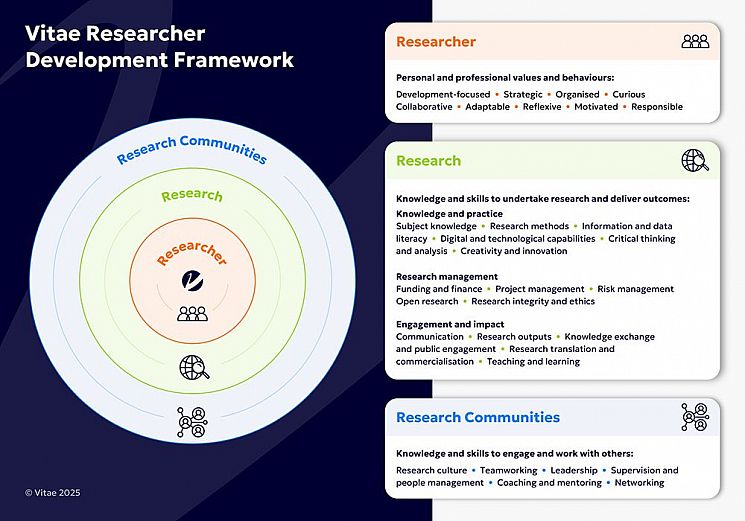
Co-developed with researchers, institutions, funders and HE professionals, and updated in 2025, the RDF is an incredibly useful tool to identify the skills you need and the areas you want to focus on in the next step of your journey.
The RDF recognises the importance of connections between the professional and career development of researchers, and initiatives to further knowledge exchange, research integrity, open research, and research culture. It presents a holistic model to help you become a successful researcher at every stage of your career.
How to use it
It’s up to you to decide what your priorities are, the skills you need to develop, and how that can be achieved. Vitae’s online professional development planning course is a good starting point to help you map out your training needs. We also cover development plans in the annual SRS induction; see our Canvas site for a recording.
Take a look at the three RDF sections in turn: Researcher, Research, and Research Communities. Each section details various skills or attributes that contribute to becoming an effective researcher.
These ‘descriptors’ are broken down into levels or ‘phases’, representing distinct levels of progression within that area. Remember that the RDF applies to the whole research career, not just to a PhD – there is no expectation that you will advance to a high phase unless you have a particular focus or ambition.
Using the full version of the RDF, work through each descriptor and decide which phase you are in right now. Being a PGR does not mean you necessarily sit at phase 1 for every skill - you bring all sorts of previous experience with you into your research degree!
From there, work out which skills you need to develop to help you over the next six to 12 months. Use what you’ve found to inform your Training Needs Analysis and conversations with your supervisor. It may be helpful to look through the RDF together.
Use the framework to help you:
- explore all the aspects of being a researcher
- identify your strengths – what you already know
- prioritise areas for professional development – what you need to know next
- write a plan, then monitor progress and success
- have productive discussions with others - your supervisor, careers advisor, librarian or other development provider
- look for formal and informal development opportunities
- prepare for one-to-one progress reviews or career development conversations with your supervisor or a mentor.
When you are looking at future career options or goals, the RDF helps you to:
- consider the capabilities and experiences that will enhance your career prospects
- assess opportunities provided by your institution and look for development opportunities outside your research
- highlight, articulate and provide evidence of your transferable skills and expertise in your CV, in job applications and at interviews.
Further Vitae resources
Vitae is an internationally recognised programme dedicated to championing careers in research. It is led by a charity, the Careers Research and Advisory Centre, working to enhance the potential of researchers in the UK.
Vitae's website has many useful resources, including advice for postgraduate researchers at each key stage and guidance for your career development.
To get full access to the website, simply register with your Sussex email address. The University does not subscribe to the separate RDF Planner but you can purchase an annual subscription relatively cheaply.
See also
- Further development opportunities at Sussex and beyond.
- Career resources – guidance and support from the Sussex Careers team.