

News
Sussex researcher discovers lost Tudor manuscript pages in Brighton archive
By: Imogen Harris
Last updated: Thursday, 17 September 2026
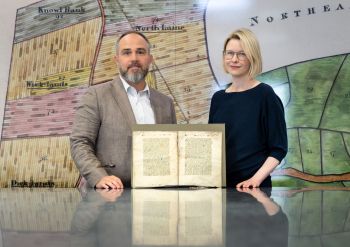
Dr Katie Walter and Dr James Wade in The Keep archive, Brighton, with the fragment of Nicholas Love’s early 15th-century Mirror of the Blessed Life of Jesus Christ
Six lost pages from a book which went from medieval religious bestseller to being a ‘risk to life’ have been discovered in an archive at The Keep, Brighton. The discovery was made by Associate Professor in Medieval English Literature at the University of Sussex, Dr Katie Walter, and Dr James Wade of the University of Cambridge.
The pages were from a copy of Nicholas Love’s Mirror of the Blessed Life of Jesus Christ, a religious text that was widely circulated in the 15th century but was subsequently banned following the Reformation. The six pages had been separated from the rest of the manuscript before a 19th-century rebinding. They were deposited with the Sussex Archaeological Society in 1929, later transferred to the East Sussex Record Office and moved to The Keep in 2013. The rest of the manuscript is currently held at Yale University in the US.
The connection was discovered when Dr Walter and Dr Wade examined a digitised version of the manuscript held at Yale’s Beinecke Library. They noticed a gap in the text that matched the pages held in Brighton. The handwriting and missing text provided further evidence that the fragments belonged to the same book.
The manuscript itself was owned by Sir John Gage, a prominent Tudor courtier whose family home was at Firle Place, near Lewes. Gage was closely involved in Henry VIII’s dissolution of the monasteries, and researchers believe the book may have come into Gage’s possession during this period, when many Catholic books were being destroyed or removed from monasteries.
“The fact two possible owners before Gage were religious women suggests the manuscript might have been in a monastic house before it came into his possession,” says Dr Walter. “The dissolution of the monasteries led to the destruction of many books but others were taken and then circulated through informal networks.”
Gage himself was a major figure in the Reformation. Yet, despite his role in dismantling monastic institutions, Gage appears to have preserved this particular Catholic book.
“We often associate this period with book burning and destruction, so this manuscript’s story goes a bit against that grain,” says Dr Walter. “It reminds us that people were also rescuing, valuing and caring for books.”
Read more about the story here: Henry VIII enforcer ‘secretly saved Catholic book he was meant to destroy’
This work supports the UN’s Sustainable Development Goal: SDG 11 (sustainable cities and communities). You can read more about our work on the SDGs here.