News
Spotlight on Researchers: Dr Avey Nelson
Posted on behalf of: Sussex Researcher School
Last updated: Monday, 18 May 2026
The Journey into Research
Growing up alongside the rise of the commercialised internet sparked my interest in communication, technology, and power. As an undergraduate I worked as a peer tutor at the university’s writing centre. I was studying at St. John’s University (Queens, NY, USA) and conducted research on the discourse used in synchronous online writing tutoring sessions.
I presented my work at the Conference on College Composition and Communication in 2013. This was really the beginning of my research career and a great way to learn about research ethics while getting to go to Las Vegas. After graduating I worked as a Learning Support Specialist at Central Arizona College (USA), which helped inform the pedagogical aspect of my research degree and career.
These experiences led me to study a Masters and then a PhD in English on Rhetoric and Composition. This field enabled me to research different topics while maintaining a strong emphasis on writing. My PhD focused on digital humanities and queer theory with my thesis, ‘Computers Can’t Get Wet: Queer Slippage and Play in the Rhetoric of Computational Structure’. It examined the interplay that occurs between the layers of the computational stack and identified the potential of queer exploitation. The research specifically examined biohacking, sex work and video game speedrunning communities. Alongside this, I made a video game called Pittsburgh 10 in Unity 2D to demonstrate my theoretical claims.
Current Research
At Sussex, I’ve had the amazing opportunity to expand my research profile to encompass critical approaches to genetic engineering technologies and queer cultural and creative heritage.
My critical research into genetic engineering technologies began with a collaborative project which examined media representations of CRISPR, a biotechnology used to edit DNA. The work focused on human applications of DNA editing and analysed the UK press and social media from 2012 to 2022. This period included the CRISPR craze, the He Jiankui controversy involving editing human embryos, and the onset of gene therapy clinical trials. It addressed the relationships between specialist science reporting and the mainstream press, by analysing three key figures; the double helix, the scientist and the human subject.

Following this our team pivoted to studying de-extinction, or the science of ‘reviving’ lost species by genetically engineering existing ones. Our current project, De-Extinction Stories, maps the actors, networks, and materials involved in the science. We are following work on three species; the woolly mammoth, the Tasmanian tiger (thylacine) and the northern white rhino. The research is contributing to a comprehensive understanding of de-extinction as a socio-technical phenomenon. It highlights the impact, not only on the species that it seeks to restore, but also on the affected cultures, environments and technologies.
My work in queer cultural and creative heritage began with Diverse Alarums. I served as the co-investigator on this project and, with the principal investigator (PI), successfully bid for over £1 million in funding from Arts and Humanities Research Council (AHRC). Working on this project broadened my experience of planning and delivering a complex programme across many different groups.
Working on the project involved hosting two theatre productions, a large-scale outdoor staging of John Lyly’s Galatea (1588) at the Brighton Festival and a queer cabaret with acts inspired by history. This project challenged the boundaries between research and practice and introduced me to working with different local queer communities and organisations.
My work around queer cultural and creative heritage has been particularly impactful due to its connections with the local area. For the ‘Queer Histories in Cabaret’ project we commissioned five queer cabaret artists to develop new acts to perform at the Attenborough Centre for the Creative Arts (ACCA). We also worked with Marlborough Productions, a Brighton-based queer production company, and local creative practitioners to provide support throughout the artist’s residencies.
I typically resist disciplinary boundaries, which can be a challenge. Although the phrase ‘interdisciplinary’ is often used, it is constantly evolving and therefore difficult to define. Alongside this, I often prefer working in teams on large-scale projects with multi-modal outputs. For instance, the De-Extinction Stories project’s core team is non-hierarchical, and I have occupied different positions throughout the project both in leadership (PI) and more supporting roles. This can be challenging as collaborative work has traditionally been valued differently than single-authored work within many humanities disciplines.
Achievements and the Future
We annually present our updates on our De-Extinction Stories at the Society for Social Studies of Science (4S) conference. We were also invited to present our work on Tasmanian tiger de-extinction at Cambridge’s History of Modern Medicine and Biology Seminar Series, which provided an incredible sounding board for the piece.
The next steps on De-Extinction Stories will involve conducting fieldwork in Australia and New Zealand, hosting creative storytelling events in Brighton and Hobart and writing a book to present our findings. As it is still an emerging discipline, we have begun to form a ‘Critical De-Extinction Studies’ consortium.

My work with the Centre for the Study of Sexual Dissidence (‘Sex Diss’) and the Sussex Digital Humanities Lab has turned to digitally archive Sex Diss's history at the institution. This will feed into a broader project about queer heritage, theory, and practice.
Independently, I recently presented on my initial analysis for a new project that considers the intersection of gender and sexuality and neoliberalism during the digital age. I’m developing this into a research article. Alongside this, I continue to work on my creative practice – the quintessential novel, a podcast and film photography.
It’s cliché, but I think that the best part about research is the friends and colleagues. I have met some incredible people who are extremely knowledgeable and it has been exhilarating to work alongside them. Together we have worked productively and collaboratively to build the infrastructure which enables us to continue to progress.
Interview by Shona Clements
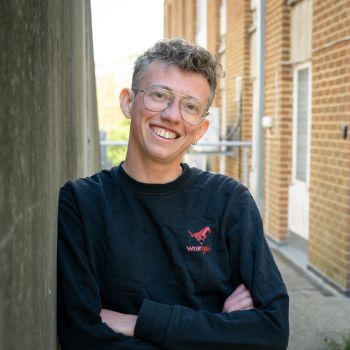
Third photo - credit Kaleido Shoots
Avey's Links
Are you an ECR and like to be featured in the series?
If so Apply Here