News
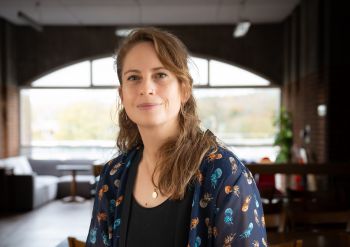
Spotlight on Researchers: Dr Rebekka Kesberg
Posted on behalf of: Sussex Researcher School
Last updated: Monday, 26 January 2026
The Journey into Research
For a long time, I hadn't realised that I could become a researcher. At the start of my undergraduate degree I had fully intended on becoming a psychotherapist, focusing on trauma experiences. However, I found social psychology and conducting experiments to be the most interesting aspect of my degree. After graduating I took a break for a year, volunteering abroad, before deciding to do a Masters in Social Psychology at the University of Göttingen, Germany.
It wasn’t until I worked as a research assistant and completed a research internship that I recognised how much I enjoyed the research process. I am a naturally curious person and I find it really fulfilling to explore and understand phenomena. I knew that I wanted to work in research but took another break after my Masters before pursuing a PhD.
My PhD explored personal values as a lens through which we perceive others and the social world around us. I was interested in how our perception and understanding of social situations are shaped by values and, therefore, influence prosocial behaviour. Initially, however, I was researching how different pay-off structures and punishment options impact individual’s cooperative behavior in social dilemmas. Personally, I found that the research was too focused on external circumstances and lacked a deeper dive into people’s internal motivations across situations and behaviors. I shifted my focus to values as guiding principles in people’s lives across different social situations.
After finishing my PhD, I wasn’t sure about continuing with research and knew that I needed a change. I rejected a post-doc position in the department in which I completed my PhD as, even though I enjoyed my studies, it wasn’t the right department for me. I started applying for jobs outside of academia but also kept looking for my ideal post-doc position. The position in Matt Easterbrook’s project on polarization and democracy immediately caught my interest. Despite not knowing where Brighton was, I applied and was successful!
The Research
I have worked on multiple topics, but values and politics have always been present within my work and personal life. My current research topic emerged out of observing the present political landscape. I am investigating the conditions under which people support a resilient and militant democracy when faced with anti-democratic political individuals. Specifically, I explore whether people perceive others in society, especially supporters of other political parties, as fellow democratic citizens or threats to democracy. My findings indicate that people who identify as democratic citizens show more tolerance and less biases towards other groups, as long as they perceive them to also be democratic. Conversely, if groups and individuals are perceived as anti-democratic, people are more likely to justify violent attacks against them.
My research indicates that creating a shared democratic civic identity can help to bridge societal divides. I think we are living in such polarized and politically difficult times. Therefore, it is important to build alliances across party lines, whilst maintaining vigilance against anti-democratic entities. When democratic parties fight amongst themselves, the non-democratic groups win.
I think conveying neutrality and objectivity can be challenging. As, naturally, I have a political opinion, people might infer that my work is politically motivated or question whether I can conduct research objectively. I have received backlash for my work on anti-gender and gender critical movements as this has been seen by some individuals as “woke” research.
I view methods as tools and believe that good research looks at a phenomenon holistically and combines multiple research methods. I was educated in an experimental quantitative department, but since then I have utilized a range of research methods. I think it is key to apply the right methods for the specific research question and there is no superior method that fits all.
I strongly believe that transparency and open science are crucial to ensure that research methods are robust. At the same time, I believe as researchers, citizens and human beings we are allowed to have informed opinions and speak out against hate, sexism and other societal problems.
Achievements and the Future
I was awarded Researcher-Led Initiative funding to co-run a conference, bringing together Sussex researchers interested in collective action and political representation. We invited three senior speakers and had seven presentations by PGRs and ECRs from Psychology, Global Studies and IDS. The talks ranged from work using ethnographic approaches to research homelessness in our local area, to using longitudinal data to understand collective action in Chile. The conference successfully generated a lot of discussion, learning and connection.
Recently I presented at the International Society of Political Psychology (ISPP) 2025 annual conference in Prague. I shared findings from my current work that indicate that individuals who endorse democratic values show less ingroup biases in moral judgements. At the Politics of Gender 2024 conference in Ghent, I presented work from another project, focusing on anti-gender movements and the narratives they use to oppose gender equality.
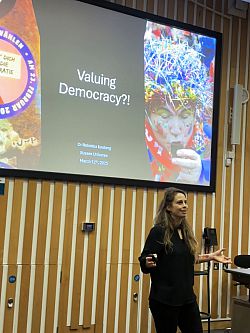
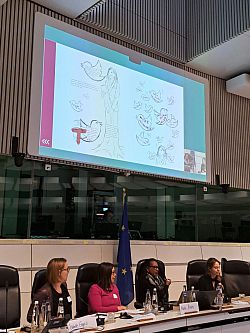
I have also been invited to share my work at public events organized by political foundations. In October 2025, I was invited to the ‘Brussels Democracy Dialogue 2025: Time to reset! How can we revitalise European democracies?’ event by the Friedrich-Ebert Stiftung. I spoke in a session on the European Democracy Shield and shared my work on how anti-gender and anti-democratic entities use social media to spread harmful narratives. It feels great seeing my work make an impact beyond academic journals and to meet policymakers and politicians in person.
I was part of a fantastic collaboration, working with the artist Beldan Sezen who translated my research into comics. The cartoons are available on the project website or Beldan’s Instagram account.
I obtained a New Investigator Grant from the Economic and Social Research Council to fund my current project. The funding covers two and half years for my research but also has a focus on my development as a researcher. This has allowed me to cover costs for workshops to learn and explore new methods.
I have applied for an ERC Starting Grant and writing the application confirmed to me that I am really passionate about conducting the research. My proposal focuses on micro-democratic acts in daily life and the relevance of democratic means in shaping how people engage in their social relationships. It also explores civic education and empowerment through lived experiences in public spaces, which really excites me.
I strongly believe that a better, kinder and more democratic society is possible and that we all can contribute to it.
Interview by Shona Clements, Sussex Researcher School
Are you an ECR and like to be featured in the series?
If so Apply Here