

News
REAL-NbS Knowledge Dissemination and Farmers’ Engagement in Ethiopia
Posted on behalf of: Dr Bayu Dume, REAL NbS researcher at Jimma University, Ethiopia
Last updated: Friday, 30 January 2026
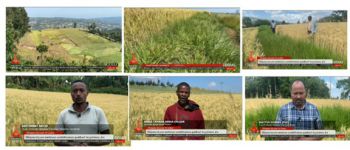
Our Jimma team on national TV with NbS testing grounds in the background
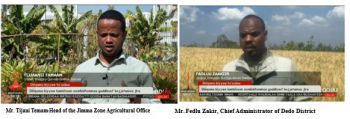
Mr. Fedlu Zakir, Chief Administrator of Dedo District, and Mr. Tijani Temam, Head of the Jimma Zone Agricultural Office
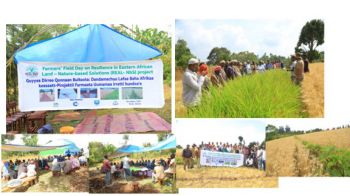
General discussions at Farmers Field Days
Our Jimma University team (Ethiopia), comprising Dr Bayu Dume, Getinet Seid, and Dr Amsalu Nebyiu, has made strong progress in translating scientific knowledge into practical action through effective awareness-raising, knowledge dissemination, and direct farmer engagement. Two main pathways have been central to this process: awareness creation and knowledge dissemination, and Farmers’ Field Day activities.
Awareness creation under the REAL-NbS project has taken place through mass media outreach, institutional engagement, and the involvement of local leadership. At the national level, the project collaborated with the Ethiopian Broadcasting Corporation (EBC) and the Fana Broadcasting Corporation (FBC). Programmes were broadcast in Afan Oromo and Amharic via television and radio, ensuring wide coverage and accessibility. These broadcasts introduced Nature-based Solutions (NbS), highlighted their role in land restoration, and shared practical experiences from project implementation sites.
Engagement with local and zonal leadership further reinforced these messages. Mr. Fedlu Zakir, Chief Administrator of Dedo District, and Mr. Tijani Temam, Head of the Jimma Zone Agricultural Office, delivered key messages emphasising the importance of NbS. Communications focused on the contribution of NbS to restoring degraded landscapes, improving soil and water conservation, enhancing crop productivity, and strengthening farmers’ livelihoods. NbS were also presented as cost-effective, environmentally friendly, and locally appropriate solutions, supported through strong collaboration among researchers, extension workers, development partners, and farmers. These efforts have contributed to growing farmer awareness and demand for NbS practices, alongside clear commitment from authorities to scale up proven interventions.
Farmers’ Field Days complemented awareness creation by providing interactive, hands-on learning opportunities. These events brought together farmers, extension workers, researchers, and local leaders at demonstration sites, where participants could observe NbS practices under real field conditions, ask questions, and learn from peer experiences.
Discussions during the field days highlighted their effectiveness in increasing community interest in NbS practices. Visual demonstrations improved understanding and trust, and farmers particularly valued seeing how interventions performed in practice. Peer-to-peer learning played an important role in strengthening knowledge exchange.
A strong and recurring message emerged throughout these discussions: seeing is believing.
Further information: https://www.sussex.ac.uk/research/projects/land-degradation-nature-based-solutions/