

News
New book explores how pointing connects humans and animals
By: Justine Charles
Last updated: Tuesday, 6 October 2026
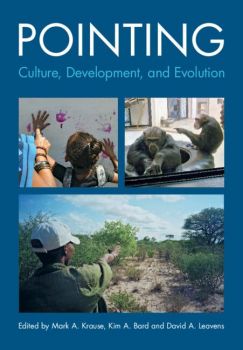
The images illustrate three themes: Culture (pointing is culturally and contextually variable in form among humans), Development (pointing unfolds differently across different cultures), and Evolution (animals point too).
A new book co-edited by Dr Dave Leavens, Emeritus Reader in Psychology at Sussex, brings together leading international research on one of humanity's most familiar forms of communication: pointing.
Published by Cambridge University Press, Pointing: Culture, Development, and Evolution has been edited by Dave alongside long-time collaborators Mark Krause and Kim Bard. Featuring 22 chapters from 42 researchers around the world, the book explores how pointing develops, how it varies across cultures, and what it can tell us about the evolution of communication in both humans and other animals.
The publication marks the culmination of more than three decades of research and collaboration between the editors, whose shared interest in pointing began in the mid-1990s.
While studying chimpanzee behaviour as a doctoral student in the US, Dave observed something that challenged a growing scientific consensus of the time: that pointing was a biologically given gesture unique to humans. Working with chimpanzees named Clint, Anna and Flora, he and his colleagues carried out one of the first systematic studies of animal pointing.
Reflecting on those early experiences, Dave said: “In 1994, I was trained to a high standard of performance by a chimpanzee named Clint.”
The team's research showed that chimpanzees used pointing intentionally and communicatively, typically only when another individual was present to observe the gesture. The findings challenged influential theories that viewed pointing as a uniquely human adaptation associated with language learning and development.
Dave's work also has strong Sussex roots. Before joining the University in 2000, he corresponded with the late Prof George Butterworth, a leading developmental psychologist at Sussex whose work helped shape contemporary thinking about pointing in infancy. Although the two researchers held different views on the origins of pointing, Dave recalls Butterworth's openness to debate and evidence, describing him as one of the most collegial scientists he ever met.
Following Butterworth's death in 2000, Dave collaborated with his final doctoral student, Brenda Todd, on research into communication and parent-infant interaction. Their work contributed to a growing body of evidence that communicative behaviours develop through social interaction and experience, as well as biological factors.
The new book is organised around three themes: culture, development and evolution. Contributors examine the ways pointing is shaped by cultural practices across different societies, highlighting how assumptions based on Western populations do not always reflect the diversity of human experience worldwide. Other chapters explore pointing and gesture use among animals including apes, monkeys, elephants, domestic pets and farm animals.
Bringing together perspectives from psychology, anthropology, developmental science and animal behaviour, the book offers a state-of-the-art overview of a dynamic field and reflects the continued importance of questioning assumptions about what makes human communication unique.
Pointing: Culture, Development, and Evolution represents the latest chapter in a research journey that began with a curious chimpanzee, a provocative scientific question, and a gesture most of us use every day without a second thought.