

News archive
Student's uncommon efforts uncover scholarly gem
By: Alison Field
Last updated: Tuesday, 23 November 2010
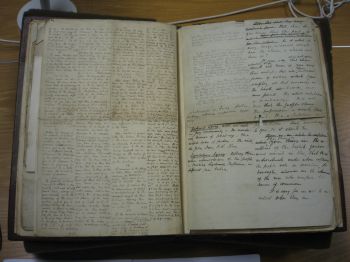
An extract from one of James Mill's common place books
A Sussex student who discovered a "treasure trove" of historical research locked away on a computer for 20 years has this week published the complete work online.
Kris Grint, who is studying for a doctorate in Intellectual History, played detective to track down the "lost" research of Canadian academic Robert Fenn, who died before he could publish more than a decade's work on the 18th-century Scottish philosopher and radical thinker James Mill.
Now the research student has published Professor Fenn's typescript on a special website, revealing how Mill shaped the ideas that were to influence a generation of radical thinkers, including his son John Stuart Mill.
The importance of dissent, the abolition of slavery, freedom of the press, the extension of the vote and an end to the House of Lords were all subjects close to the heart of James Mill.
He shared his scholarly thoughts on these and other topics in a series of manuscript volumes - the common place books - spanning the period 1806 until the mid 1820s.
It is these books - five thick ledgers equating to about 1,200 pages of typescript - that Toronto University academic Professor Fenn spent a decade transcribing before his death. Now the results of his work will be available for all to study online.
Kris began work on the research - funded by the Arts and Humanities Research Council (AHRC) - in 2008.
Having found excerpts from the transcripts in the Mill archive in the London Library, Kris traced Professor Fenn's literary executor out in the wilds of Ontario and talked him through the delicate operation of extracting Professor Fenn's valuable work from his computer, which had lain idle for 15 years.
Kris was delighted with the find. He says: "I'd been looking at the original manuscripts in the London Library and at LSE and was convinced that transcribing the material from scratch would take me absolutely years, as Mill's original hand is extremely hard to read.
"I was of course very excited when the material from Canada came through and I realised it was complete.
"I think it's definitely a lost treasure. Some academics I contacted had seen it, some had early drafts of it in their possession, but no-one knew if Fenn had actually finished the work before he died and, if so, where a completed version of it might be.
"What was exceptional about the typescript is the level of detail Fenn had put in to the research. He had checked every single citation of other books Mill made to ensure it was correct and provided an updated, scholarly reference, he had provided editorial notes for each chapter, and he had translated the material that was in Greek, Latin and French into English. The amount of work done was incredible."