Research news
Astrophysicists discover earliest known ‘starburst’ galaxy in Universe
Posted on behalf of: School of Mathematical and Physical Sciences
Last updated: Thursday, 18 April 2013
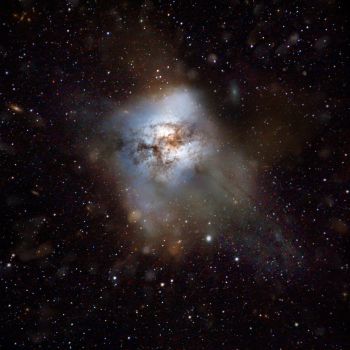
An artist's impression of the distant 'starburst' galaxy HFLS3. Courtesy of the European Space Agency
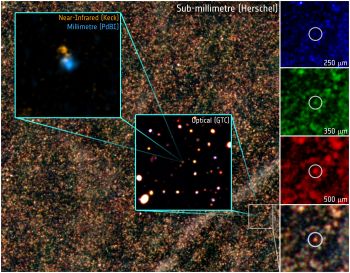
The galaxy HFLS3 as revealed by Herschel and further ground-based telescope observations. Images: ESA/Herschel/HerMES/IRAM/GTC/W.M. Keck Observatory
University of Sussex astronomers using the Herschel Space Observatory are part of an international team that has discovered a distant star-forming galaxy that challenges the current theories of galaxy evolution.
Seen when the Universe was less than a billion years old (880 million years) the galaxy, known only as “HFLS3”, is forming stars at a much faster rate than should be possible according to existing predictions. In the infant Universe, galaxies should have been forming stars at a much slower rate than is observed in HFLS3.
HFLS3 is so distant that the light we see from it has taken 13 billion years to get to Earth.
The Herschel observatoryhas been surveying the distant cosmos and finding hundreds of thousands of distant galaxies. Images produced by Herschel show how fast these distant galaxies are forming stars.
By determining the ages of the galaxies, astronomers have been building up a cosmic timeline of star formation, searching for when the first massive galaxies started churning out stars.
University of Sussex PhD student Peter Hurley, Dr Isaac Roseboom, Dr Anthony Smith, Dr Lingyu Wang and Professor Seb Oliver, who leads the HerMESsurvey that found the galaxy, analysed data from Herschel and built the HFLS3 galaxy as a computer model to discover what conditions are like in the galaxy.
Peter says: “The stars being born in HFLS3 heat up the surrounding material within the galaxy. This material contains gas molecules such as carbon monoxide and water, which emit their own unique signatures when heated. By comparing the telescope observations with models, we can gain a better understanding of the conditions within this extreme galaxy.”
The galaxy “HFLS3” was first seen as a small red dot in the Herschel images, and its colour is what first intrigued the team because red galaxies might be very distant.
Further investigations using optical and near-infrared telescopes the Gran Telescopio Canarias in the Canary Islands and the Keck Telescope in Hawaii helped to rule out any other effects that might cause the HFLS3 galaxy to look so bright.
It was observations with radio and millimetre-wave telescopes, such as the Plateau de Bure Interferometer in the French Alps, which determined that this tiny galaxy, only around one twentieth the size of our Milky Way, is seen at such an immense distance.
These additional observations also showed that HFLS3 is incredibly rich in carbon, nitrogen and oxygen, forming compounds such as carbon monoxide, water and ammonia. These compounds reveal the physical processes at work in this distant galaxy.
Combined with the Herschel observations, these measurements allow the astronomers to deduce that this tiny star factory is producing stars around two thousand times faster than our own Milky Way, making it a type of galaxy known as a “starburst”. Environments like this do not exist on galaxy-wide scales in the Universe today.
Professor Oliver says: “We’ve shown that Herschel data can find these extreme examples. The next step is to sift through the Herschel data more carefully, and try to deduce just how common such galaxies were in the early Universe.
“I am also very pleased that a Sussex PhD student has been able to make an important contribution to this work.”