Research news
Sussex chemist takes her research to Parliament
Posted on behalf of: Chemistry
Last updated: Monday, 18 March 2013
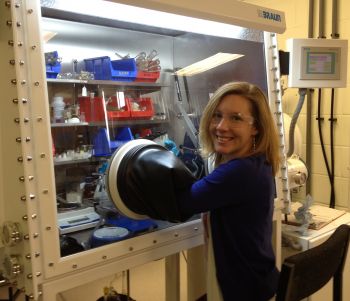
PhD student Jessica Higgins in the chemistry lab at Sussex where she is conducting her research on uranium complexes for small molecule activation.
A Sussex research student is attending Parliament today (Monday 18 March) to present her science to a range of politicians and a panel of expert judges, as part of a national poster competition.
Jessica Higgins’ poster on her research about uranium complexes for small molecule activation will be judged against dozens of other posters as part of SET for Britain, the only national competition of its kind.
Jessica, who is studying for her PhD at Sussex under the supervision of Professor Geoff Cloke, was selected from hundreds of applicants to appear in Parliament.
She says: “I applied to take part in the SET for Britain competition because I believe it is important for scientists to have a forum for communicating their research to a wider audience, particularly to MPs and other influential people as it is vital that they have an insight into current scientific endeavours in the UK.
“I am looking forward to meeting other young researchers from around the country and talking about my research to people from both scientific and non-scientific backgrounds.”
Jessica’s research has been entered into the Chemistry section of the competition, which is judged by leading academics. The gold medalist receives £3,000, while silver and bronze receive £2,000 and £1,000 respectively.
Andrew Miller MP, Chairman of the Parliamentary and Scientific Committee, says: “This annual competition is an important date in the parliamentary calendar because it gives MPs an opportunity to speak to a wide range of the country’s best young researchers.
“These early career scientists are the architects of our future and SET for Britain is politicians’ best opportunity to meet them and understand their work.”
The Parliamentary and Scientific Committee runs the event in collaboration with the Institute of Physics, The Physiological Society, the Royal Academy of Engineering, the Royal Society of Chemistry, the Society of Biology and the Society of Chemical Industry, with financial support from BP, Airbus/EADS, INEOS, AgChemAccess, Essar, the Institute of Biomedical Science, GAMBICA and WMG.