Research news
Sussex co-organises unique workshop in China on genetics and ethnicity
Posted on behalf of: Centre for Bionetworking and Department of Anthropology
Last updated: Tuesday, 7 May 2013
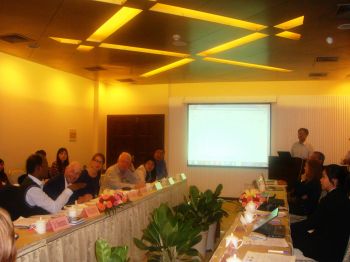
Dr Prasanna Patra (seated left), a post-doctoral researcher at Sussex, asks Professor Jiayou Chu (standing at the lectern), head of China's genetic bank of ethnic minorities, about the ethical aspects of genetic sampling practices of researchers in China.
An international workshop at the weekend on genetics and race was the first of its kind to be held in China.
The Centre for Bionetworking and the Department of Anthropology at Sussex co-organised with Chinese and German partners the international Sigenet Workshop on Genetics and Race, which took place in Kunming from 3-5 May.
The interdisciplinary event brought together 35 experts in genetics, molecular biology, anthropology, sociology, law, philosophy and medicine from all over the world: USA, Belgium, Netherlands, UK, India, Germany, Taiwan and mainland China.
The workshop – which aimed to address ethical and social concerns related to the sampling, banking and research of human DNA of vulnerable ethnic and minority groups, such as people with disabilities - identified a number of issues in need of public discussion.
One main issue concerned the relation between the genetic characterisation of genetic group samples and the categorisation of ethnic minorities, which has led to debate about genetic discrimination in many countries. The experts discussed how scientists could take responsibility by actively correcting misinterpretations of their work.
Another main issue concerned the indirect discrimination occurring with the ability to test a foetus for a whole range of traits considered “undesirable” in society. The workshop urged reflection about the norms and values that underpin a resolution to give birth to “high-quality children”, lest they threaten to devalue the lives of members of society.
Further discussion was held on the feasibility of selecting embryos for traits such as intelligence, while at the same time attracting attention to the increasing demand for technology to facilitate the birth planning of “ideal” offspring. This discussion is to be continued at other international forums.
The host of the workshop, Jiayou Chu from Peking Union Medical College in Kunming, heads the world’s largest ethnic DNA bank, housing the immortalised cells of China’s ethnic groups and subgroups.
The co-organiser, Huanming (Henry) Yang, co-founder of the Beijing Genomics Institute (BGI), the world’s largest DNA sequencing company, suggested the theme of the workshop, as he attaches great value to discussion of the ethical consequences of life science in society.