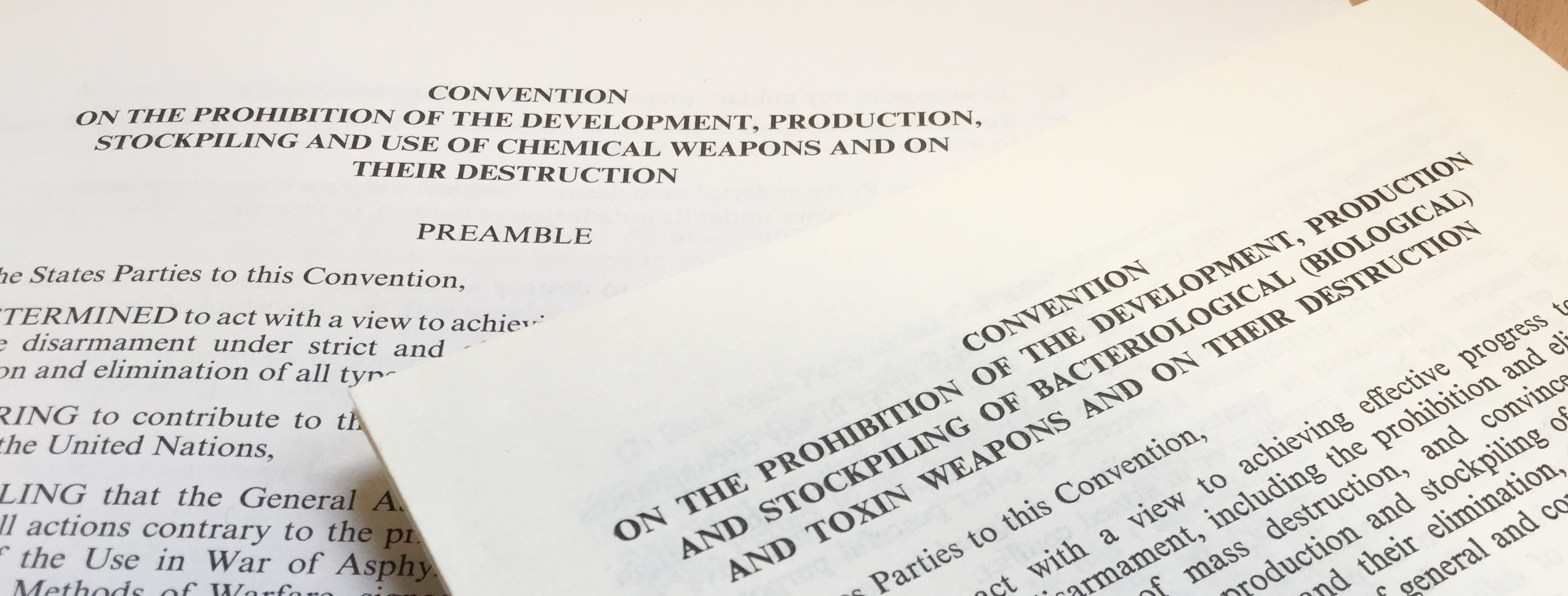
CWC and
BWC Experience Sharing
13th Workshop
of the Pugwash Study Group on the Implementation of the Chemical
and Biological Weapons Conventions: 8-9 April 2000, Oegstgeest,
The Netherlands
Participants
List of Papers
Workshop
Report
by Daniel Feakes
THIS was the
seventh of the current Pugwash CBW workshop series, held in collaboration
with the Harvard Sussex Program, to be hosted by Pugwash Netherlands.
The Dutch ministries of foreign affairs, economic affairs and defence
provided financial assistance for this meeting. The meetings were
held in the Oud Poelgeest Conference Centre in Oegstgeest. Participating
by invitation were some 37 people from 15 countries (Australia,
Belgium, China, Finland, France, Germany, India, Ireland, Italy,
Netherlands, Poland, Russia, Switzerland, the UK and the USA), all
of them doing so in their private capacities. The present report
is the sole responsibility of its author, who was asked by the meeting
to prepare a report in consultation with the Steering Committee.
It does not necessarily reflect a consensus of the workshop as a
whole, or of the Study Group.
The workshop
concentrated on the sharing of experiences between the Chemical
Weapons Convention (CWC) and the Biological Weapons Convention (BWC).
Discussions were greatly facilitated by the presence of individuals
directly involved in the subject, either with the Organisation for
the Prohibition of Chemical Weapons (OPCW) in The Hague or with
the Ad Hoc Group (AHG) which is negotiating a BWC protocol in Geneva.
While previous workshops in this series have addressed lessons that
could be learnt from the CWC for the BWC protocol, this workshop
looked in particular at the practical experiences of implementing
the CWC, the implications for its implementation and for the negotiation
and implementation of the BWC protocol. There was also input from
individuals who had been involved in the work of the United Nations
Special Commission (UNSCOM) to eliminate Iraq’s chemical and biological
weapons.
Reports from
international CBW bodies
As is the custom
within the Study Group, the workshop opened with brief reports on
activities relevant to the implementation of the CBW conventions.
CWC: Progress
in Implementation
The workshop
was fortunate to have participation from a number of individuals
involved in the OPCW. Participants therefore received a detailed
briefing on the current status of implementation of the CWC and
on some of the challenges facing the OPCW. The Executive Council
had convened for its nineteenth session immediately prior to the
workshop.
As of early
April, 132 states have joined the CWC and a further 39 have signed
the Convention but have yet to complete the final step of ratification.
Rather more than 20 states have yet to make any commitments under
the CWC. This unprecedented rate of growth has been achieved in
under three years -- 29 April 2000 is the third anniversary of the
entry into force of the CWC -- and compares well with other major
arms control treaties. However, problem areas still exist, particularly
the Middle East where the CWC has been linked to regional security
issues.
With respect
to the submission by states parties of initial declarations, a recent
political initiative by the Secretariat and states parties has reduced
the number of outstanding declarations from around 35 to 10, with
the prospect of further submissions before the fifth session of
the Conference of the States Parties in May. However, a large minority
of states parties have failed to submit other required notifications
and to implement the Convention nationally. As of 3 April the OPCW
had conducted 685 inspections at 336 sites in 35 states parties.
The focus has been on chemical weapons facilities and on chemical
weapons destruction facilities in particular, where the CWC requires
the permanent presence of OPCW inspectors when chemical weapons
are being destroyed. Destruction operations will reach a peak in
the period from 2003 to 2005, and will necessitate either the recruitment
of around 200 additional inspectors or changes in the verification
regime applied to such facilities. With regard to industry inspections,
the workshop heard that a number of issues remain to be addressed,
including the frequency of inspections, the balance between inspections
to the different categories of industrial facilities, the declaration
and transfer thresholds for scheduled chemicals in low concentrations
and the extent of access by inspectors to plant sites and records.
Over one third
of the chemical weapons production facilities declared have already
been certified as destroyed; 21 facilities of a total of 60 declared
by nine states parties (China, France, India, Iran, Japan, Russia,
UK, USA and one unidentified state party). Two additional facilities
have been converted to peaceful purposes, three more have been approved
for conversion and a further six have been recommended for conversion.
Of the remaining 28 facilities, around 21 might also be converted
and the rest will have to be destroyed. Chemical weapons are currently
under OPCW verification at 31 storage facilities in four states
parties (India, Russia, USA and one unidentified state party). In
the USA chemical weapons are being destroyed continuously under
OPCW monitoring at three destruction facilities, while destruction
operations are also underway in two of the three remaining possessor
states. As of 1 March, OPCW inspectors have witnessed the destruction
of 1,140,000 munitions and bulk containers and 4,284 tonnes of chemical
agent out of the 8.4 million munitions and bulk containers and 70,000
tonnes of agent that have been declared. According to the CWC, states
parties should have destroyed one per cent of their stockpiles by
29 April. The USA, India and an unidentified state party have already
met this deadline, but Russia has requested, and been granted, an
extension to the deadline as it has not yet destroyed any chemical
weapons.
BWC: Work
of the Ad Hoc Group
Workshop participants
heard a presentation on the latest developments within the AHG and
then heard from a number of people actively involved in the negotiations.
The AHG had concluded its nineteenth session on 31 March. Since
its establishment, the group has met for fifty weeks, with between
six and eight more planned for this year. At this stage, it appears
that everything necessary for the protocol is already included in
the current draft (the "rolling text"); in 1996 there was an average
of seventeen working papers submitted per week, whereas that figure
is now down to one per week. The rolling text produced by the nineteenth
session will be the twelfth such version, and reflects a steady
reduction in the number of square brackets, which indicate text
upon which agreement still has to be reached. The number of square
brackets peaked in late 1998 with more than 3,000 in total, roughly
12 per page. However, by April 2000 this figure had fallen to less
than 1,500 and around 5 per page.
The nineteenth
session adopted new working methods, involving more informal meetings
between delegations, which should allow the friends of the chair
to focus on the remaining contentious issues. The 25th anniversary
of the BWC fell during the last session of the AHG, on 26 March.
This was occasion for a number of important events: statements by
the UN Secretary-General, the three depository governments and various
foreign ministers; NGO events in Geneva and New York; and the publication
by the Department of Peace Studies at the University of Bradford
of a proposed "clean text" of the protocol.
It appears that
the negotiations are now poised at a delicate moment. The negotiators
have gone as far as possible in drafting the protocol and in reducing
the number of square brackets. Many workshop participants commented
that it was now time for a higher level of political involvement
in order to prepare for the concessions and compromises that will
have to occur during the endgame of the negotiations. It was also
suggested that the responsibility for moving the negotiations forward
lies with the AHG chairman, although it was also felt that the time
is not quite right for him to introduce a "clean text". It was recalled
that the USA announcing it wanted a completed text within one year
provided momentum in the endgame of the CWC negotiations. So far,
no AHG delegation has set a similar deadline, although the negotiations
are important to many delegations as they are the only multilateral
disarmament treaty negotiations currently underway.
Despite the
impressive progress made, a number of issues still remain to be
resolved. Among these are issues which can only be resolved at a
higher political level, such as the balance between technical co-operation
and export controls, whether the provision for clarification visits
should also cover undeclared facilities, the initiation procedure
for field and facility investigations and the conditions for the
entry into force of the protocol. Workshop participants also highlighted
the absence of involvement in the AHG by the biotech and pharmaceutical
industries, especially those of the USA. Given that there are only
a few weeks of negotiations left this year and a number of important
issues yet to be resolved, some participants doubted whether the
protocol could be finalised before the end of the year.
UNSCOM
and After
The next report
covered the final activities of UNSCOM in Iraq and the establishment
of its successor, the United Nations Monitoring, Verification and
Inspection Commission (UNMOVIC). The workshop heard from people
involved with both organisations. Looking at the behaviour of the
three main actors -- Iraq, UNSCOM and the Security Council -- the
workshop was told that conflict was practically inevitable. Iraq’s
policy of retaining as many of its weapons of mass destruction (WMD)
as possible led UNSCOM to adopt increasingly intrusive tools and
techniques in an attempt to fulfil its mandate. The enforcement
measures adopted by the Security Council ranged from sanctions,
through statements and resolutions to military action. The behaviour
of the Security Council was characterised by initial staunch support
for disarmament, although as the years passed the Council became
increasingly inattentive to the evolving crisis, reflecting a fading
memory of the Iraqi WMD threat. Later, factors external to the UNSCOM-Iraq
crisis came to dominate and Council members displayed competing
and conflicting objectives. The experience of UNSCOM demonstrates
that there is a clear distinction between the investigation and
enforcement of compliance with disarmament obligations.
Following Operation
Desert Fox and the retirement of Richard Butler UNSCOM went into
a state of abeyance. After months of deliberations, the Security
Council adopted a new resolution on Iraq (S/RES/1284, dated 17 December
1999) establishing UNMOVIC as UNSCOM’s successor. UNMOVIC retains
the rights and privileges of its predecessor but will be staffed
primarily by individuals on UN contracts rather than being seconded
by national governments. UNMOVIC will pay more attention than UNSCOM
to data management and the training and supervision of its personnel.
In contrast to UNSCOM, which initially had strong support from all
the members of the Security Council, UNMOVIC has been established
in a less benign international climate. If UNMOVIC is able to conduct
inspections in Iraq, the focus of its activities will likely be
Iraq’s biological weapons programme. Of all its WMD, Iraq appears
to have tried hardest to retain its biological weapons and there
is evidence that it is still trying to procure materials abroad
and keep its domestic expertise together. Rather than stockpiling
weaponised agent, Iraq appears to be focusing on the bare essentials
of the programme and on the retention of capabilities, making UNMOVIC’s
task particularly difficult.
HSP International
Criminal Law Initiative
Finally, the
workshop was briefed on the progress of the Harvard Sussex Program’s
international criminal law initiative. A draft convention to prohibit
biological and chemical weapons under international law was published
in the December 1998 issue of The CBW Conventions Bulletin. A number
of governments are currently considering the draft and the next
step would be for one or more of them to introduce it to the United
Nations General Assembly’s Sixth Committee.
CWC/BWC EXPERIENCE
SHARING
General
Purpose Criterion
Moving into
its main agenda item on CWC/BWC experience sharing, the workshop
first addressed the implementation of the general purpose criterion
(GPC) by the OPCW and implications for the BWC protocol. It was
noted that the CWC is a complex treaty and that its implementation
is not a simple matter. While the GPC lies at the heart of both
the BWC and the CWC and is essential for dealing with the dual-use
aspect of CBW technologies, making the GPC verifiable is problematic
as it is a standard based on purpose. The OPCW has therefore adopted
a pragmatic approach to its implementation. For example, there was
disagreement between the Secretariat and some states parties as
to whether facilities on their territory were chemical weapons production
facilities. In the end, a pragmatic solution was adopted whereby
the states parties concerned simply destroyed the facilities in
question. A similar problem arose with respect to declarations of
adamsite by states parties. In the past, adamsite has been used
both for riot control purposes and also as a weapon of war. However,
today it is widely regarded as unsuitable for riot control purposes,
due to its high toxicity. The workshop heard how one state party,
which did not know the identity of the producing state or the purpose
of production, had declared its stock of adamsite as toxic waste
and decided to destroy it.
The workshop
debated the value of defining criteria in both the CWC and BWC protocol
contexts. A presentation proposed an approach for those agents of
concern which do not appear in the CWC’s three schedules. Four criteria
for assessing the risk posed by such agents were presented: toxicity,
mass, volatility and availability. Some participants believed that
such criteria would be useful, for example in identifying the unscheduled
chemicals of most concern. However, others believed this would be
a dangerous approach as it would undermine the whole concept of
the GPC, which is based on purpose, rather than on any specific
chemical or physical properties.
In the BWC protocol,
it is envisaged that lists of agents will be used to trigger declarations,
not to limit the applicability of the protocol or the BWC. Implementation
of the GPC in the BWC protocol context is more difficult as all
agents may be used for peaceful purposes; there are none which can
be said to be only of military or other hostile use. It was suggested
that the implementation of the GPC could benefit from a division
of labour between national authorities and international organisations,
in the case of the CWC, the latter would focus, though not exclusively,
on scheduled chemicals and the national authorities would be responsible,
along with national intelligence agencies and the OPCW’s Scientific
Advisory Board, for monitoring the use of unscheduled chemicals
within their jurisdictions.
Compliance
Measures
Before moving
on to study in detail the compliance elements of the draft protocol,
the workshop addressed the overall architecture of the protocol’s
verification regime, with reference to relevant OPCW and UNSCOM
experience. During the discussions, reference was made to an article
in the March 1998 issue of The CBW Conventions Bulletin which addressed
the elements of a verification architecture, particularly two types
of on-site activity: infrequent random visits to declared facilities
and challenge investigations. Many participants emphasised that
the inclusion of both types of activities in the BWC protocol was
essential if it is to act as an effective deterrent against biological
weapons. A protocol incorporating such measures could not only deter
states from seeking biological weapons, it could also reduce the
degree of uncertainty and confusion as to how many and which states
have offensive biological weapons programs. Any suspect state which
chose to remain outside the protocol would effectively paint itself
as a likely possessor. Many participants agreed that deterrence
would indeed be the protocol’s main objective.
A paper presented
to the workshop stated that the CWC and BWC have three primordial
functions: asserting a norm of abstention from CBW armament; reaffirming
the ancient cross-cultural taboo against the use of disease and
poison as weapons; and making it difficult for the international
community not to take action against violators of the norms, and
providing the nucleus around which such international action can
crystallise. However, a number of examples were given of international
action taking place outside of the CWC and BWC contexts. For example,
investigations of allegations of chemical weapons use conducted
by the UN Secretary-General in the 1980s; the disarmament of Iraq
by UNSCOM in the 1990s; and investigations by non-governmental organisations
of the Sverdlovsk anthrax outbreak of 1979, of the "yellow rain"
allegations of the early 1980s, and of allegations of chemical weapons
use by CWC States Parties in the late 1990s. Although the investigation
of the thrips outbreak in Cuba in 1997 took place under the auspices
of the BWC, participants disagreed whether it represented a successful
use of the Convention’s machinery.
A distinction
was made between positive verification of disarmament -- the elimination
of declared weapons and prohibited facilities -- and negative verification
-- verifying the non-production of weapons in civil dual-use capable
facilities and the non-possession of prohibited weapons and facilities.
The OPCW carries out both types of verification and states parties
have a fairly high level of confidence in positive verification,
but less in negative verification. As biological weapons are already
prohibited by the BWC, the OPBW will only carry out negative verification,
thus influencing the degree of confidence states parties have in
the organisation. However, it was also remarked that conducting
negative verification is difficult without a full understanding
of positive verification. The detailed requirements regarding the
extent to which states parties have to declare past programmes is
one of the issues yet to be resolved by the AHG.
The workshop
next discussed three essential elements of the BWC protocol in turn,
declarations, visits and investigations. Beginning with declarations,
the workshop discussed briefly the submission of declarations under
the CWC, both from the point of view of the Secretariat and of states
parties. Besides having problems with the timely submission of initial
declarations, the Secretariat is also experiencing difficulties
in reconciling transfers between states parties of Schedule 2 and
3 chemicals. The Secretariat is working on ways to improve the situation,
including simpler declaration forms and enhanced co-operation with
other relevant international organisations. From the point of view
of states parties, the workshop was told that there is a lack of
uniformity, both in the forms themselves and in the information
submitted by states parties. Some of the forms are not particularly
"user-friendly" and it is probably inevitable that there will be
mistakes in the forms submitted to the Secretariat.
Turning next
to on-site visits, a number of participants observed that visits
are essential for the effectiveness of the protocol. Visits act
as a follow-up to declarations. Without random visits to declared
facilities, there would be nothing to deter states parties concealing
biological weapons activities in otherwise legitimate facilities.
Among the trio of visits currently included in the draft protocol,
random, clarification and assistance, the importance of clarification
visits, especially to undeclared facilities, was emphasised by some
participants.
Over the years,
the role of visits has been progressively modified, supposedly at
the insistence of the biotech and pharmaceutical industries, in
particular those in the USA. Some participants therefore felt that
governments needed to put more effort into persuading industry to
support the BWC protocol, emphasising the safeguards against the
loss of confidential business information. In the USA the industries,
represented by the Pharmaceutical Research and Manufacturers of
America (PhRMA), have major concerns with on-site visits following
their experiences with the intrusive Trilateral Process inspections
in the early 1990s. Due to the delayed submission of the US industrial
declaration to the OPCW, US companies only have their own experience
of the "trilaterals" to go on. It was remarked that it could therefore
be productive for European companies to share their experiences
of CWC implementation and BWC protocol national trial inspections
with their US counterparts. A paper noted that European companies
are accustomed to much more intrusive and burdensome inspections
than those envisaged by the AHG, with some even including foreign
inspectors. Contacts between governments and industry appear to
be further developed in Europe than in the USA. Another paper was
circulated presenting a summary of a national trial inspection to
a European vaccine production facility. The ensuing discussion demonstrated
that the visits proposed under the BWC protocol would be neither
burdensome nor present an unacceptable risk to confidential proprietary
information and that they instead offer the major benefit of providing
information which cannot be gleaned from a declaration. It was also
pointed out that industry could benefit by being seen to take a
proactive role in efforts to strengthen the BWC.
In its consideration
of the elements of the protocol’s verification regime, the workshop
finally turned its attention to investigations. A paper was presented
describing an investigation undertaken in 1976 following the mysterious
death of a number of horses close to Dugway Proving Ground in the
USA. As Dugway had previously been a chemical/biological weapons
testing range, some commentators ascribed the horse deaths to a
release of chemical-warfare agent from the base. The paper detailed
the methodology of the ensuing investigation and highlighted some
important lessons learned. It is important that a single authority
acts as lead investigator, that past activities in the area are
taken into account, that the investigation itself is exhaustive
and issues a final report. This last point was echoed by other workshop
participants who observed that unresolved allegations could undermine
the regime itself.
The workshop
then turned to a more general discussion of investigations, particularly
in the CWC context. Within the last year, there have been allegations
of chemical weapons use in at least four different conflict areas,
none of which have been the subject of investigations of alleged
use by the OPCW. The point was made that the OPCW can only act at
the request of a state party and not upon media or civil society
pressure. However, if such allegations linger, doubts could be cast
upon the norm against the use of chemical weapons and upon the effectiveness
of the CWC and OPCW. Other participants felt that it was impossible
to react to every allegation of chemical weapons use as they occur
frequently in conflicts, often for propaganda purposes. The workshop
also heard that the OPCW has not ignored the recent allegations.
Indeed, consultations with the relevant states parties were undertaken
and other states parties have initiated consultations under the
procedures provided for in the CWC. On a more general note, some
participants remarked that certain CWC states parties continued
to allege that other states parties possessed chemical weapons,
but did not then utilise the consultation and investigation provisions
of the CWC.
The Organisation
While the opening
presentation on the status of CWC implementation showed that much
had been achieved since entry into force, the debate that followed
included some rather more negative experiences. Although it was
widely acknowledged that the Secretariat was performing well, a
paper presented to the workshop described an impasse in the implementation
of the CWC by the OPCW and states parties, and another participant
spoke of a growing "implementation gap" between the CWC and the
OPCW. The workshop heard a number of examples, such as the inability
of the OPCW’s policy-making organs, particularly the Executive Council,
to take timely decisions on implementation issues and their apparent
preference to discuss administrative matters; the fact that many
issues from prior to entry into force have still not been resolved;
the uneven manner in which states parties have implemented the CWC
nationally; and the fact that many states parties are still in technical
non-compliance with the Convention. The paper advanced a number
of reasons for this situation including: the general political climate
surrounding arms control; an absence of political leadership from
states parties; a lack of public attention to the OPCW; and a sense
of complacency that chemical weapons had been "dealt with" upon
the CWC’s entry into force. The workshop heard that the political
culture within the OPCW changed after entry into force. Previously,
the focus had been on proliferation, disarmament and the dangers
of WMD. While the rhetoric remained, the emphasis now has shifted
to the protection of national economic and military interests. In
addition, the community engaged in the implementation of the CWC
is largely concerned with commerce and trade and is therefore different
from that which negotiated the Convention which had primarily consisted
of multilateral disarmament experts.
The workshop
then considered the lessons which the AHG could learn from the OPCW’s
first three years. The AHG should carefully consider what burden
and when the OPBW should take on. The CWC was described as "front-loaded"
in that its timelines were very short. Participants heard that the
AHG is indeed extending the protocol’s timelines to anything from
six months to two years after entry into force. Drawing on the experiences
of UNSCOM, participants emphasised the importance of achieving a
balance between the technical and political aspects of disarmament.
The effects, as one participant put it, of UNSCOM straying into
politics after 1997 demonstrated that the technical and political
aspects of OPBW activities should be clearly separated and the roles
of the Executive Council and Secretariat should be precisely defined.
While some participants felt that too many issues had been left
unresolved by the CWC negotiators in Geneva, others believed that
some issues were best resolved pragmatically on the ground after
entry into force. It was also found that some issues which had been
contentious during the Preparatory Commission, lost their importance
with the practical implementation of the CWC. The workshop also
received a presentation containing a proposed structure for the
OPBW, based on the current draft of the protocol and the experiences
of the OPCW. It would consist of four main divisions and have a
total staff of around 250, roughly half that of the OPCW.
The Public
Interest
Recurrent themes
throughout the workshop’s discussions were the absence of public
and political interest in the CWC and BWC, the dominant role occupied
by governments in their implementation and the relatively limited
information available to the public on the implementation of the
CWC. It was frequently observed that an injection of political will
is required to encourage CWC states parties to fulfil their obligations
while the AHG requires it to bring its negotiations to a conclusion.
Political and public attention is also necessary to achieve the
universality of both the CWC and BWC protocol. Civil society can
play an important role in holding governments accountable to their
international obligations and in ensuring that the "implementation
gap" between the treaties as negotiated and the way in which they
are actually implemented does not widen. Particular emphasis was
given to raising awareness and support for the CWC and BWC protocol
within the scientific community, particularly amongst chemists and
biologists. The workshop heard that the OPCW is still developing
its links with civil society and that these efforts indeed suffer
from a lack of public attention to chemical weapons. Participants
proposed ideas such as a "friends of the CWC" group and widening
the CWC "support community" to include those beyond the traditional
arms control constituency. The awareness-raising value of events
such as the "Millennium Forum" in May and the 75th anniversary of
the Geneva Protocol in June was also mentioned. However, it was
argued that it is difficult to raise the profile of an organisation
that prides itself on its strict confidentiality regime.
Confidentiality
The confidentiality
provisions of the draft protocol are almost settled, the workshop
was told. Some participants remarked that too much emphasis had
been placed on the risks to confidential proprietary information
(CPI). This emphasis came mainly from diplomats and governmental
experts who feel they have to protect their national industries.
However, practical experience from the CWC and from national trial
inspections in the BWC protocol context has demonstrated that facility
managers themselves often have fewer concerns. In the biotech and
pharmaceutical industries managers are more often concerned with
protecting the small "kitchen tricks" which make their products
cheaper or better than their rivals’. Such innovations would not
be relevant to visiting inspectors and could easily be concealed.
After almost
three years of CWC implementation, chemical industries have expressed
themselves satisfied with the confidentiality procedures of the
OPCW. The workshop heard that the most sensitive period for CPI
in the pharmaceutical industry is one to five years after a patent
application is filed. It would be in this research and development
phase that visits by inspectors would cause the greatest concern.
However, the protection of CPI could be ensured by the use of managed
access techniques similar to those in the CWC. It was suggested
that industrial espionage was more likely to be committed by a member
of the facility’s own staff than by a member of a small inspection
team who only visits the facility perhaps once every several years
and on a randomly-selected basis, as the latter would be a remarkably
uncertain way of targeting particular information. With the safeguards
envisaged in the draft protocol, the risks to CPI are likely to
be less than those in the CWC.
Non-Transfer
Measures
Approaching
the end of deliberations on its main agenda item, the workshop turned
to the non-transfer measures envisaged in the BWC protocol and relevant
experience from the CWC. Some participants doubted whether certain
delegations would ever agree to follow a similar approach to that
adopted in the CWC because ad hoc arrangements such as the Australia
Group are still unchanged. Participants debated the legitimacy of
ad hoc arrangements with some arguing that all states parties are
entitled to enact their own controls and others responding that
such controls should not be enacted on an ad hoc basis.
The workshop
also heard differing views on the impact of the export control debate
on the AHG negotiations. On one side it was argued that export controls
are a reality which has been accepted by OPCW delegations as demonstrated
by the abandonment of opposition to the Australia Group in favour
of trade-offs in other areas. However, on the other side, it was
argued that in fact not all OPCW delegations had accepted the situation
and that a continued lack of progress there would influence their
position within the AHG.
It was suggested
that it might be worthwhile to distinguish between states parties
to the BWC and states parties to the protocol. As there would be
significant consequences of joining the protocol, states which do
so should be rewarded, while there should also be disincentives
for those who stay outside. Non-transfer measures could be one way
to make this distinction in a similar way to the graduated transfer
restrictions contained in the CWC, the second stage of which enters
into force on 29 April.
FUTURE WORK
OF THE STUDY GROUP
The closing
session considered topics for discussion at future meetings of the
study group. The next workshop will meet from 18-19 November in
Geneva where the general topic will be key issues facing the fifth
BWC review conference, which will be held in 2001. A number of topics
were suggested for discussion, including: advances in science and
technology; bioregulators; pests and vectors; production facilities;
Article V procedures; engaging scientists and the scientific community;
toxins; the human genome project; crop warfare; and co-operation
with those working in the bioethics field.
There is a continuing
need for cross-fertilisation between those involved in CWC implementation
and those involved in the negotiation of the BWC protocol. While
there seems to be an increasing public awareness of the side effects
of technological advances, this has not yet provided additional
impetus or public attention to the protocol negotiations. The workshop
was reminded that technological developments can also support the
objectives of the protocol as well as undermine them.
top
of page
|