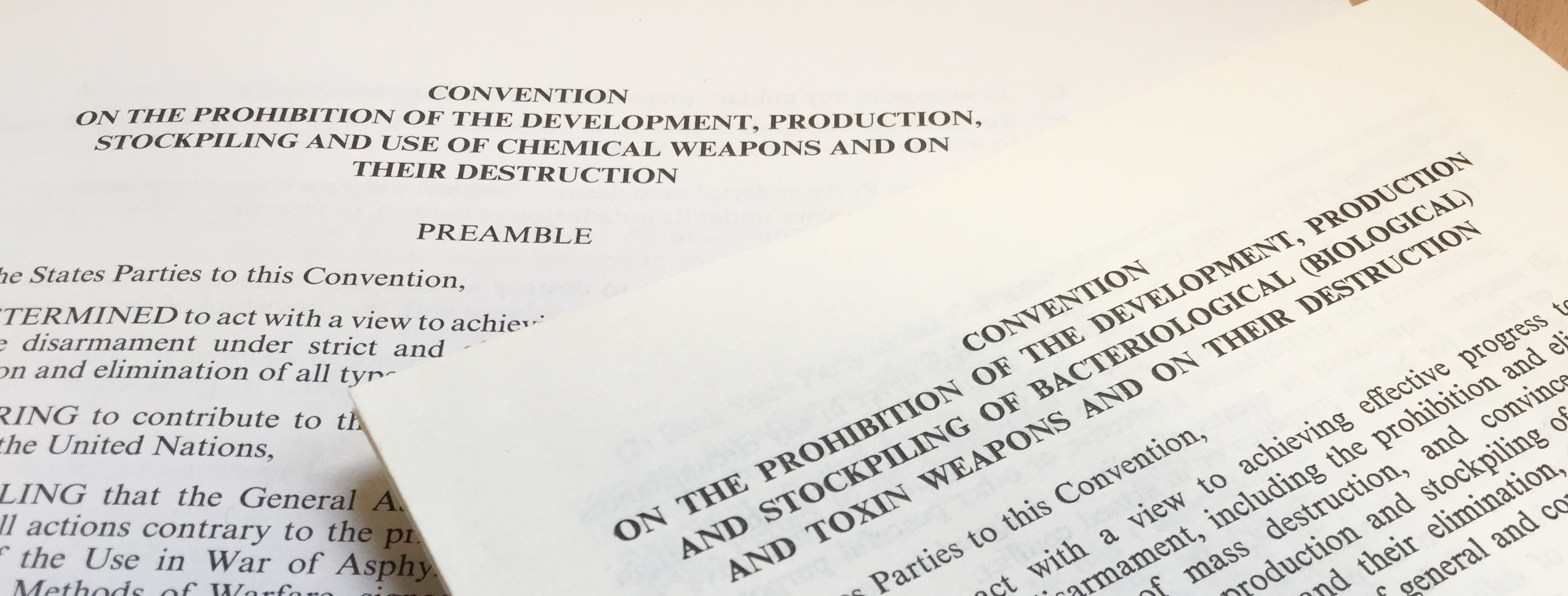
Convention
on the Prohibition of the Development, Production and Stockpiling
of Bacteriological (Biological) and Toxin Weapons and on their Destruction
Opened for signature:
10 April 1972, entered into force: 26 March 1975
The States Parties
to this Convention,
Determined to
act with a view to achieving effective progress toward general and
complete disarmament, including the prohibition and elimination
of all types of weapons of mass destruction, and convinced that
the prohibition of the development, production and stockpiling of
chemical and bacteriological (biological) weapons and their elimination,
through effective measures, will facilitate the achievement of general
and complete disarmament under strict and effective control,
Recognizing
the important significance of the Protocol for the Prohibition of
the Use in War of Asphyxiating, Poisonous or Other Gases, and of
Bacteriological Methods of Warfare, signed at Geneva on June 17,
1925, and conscious also of the contribution which the said Protocol
has already made and continues to make, to mitigating the horrors
of war,
Reaffirming
their adherence to the principles and objectives of that Protocol
and calling upon all States to comply strictly with them,
Recalling that
the General Assembly of the United Nations has repeatedly condemned
all actions contrary to the principles and objectives of the Geneva
Protocol of June 17, 1925,
Desiring to
contribute to the strengthening of confidence between peoples and
the general improvement of the international atmosphere,
Desiring also
to contribute to the realization of the purposes and principles
of the Charter of the United Nations,
Convinced of
the importance and urgency of eliminating from the arsenals of States,
through effective measures, such dangerous weapons of mass destruction
as those using chemical or bacteriological (biological) agents,
Recognizing
that an agreement on the prohibition of bacteriological (biological)
and toxin weapons represents a first possible step towards the achievement
of agreement on effective measures also for the prohibition of the
development, production and stockpiling of chemical weapons, and
determined to continue negotiations to that end,
Determined,
for the sake of all mankind, to exclude completely the possibility
of bacteriological (biological) agents and toxins being used as
weapons,
Convinced that
such use would be repugnant to the conscience of mankind and that
no effort should be spared to minimize this risk,
Have agreed
as follows:
ARTICLE I
Each State Party
to this Convention undertakes never in any circumstance to develop,
produce, stockpile or otherwise acquire or retain:
(1) Microbial
or other biological agents, or toxins whatever their origin or method
of production, of types and in quantities that have no justification
for prophylactic, protective or other peaceful purposes;
(2) Weapons,
equipment or means of delivery designed to use such agents or toxins
for hostile purposes or in armed conflict.
ARTICLE II
Each State Party
to this Convention undertakes to destroy, or to divert to peaceful
purposes, as soon as possible but not later than nine months after
the entry into force of the Convention, all agents, toxins, weapons,
equipment and means of delivery specified in article I of the Convention,
which are in its possession or under its jurisdiction or control.
In implementing the provisions of this article all necessary safety
precautions shall be observed to protect populations and the environment.
ARTICLE III
Each State Party
to this Convention undertakes not to transfer to any recipient whatsoever,
directly or indirectly, and not in any way to assist, encourage,
or induce any State, group of States or international organizations
to manufacture or otherwise acquire any of the agents, toxins, weapons,
equipment or means of delivery specified in article I of the Convention.
ARTICLE IV
Each State Party
to this Convention shall, in accordance with its constitutional
processes, take any necessary measures to prohibit and prevent the
development, production, stockpiling, acquisition or retention of
the agents, toxins, weapons, equipment and means of delivery specified
in article I of the Convention, within the territory of such State,
under its jurisdiction or under its control anywhere.
ARTICLE V
The States Parties
to this Convention undertake to consult one another and to cooperate
in solving any problems which may arise in relation to the objective
of, or in the application of the provisions of, the Convention.
Consultation and cooperation pursuant to this article may also be
undertaken through appropriate international procedures within the
framework of the United Nations and in accordance with its Charter.
ARTICLE VI
(1) Any State
Party to this Convention which finds that any other State Party
is acting in breach of obligations deriving from the provisions
of the Convention may lodge a complaint with the Security Council
of the United Nations. Such a complaint should include all possible
evidence confirming its validity, as well as a request for its consideration
by the Security Council.
(2) Each State
Party to this Convention undertakes to cooperate in carrying out
any investigation which the Security Council may initiate, in accordance
with the provisions of the Charter of the United Nations, on the
basis of the complaint received by the Council. The Security Council
shall inform the States Parties to the Convention of the results
of the investigation.
ARTICLE VII
Each State Party
to this Convention undertakes to provide or support assistance,
in accordance with the United Nations Charter, to any Party to the
Convention which so requests, if the Security Council decides that
such Party has been exposed to danger as a result of violation of
the Convention.
ARTICLE VIII
Nothing in this
Convention shall be interpreted as in any way limiting or detracting
from the obligations assumed by any State under the Protocol for
the Prohibition of the Use in War of Asphyxiating, Poisonous or
Other Gases, and of Bacteriological Methods of Warfare, signed at
Geneva on June 17, 1925.
ARTICLE IX
Each State Party
to this Convention affirms the recognized objective of effective
prohibition of chemical weapons and, to this end, undertakes to
continue negotiations in good faith with a view to reaching early
agreement on effective measures for the prohibition of their development,
production and stockpiling and for their destruction, and on appropriate
measures concerning equipment and means of delivery specifically
designed for the production or use of chemical agents for weapons
purposes.
ARTICLE X
(1) The States
Parties to this Convention undertake to facilitate, and have the
right to participate in, the fullest possible exchange of equipment,
materials and scientific and technological information for the use
of bacteriological (biological) agents and toxins for peaceful purposes.
Parties to the Convention in a position to do so shall also cooperate
in contributing individually or together with other States or international
organizations to the further development and application of scientific
discoveries in the field of bacteriology (biology) for prevention
of disease, or for other peaceful purposes.
(2) This Convention
shall be implemented in a manner designed to avoid hampering the
economic or technological development of States Parties to the Convention
or international cooperation in the field of peaceful bacteriological
(biological) activities, including the international exchange of
bacteriological (biological) agents and toxins and equipment for
the processing, use or production of bacteriological (biological)
agents and toxins for peaceful purposes in accordance with the provisions
of the Convention.
ARTICLE XI
Any State Party
may propose amendments to this Convention. Amendments shall enter
into force for each State Party accepting the amendments upon their
acceptance by a majority of the States Parties to the Convention
and thereafter for each remaining State Party on the date of acceptance
by it.
ARTICLE XII
Five years after
the entry into force of this Convention, or earlier if it is requested
by a majority of the Parties to the Convention by submitting a proposal
to this effect to the Depositary Governments, a conference of States
Parties to the Convention shall be held at Geneva, Switzerland,
to review the operation of the Convention, with a view to assuring
that the purposes of the preamble and the provisions of the Convention,
including the provisions concerning negotiations on chemical weapons,
are being realized. Such review shall take into account any new
scientific and technological developments relevant to the Convention.
ARTICLE XIII
(1) This Convention
shall be of unlimited duration.
(2) Each State
Party to this Convention shall in exercising its natural sovereignty
have the right to withdraw from the Convention if it decides that
extraordinary events, related to the subject matter of the Convention,
have jeopardized the supreme interests of its country. It shall
give notice of such withdrawal to all other States Parties to the
Convention and to the United Nations Security Council three months
in advance. Such notice shall include a statement of the extraordinary
events it regards as having jeopardized its supreme interests.
ARTICLE XIV
(1) This Convention
shall be open to all States for signature. Any State which does
not sign the Convention before its entry into force in accordance
with paragraph (3) of this Article may accede to it at any time.
(2) This Convention
shall be subject to ratification by Signatory States. Instruments
of ratification and instruments of accession shall be deposited
with the Governments of the United States of America, the United
Kingdom of Great Britain and Northern Ireland and the Union of Soviet
Socialist Republics, which are hereby designated the Depositary
Governments.
(3) This Convention
shall enter into force after the deposit of instruments of ratification
by twenty-two Governments, including the Governments designated
as Depositaries of the Convention.
(4) For States
whose instruments of ratification or accession are deposited subsequent
to the entry into force of this Convention, it shall enter into
force on the date of the deposit of their instruments of ratification
or accession.
(5) The Depositary
Governments shall promptly inform all signatory and acceding States
of the date of each signature, the date of deposit of each instrument
of ratification or of accession and the date of the entry into force
of this Convention, and of the receipt of other notices.
(6) This Convention
shall be registered by the Depositary Governments pursuant to Article
102 of the Charter of the United Nations.
ARTICLE XV
This Convention,
the English, Russian, French, Spanish and Chinese texts of which
are equally authentic, shall be deposited in the archives of the
Depositary Governments. Duly certified copies of the Convention
shall be transmitted by the Depositary Governments to the Governments
of the signatory and acceding States.
top
of page
|